High-Rate Deposition of Stoichiometric Compounds by Reactive Magnetron Sputtering at Oblique Angles

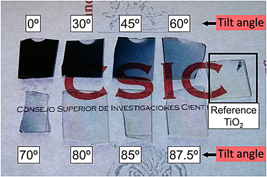
Target poisoning in reactive magnetron sputtering deposition of thin films is an undesired phenomenon, well known for causing a drastic fall of the process efficiency. We demonstrate that when this technique is operated at oblique angles, films with composition raging from pure metallic to stoichiometric compound can be grown in non-poisoned conditions, thus avoiding most…

Cathode and ion-luminescence of Eu:ZnO thin films prepared by reactive magnetron sputtering and plasma decomposition of non-volatile precursors

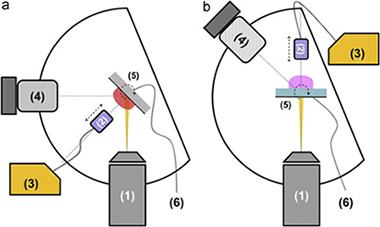
This paper reports the luminescent behavior of Eu:ZnO thin films prepared by an one-step procedure that combines reactive magnetron sputtering deposition of ZnO with the plasma activated decomposition of a non-volatile acetylacetonate precursor of Eu sublimated in an effusion cell. Chemical composition and microstructure of the Eu:ZnO thin films have been characterized by several methods…

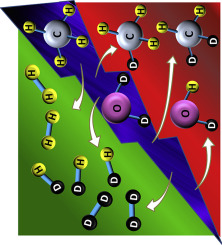
Stabilization of catalyst particles against sintering on oxide supports with high oxygen ion lability exemplified by Ir-catalyzed decomposition of N2O

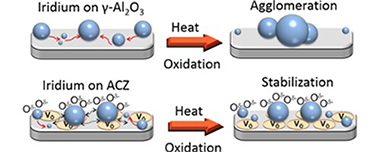
Iridium nanoparticles deposited on a variety of surfaces exhibited thermal sintering characteristics that were very strongly correlated with the lability of lattice oxygen in the supporting oxide materials. Specifically, the higher the lability of oxygen ions in the support, the greater the resistance of the nanoparticles to sintering in an oxidative environment. Thus with gamma-Al2O3…

Nanocolumnar association and domain formation in porous thin films grown by evaporation at oblique angles

Porous thin films grown at oblique angles by evaporation techniques are formed by tilted nanocolumnar structures which, depending on the material type and growth conditions, associate along certain preferential directions, giving rise to large domains. This arrangement, commonly denoted as bundling association, is investigated in the present work by performing fundamental experiments and growth simulations.…

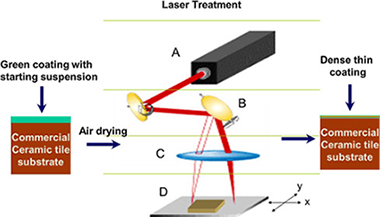
Metallization of ceramic substrates by laser induced decomposition of coordination complexes

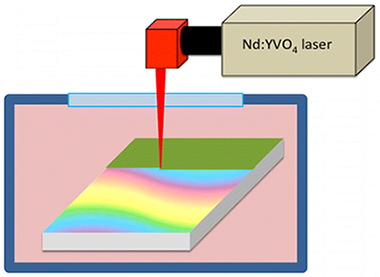
This work describes an in-situ Nd:YAG laser-assisted coating method to modify industrial glazed ceramic surfaces. The method makes use of a Cu polymer coordination complex, transformed via 1064 nm continuos wave (cw) laser irradiation, into a lustre-type glassy coating covering the ceramic substrate. The obtained coatings, with typical thicknesses ranging between 4 and 14 μm, become integrated…

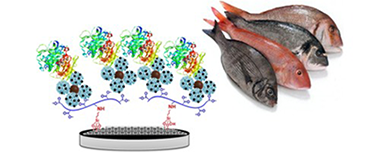
Reduced graphene oxide-carboxymethylcellulose layered with platinum nanoparticles/PAMAM dendrimer/magnetic nanoparticles hybrids. Application to the preparation of enzyme electrochemical biosensors

The assembly of a novel layer-by-layer biosensor architecture using hybrid nanomaterials is explored for the construction of an amperometric enzyme biosensors. The nanostructured sensing interface was prepared with poly(dopamine)-modified magnetic nanoparticles which were covalently coated with four-generation ethylenediamine core polyamidoamine G-4 dendrimers and further decorated with platinum nanoparticles. This nanohybrid was fully characterized and further…

Effect of Nickel and Magnesium on the Electrochemical Behavior of AA 1050 Alloys in Nitric Acid Solution

The study investigates the influence of nickel and magnesium additions to AA 1050 aluminum alloy on the electrochemical behavior of the alloy in nitric acid solution under conditions relevant to the lithographic and electronic industries. Magnesium and nickel additions are of interest, since they can improve the alloy properties for the printing process by improving…

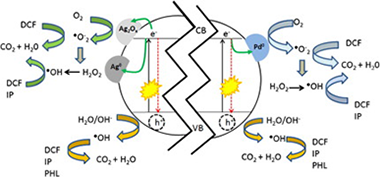
Effect of TiO2-Pd and TiO2-Ag on the photocatalytic oxidation of diclofenac, isoproturon and phenol

The effects of silver and palladium metals on the photocatalytic degradation of diclofenac sodium salt (DCF), isoproturon (IP) and phenol (PHL) in water over lab-made TiO2 synthesized following a sol-gel method were investigated. Silver and palladium catalysts were prepared by photodeposition at 1 wt.% of loading metal. The resulting materials were characterized through BET, XRD,…