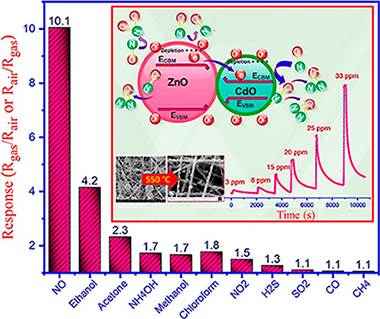
Highly selective few-ppm NO gas-sensing based on necklace-like nanofibers of ZnO/CdO n-n type I heterojunction

Electrospinning method followed by calcination is applied to synthesize ZnO/CdO nanofibers. Characterization is performed by X-ray diffraction (XRD), scanning electron microscopy (SEM), field emission scanning electron microscopy (FESEM), energy dispersive spectroscopy (EDS), diffuse reflectance spectroscopy (DRS), X-ray photoelectron spectroscopy (XPS), ultraviolet photoelectron spectroscopy (UPS) and reflection electron energy loss spectroscopy (REELS), which resulted in detailed…

Sodium ion storage performance of magnetron sputtered WO3 thin films

WO3 thin film electrodes were successfully prepared by magnetron sputtering (MS) deposition under an oblique angle configuration (OAD). Intercalation of Na ions in the tungsten oxide layers has been studied using electrochemical techniques. Sample characterization before and after sodium intercalation has been carried out by Raman, XPS and XRD measurements. ToF-SIMS analysis has been also…

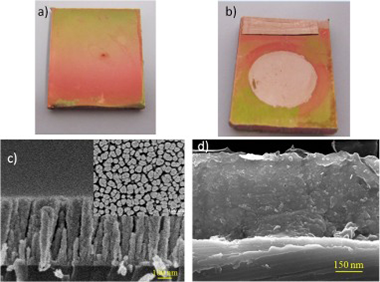
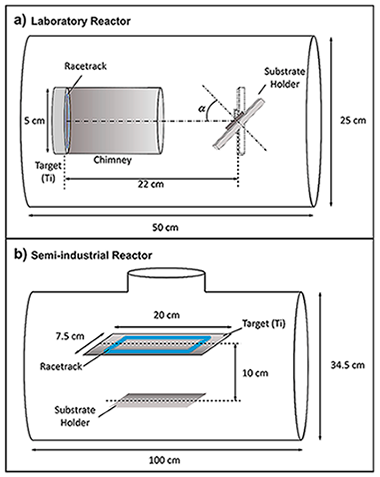
Antibacterial Nanostructured Ti Coatings by Magnetron Sputtering: From Laboratory Scales to Industrial Reactors

Based on an already tested laboratory procedure, a new magnetron sputtering methodology to simultaneously coat two-sides of large area implants (up to similar to 15 cm(2)) with Ti nanocolumns in industrial reactors has been developed. By analyzing the required growth conditions in a laboratory setup, a new geometry and methodology have been proposed and tested…

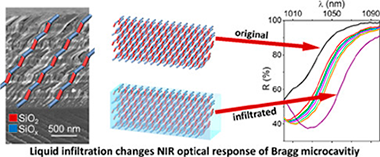
SiOx by magnetron sputtered revisited: Tailoring the photonic properties of multilayers

Traditionally porous silicon based photonic structures have been prepared by electrochemically etching of silicon. In this work, porous multilayers of nanocolumnar SiOx and SiO2 thin films acting as near infrared (NIR) 1D-photonic nanostructures are prepared by magnetron sputtering deposition at oblique angles (MS-OA). Simultaneous control of porosity and stoichiometry of the stacked films is achieved…

Plasma Enabled Conformal and Damage Free Encapsulation of Fragile Molecular Matter: from Surface-Supported to On-Device Nanostructures

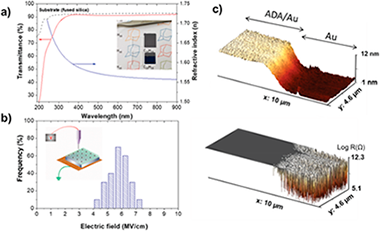
Damage-free encapsulation of molecular structures with functional nanolayers is crucial to protect nanodevices from environmental exposure. With nanoscale electronic, optoelectronic, photonic, sensing, and other nanodevices based on atomically thin and fragile organic matter shrinking in size, it becomes increasingly challenging to develop nanoencapsulation that is simultaneously conformal at atomic scale and does not damage fragile…

Large gap atmospheric pressure barrier discharges using ferroelectric materials

This work reports a phenomenological comparative study of atmospheric pressure barrier plasmas using ferroelectric (ferroelectric barrier discharge (FBD)) and dielectric (dielectric barrier discharge (DBD)) plates to moderate the discharge. For FBD operation and large inter-electrode distances, experiments with helium carried out in a parallel plate reactor as a function of applied voltage have shown an…

On‐Surface Synthesis and Characterization of Acene‐Based Nanoribbons Incorporating Four‐Membered Rings

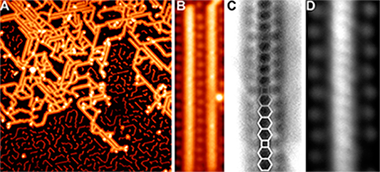
A bottom up method for the synthesis of unique tetracene-based nanoribbons, which incorporate cyclobutadiene moieties as linkers between the acene segments, is reported. These structures were achieved through the formal [2+2] cycloaddition reaction of ortho-functionalized tetracene precursor monomers. The formation mechanism and the electronic and magnetic properties of these nanoribbons were comprehensively studied by means…

2D compositional self-patterning in magnetron sputtered thin films

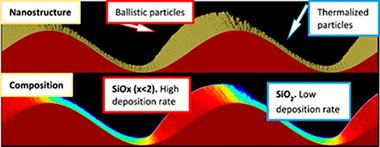
Unlike topography patterning, widely used for numerous applications and produced by means of different technologies, there are no simple procedures to achieve surface compositional patterning at nanometric scales. In this work we have developed a simple method for 2D patterning the composition of thin films. The method relies on the magnetron sputtering deposition at oblique…

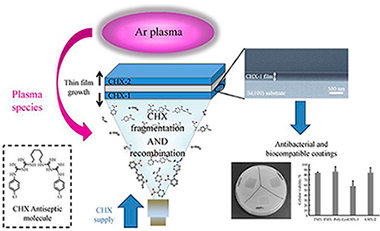
Multifunctional antimicrobial chlorhexidine polymers by remote plasma assisted vacuum deposition

Novel antibacterial materials for implants and medical instruments are essential to develop practical strategies to stop the spread of healthcare associated infections. This study presents the synthesis of multifunctional antibacterial nanocoatings on polydimethylsiloxane (PDMS) by remote plasma assisted deposition of sublimated chlorhexidine powders at low pressure and room temperature. The obtained materials present effective antibacterial…