CuOx supported LaCoO3 perovskite for the photoassisted reverse water gas shift reaction at low temperature

  CuOx/LaCoO3 systems have been studied for the rWGS reaction under thermal assisted photocatalytic conditions within low temperature range of 180-330 degrees C. CuOx species deposited from chemical reduction method over LaCoO3 homogeneously covered the perovskite surface. The reduction pretreatment before reaction leads to the partial Co reduction and the complete reduction of Cu. A…

Application of novel Zn-MIL53(Fe) for removal of micropollutants using an activated peroxymonosulphate system

Novel zinc-doped Metal-Organic Framework based on MIL53(Fe) (Zn-MIL53(Fe)) has been successfully synthesised in one-step, exhibiting dual applications as adsorbent and catalyst. Initially, the adsorption capacity of MIL53(Fe) and Zn-MIL53(Fe) for removing Rhodamine B was assessed through kinetic and isotherm studies. The bimetallic variant exhibited superior performance, showcasing enhanced adsorption capabilities, particularly in the context of…

A sustainable lecithin-based ligand for the bio-functionalization of iron and hybrid metal organic frameworks (MOFs) nanoparticles with the sugar mannose

The functionalization of nanoparticles with specific ligands, such as antibodies, peptides, and small molecules, plays a critical role in achieving targeted delivery, enhancing biocompatibility, and controlling drug release. However, to date, practically no attention has been paid to the design of green ligands. Herein, an innovative approach to develop a sustainable ligand for nanoparticle functionalization…

In situ XRD and operando XRD-XANES study of the regeneration of LaCo0.8Cu0.2O3 perovskite for preferential oxidation of CO

Combinations of perovskite-type oxides with transition and precious metals exhibit remarkable regenerating properties that can be exploited for catalytic applications. The objective of the present work was to study the structural changes experienced by LaCo0.8Cu0.2O3 under reducing/oxidizing atmosphere (redox) and Preferential Oxidation of CO (PrOx, with high H2 concentration) conditions and their reversibility. LaCo0.8Cu0.2O3 was prepared by ultrasonic…

MoS2 2D materials induce spinal cord neuroinflammation and neurotoxicity affecting locomotor performance in zebrafish

MoS2 nanosheets belong to an emerging family of nanomaterials named bidimensional transition metal dichalcogenides (2D TMDCs). The use of such promising materials, featuring outstanding chemical and physical properties, is expected to increase in several fields of science and technology, with an enhanced risk of environmental dispersion and associated wildlife and human exposures. In this framework, the…

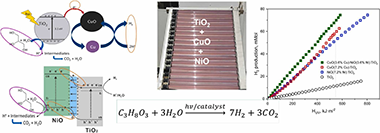
H2 production based on a ternary mixture of commercial CuO-NiO-TiO2 in a solar pilot plant

Glycerol is a by-product in biodiesel production (in the range of g·L−1), so its photoreforming by photocatalysis is a way of valorising it. TiO2 in photocatalysis has been widely studied, although its efficiency is limited by the high energy band gap, and the electron-hole recombination. Its combination with different semiconductors should improve charge separation, extending also…

Surface Defect Engineered Nano-Cu/TiO2 Photocatalysts for Hydrogen Production

Surface defects engineered nano-Cu/TiO2 photocatalysts are synthesized through an easy and cost-effective microwave-assisted hydrothermal synthesis, mixing commercial P25 titania (TiO2) and oxalic acid (Ox), followed by 2.0 wt% Cu co-catalyst (labeled as Cu2.0) loading through in situ photodeposition during reaction. The hydrothermal treatment does not affect the catalyst crystalline structure, morphology, nor the surface area. However,…

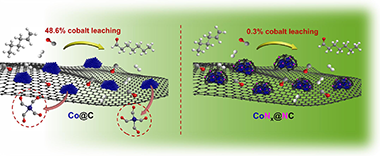
Developing and understanding Leaching-Resistant cobalt nanoparticles via N/P incorporation for liquid phase hydroformylation

The ultimate target in heterogeneous catalysis is the achievement of robust, resilient and highly efficient materials capable of resisting industrial reaction conditions. Pursuing that goal in liquid -phase hydroformylation poses a unique challenge due to carbon monoxide -induced metal carbonyl species formation, which is directly related to the formation of active homogeneous catalysts by metal…

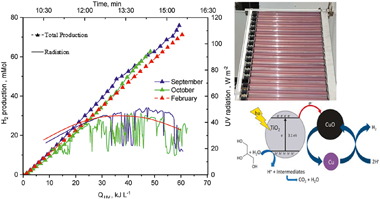
CuO-TiO2 pilot-plant system performance for solar photocatalytic hydrogen production

  The main goal of the present study was to explore photocatalytic performance of the TiO2 -CuO mixture, for solar to hydrogen conversion at pilot plant scale under two different irradiation conditions (sunny and partly cloudy), focusing on high-temperature pretreat-ment of the catalyst mixture to try to improve TiO2 doping with copper. P25-TiO2 and commercial CuO were used with different amounts of Cu (2 wt%…

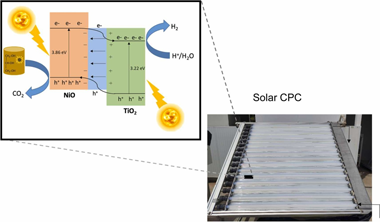
Photoreforming of glycerol to produce hydrogen from natural water in a compound parabolic collector solar photoreactor

To improve TiO2 for H2 generation, one strategy for the separation of photogenerated charges is the formation of heterostructures with other materials. In particular, NiO is a photocatalyst known for its good stability and low cost. However, no studies at pilot scale using solar energy have been described. Consequently, an evaluation of a physical NiO:TiO2 mixture at pilot scale (25 L) with natural irradiation (2.10 m2 of sun-exposed surface) and with simultaneous glycerol photoreforming was explored.…