Exalted photocatalytic activity of tetragonal BiVO4 by Er3+ doping through a luminescence cooperative mechanism

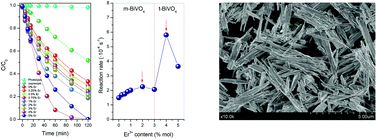
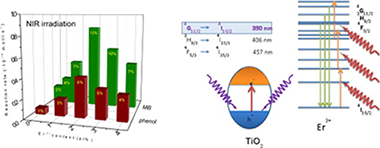
Er-doped BiVO4 are synthesized by means of a surfactant free microwave assisted hydrothermal method having good photoactivities under sun-like excitation for the degradation of methylene blue. From the structural and morphological characterization, it has been stated that the presence of Er3+ induces a slight stabilization of the tetragonal phase, probably due to its incorporation in…

A single-source route to bulk samples of C3N and the co-evolution of graphitic carbon microspheres

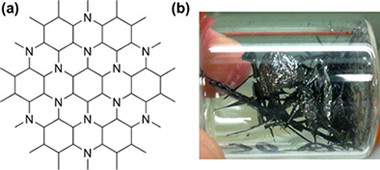
The thermolysis of commercially available m-phenylenediamine (1,3-(NH2)2C6H4) at 800 °C under a static vacuum in a sealed quartz tube provides the first bulk synthesis of C3N, whose properties have only been predicted theoretically previously. Hollow carbon microspheres (CMSs) which do not contain significant nitrogen doping (1–3 μm diameter) are co-produced in the reaction and readily…

Monoclinic–Tetragonal Heterostructured BiVO4 by Yttrium Doping with Improved Photocatalytic Activity

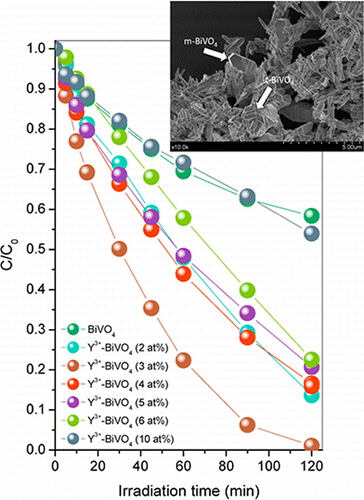
Yttrium-doped BiVO4 has been synthesized by means of a surfactant free hydrothermal method having good photoactivities under sun-like excitation for the degradation of Methylene Blue (MB). From the structural and morphological characterization it has been stated that the presence of Y3+ induces the progressive stabilization of the tetragonal phase and the slight higher surface area…

On the different photocatalytic performance of BiVO4 catalysts for Methylene Blue and Rhodamine B degradation

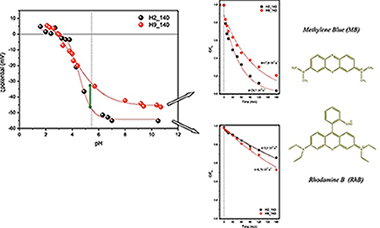
BiVO4 hierarchical structures were synthesized by means of a surfactant free hydrothermal method having good photoactivities for the degradation of Methylene Blue and Rhodamine B under UV–vis irradiation. From the structural and morphological characterization it has been stated that BiVO4 present the monoclinic crystalline phase with different morphologies depending on the pH value. For Methylene…

Promotional effect of the base metal on bimetallic Au-Ni/CeO2 catalysts prepared from core-shell nanoparticles

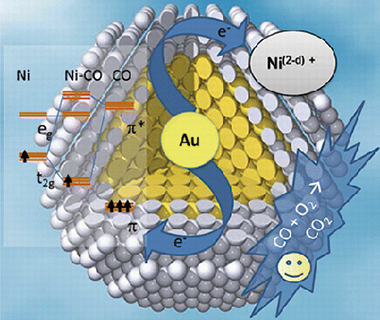
A set of three catalysts (a Au–Ni bimetallic and their corresponding Au and Ni monometallics) has been prepared by impregnation of previously prepared suspensions of monodisperse metallic particles to ensure the precise control of their physicochemical characteristics (size and composition). The Au–Ni/CeO2 bimetallic catalysts present better reactivity toward CO oxidation than monometallic Au/CeO2 and Ni/CeO2…

A low-temperature single-source route to an efficient broad-band cerium(III) photocatalyst using a bimetallic polyoxotitanium cage

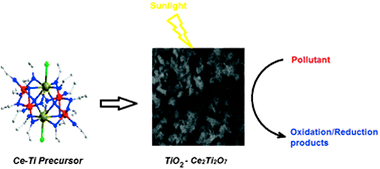
Aqueous hydrolysis of a series of cerium-containing polyoxotitanium cages gives Ce(III)-doped TiO2 [TiO2(Ce)] or TiO2-supported Ce(III)2Ti2O7, depending on the starting Ti : Ce ratio of the precursor. TiO2-supported Ce2Ti2O7 exhibits superior photocatalytic activity to the Ce-doped TiO2 materials and unusual broad-band absorption behaviour across the visible and near-infrared regions.

Erbium doped TiO2–Bi2WO6 heterostructure with improved photocatalytic activity under sun-like irradiation

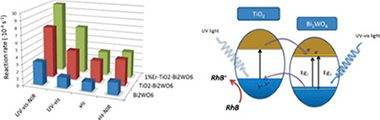
Erbium doped TiO2–Bi2WO6 have been synthesized by means of a surfactant free hydrothermal method having good photoactivities under sun-like excitation for the degradation of Rhodamine B. From the structural and morphological characterization it has been stated that the presence of Er3+ induces a progressive russelite cell contraction due to its incorporation in the Bi2WO6 lattice…

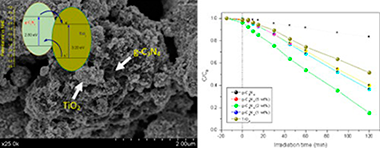
Improved photocatalytic activity of g-C3N4/TiO2 composites prepared by a simple impregnation method

g-C3N4 and TiO2 hybrid structures are synthesized by means of a simple impregnation method having good photoactivities for the degradation of phenol under UV irradiation. From the wide structural and surface characterization we have stated that the presence of g-C3N4 notably affect the surface feature of TiO2 (surface area and pore size distribution). Enhanced photoactivities…