Chromium removal on chitosan-based sorbents – An EXAFS/XANES investigation of mechanism

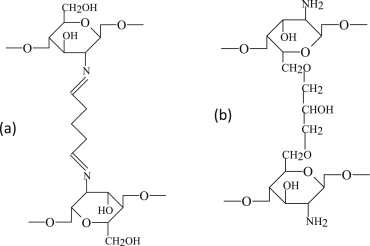
Chitosan is known to be a good sorbent for metal-containing ions as the presence of amino groups and hydroxyl functions act as effective binding sites. Its crosslinking, employing glutaraldehyde or epichlorohydrin, may change the sorption properties (sorption capacity or diffusion properties) of this biopolymer, since the available functional groups are different in each case. X-ray…

Improved O-2 evolution from a water splitting reaction over Er3+ and Y3+ co-doped tetragonal BiVO4

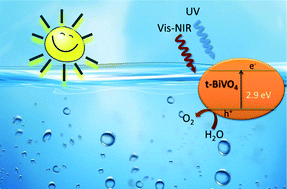
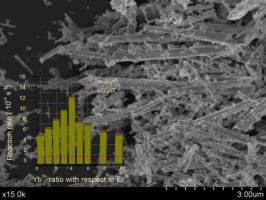
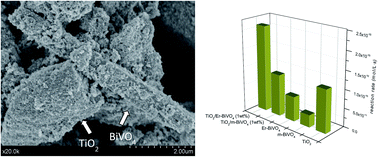
Erbium–yttrium co-doped BiVO4 with a tetragonal structure is synthesized by means of a surfactant free hydrothermal method. The studied photocatalyst shows good photoactivity under sun-like excitation for the degradation of methylene blue (MB) and for O2 evolution. From structural and morphological characterization, it has been stated that the presence of lanthanides induces the stabilization of…

A study of the optical properties of metal-doped polyoxotitanium cages and the relationship to metal-doped titania

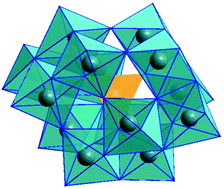
To what extent the presence of transition metal ions can affect the optical properties of structurally well-defined, metal-doped polyoxotitanium (POT) cages is a key question in respect to how closely these species model technologically important metal-doped TiO2. This also has direct implications to the potential applications of these organically-soluble inorganic cages as photocatalytic redox systems…

In situ XAS study of an improved natural phosphate catalyst for hydrogen production by reforming of methane

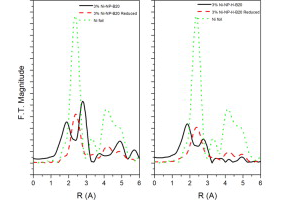
Some nickel catalysts supported on natural phosphate (NP) have been tested for the dry methane reforming reaction. Although the original impregnated 15%Ni/NP catalyst has no activity at all, the modification of the support by mechano-chemical and/or acid treatment strongly improved the catalytic performance, yielding a series of very active and stable catalysts. The chemical and…

Promoting effect of Ce and Mg cations in Ni/Al catalysts prepared from hydrotalcites for the dry reforming of methane

Several catalytic systems containing Ni/Mg/Al/Ce were synthesized from nitrates of Ni2+, Mg2+, Al3+ and Ce3+ cations with M2+/M3+ = 2 ratios by means of the carbonate co-precipitation method and subsequent calcination at 800 A degrees C. Atomic absorption spectroscopy, X-ray diffraction (XRD), FT-IR spectroscopy, BET, temperature programmed reduction and scanning electron microscopy were used in…

Spinodal decomposition and precipitation in Cu–Cr nanocomposite

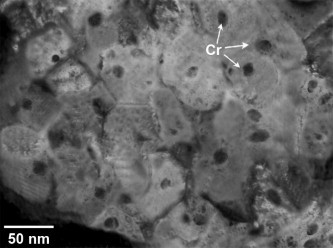
In this study, spinodal decomposition and precipitation mechanism of mechanically alloyed supersaturated Cu–3wt.%Cr and Cu–5wt.%Cr solid solutions was investigated under nonisothermal aging. Decomposition mechanism and kinetics were studied using differential scanning calorimetry (DSC) and X-ray diffraction (XRD) techniques. Also, the microstructure was characterized by transmission electron microscopy (TEM). Effect of Al2O3 reinforcement on the aging…

Improved H2 production of Pt-TiO2/g-C3N4-MnOx composites by an efficient handling of photogenerated charge pairs

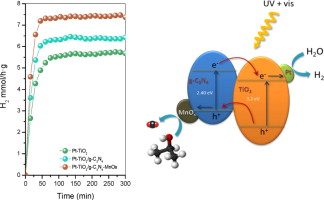
Pt-TiO2/g-C3N4-MnOx hybrid structures are synthesized by means of a simple impregnation method of Pt-TiO2 and g-C3N4-MnOx. From the wide structural and surface characterization we have stated that TiO2/g-C3N4 composites are formed by an effective covering of g-C3N4 by TiO2. The modification of composite by Pt and/or MnOx leads to improved photoactivities for phenol degradation reaction.…