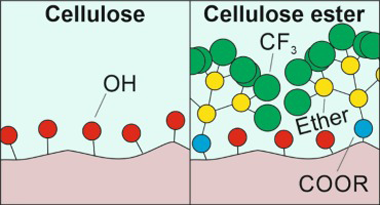
Waterproof-breathable films from multi-branched fluorinated cellulose esters

Cellulose ester films were prepared by esterification of cellulose with a multibranched fluorinated carboxylic acid, «BRFA» (BRanched Fluorinated Acid), at different anhydroglucose unit:BRFA molar ratios (i.e., 1:0, 10:1, 5:1, and 1:1). Morphological and optical analyses showed that cellulose-BRFA materials at molar ratios 10:1 and 5:1 formed flat and transparent films, while the one at 1:1…

Impact of flame confinement with inert ceramic foams on the particulate emissions of domestic heating systems

Small solid biomass combustion systems are among the main contributors to the global particulate emissions share, and cheap, efficient abatement systems are not yet available for them. The placement of inert porous material to confine the combustion region is being recently explored as a possible mitigation system for this kind of pollution. However, given the…

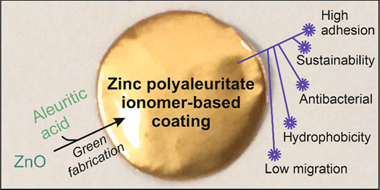
Zinc Polyaleuritate Ionomer Coatings as a Sustainable, Alternative Technology for Bisphenol A-Free Metal Packaging

Sustainable coatings for metal food packaging were prepared from ZnO nanoparticles (obtained by the thermal decomposition of zinc acetate) and a naturally occurring polyhydroxylated fatty acid named aleuritic (or 9,10,16-trihydroxy-hexadecanoic) acid. Both components reacted, originating under specific conditions zinc polyaleuritate ionomers. The polymerization of aleuritic acid into polyaleuritate by a solvent-free, melt polycondensation reaction was…

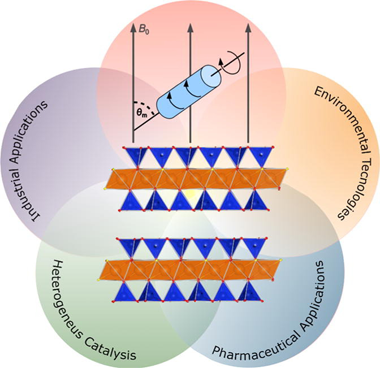
Swelling layered minerals applications: A solid state NMR overview

Swelling layered clay minerals form an important sub-group of the phyllosilicate family. They are characterized by their ability to expand or contract in the presence or absence of water. This property makes them useful for a variety of applications, ranging from environmental technologies to heteroge-neous catalysis, and including pharmaceutical and industrial applications. Solid State Nuclear…

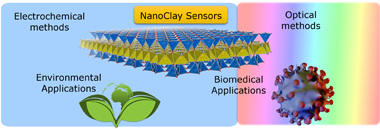
New Trends in Nanoclay-Modified Sensors

Nanoclays are widespread materials characterized by a layered structure in the nano-scale range. They have multiple applications in diverse scientific and industrial areas, mainly due to their swelling capacity, cation exchange capacity, and plasticity. Due to the cation exchange capacity, nanoclays can serve as host matrices for the stabilization of several molecules and, thus, they…

Pectin-cellulose nanocrystal biocomposites: Tuning of physical properties and biodegradability

The fabrication of pectin-cellulose nanocrystal (CNC) biocomposites has been systematically investigated by blend-ing both polysaccharides at different relative concentrations. Circular free-standing films with a diameter of 9 cm were prepared by simple solution of these carbohydrates in water followed by drop-casting and solvent evaporation. The addition of pectin allows to finely tune the properties of…

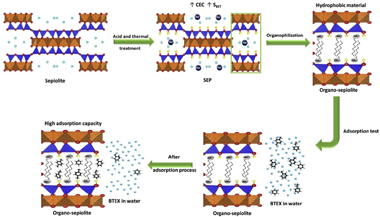
Organophilization of acid and thermal treated sepiolite for its application in BTEX adsorption from aqueous solutions

Acid and thermal treated sepiolite was organophilized by cationic exchange with several alkylammonium cations (octylammonium, hexadecylammonium, tetradecyltrimethylammonium, and hexadecyltrimethylammonium). The adsorption capacity of BTEX from aqueous solutions was evaluated through the adsorption isotherms performed in batch. The results were analysed using three isotherm models: Freundlich, Langmuir and Dubinin-Radushkevich (D-R model). The behaviour of adsorption isotherm…