


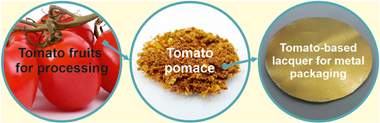
Bio-based lacquers from industrially processed tomato pomace for sustainable metal food packaging

Bio-based lacquers prepared from an underutilized tomato processing residue such as pomace have been investigated as sustainable alternatives to bisphenol A (BPA)-based coatings for metal food packaging. The fabrication methodology consisted of a two-step process: spray-coating of a paste of the lipid fraction of tomato pomace with a mixture ethanol:H2O (3:1, v:v) on common metal…
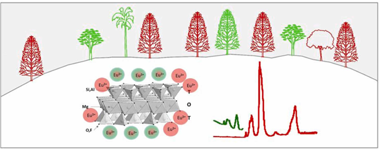
Exploring the local environment of the engineered nanoclay Mica-4 under hydrothermal conditions using Eu(3+)as a luminescent probe

High charge mica Na4Al4Si4Mg6O20F4 , Mica-4, is a promising candidate as a filling material to immobilize high-level radioactive waste in deep geological repositories due to its extraordinary adsorption capacity. In contrast to traditional clay materials, the structural composition of this mica, with a high content of alu-minum in the tetrahedral sheet, enhances its chemical reactivity,…

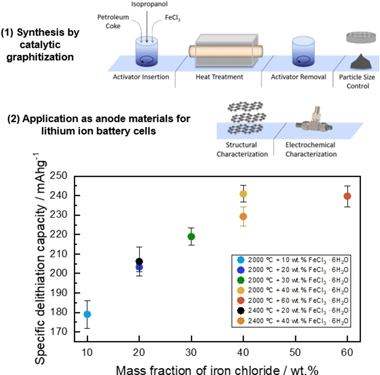
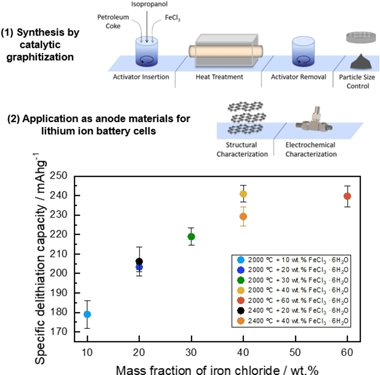
Insights into the Impact of Activators on the ‘Catalytic’ Graphitization to Design Anode Materials for Lithium Ion Batteries

In this work, we systematically investigate the ‘catalytic’ graphitization of a biomass precursor (coffee ground) using 10-60 wt.% of the activator iron (III) chloride hexahydrate in a temperature range of 1000 degrees C-2400 degrees C. Special focus is put on the correlation of synthesis conditions, e.g., heat treatment temperature and mass fraction of iron chloride,…

Biopolymer-Based Films Reinforced with FexOy-Nanoparticles

Nowadays, natural polymer-based films are considered potentially environmentally friendly alternatives to conventional plastic films, due to many advantageous properties, including their easy processability, high flexibility, non-toxicity, low cost, high availability, and environmental safety. However, they are limited in their application by a number of shortcomings, including their high water solubility and vapor permeability as well…

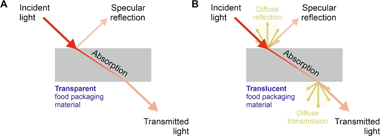
Transparency of polymeric food packaging materials

Transparency is a very important technical parameter to evaluate and validate certain food packaging materials. In the recent scientific literature, several methods (i.e. transmittance, opacity, haze, and absorbance) have been used and such variety hinders a direct comparison of results from different authors. In this Review, we describe and discuss the most widely employed methods…

Exploring the local environment of the engineered nanoclay Mica-4 under hydrothermal conditions using Eu(3+)as a luminescent probe

High charge mica Na4Al4Si4Mg6O20F4 , Mica-4, is a promising candidate as a filling material to immobilize high-level radioactive waste in deep geological repositories due to its extraordinary adsorption capacity. In contrast to traditional clay materials, the structural composition of this mica, with a high content of alu-minum in the tetrahedral sheet, enhances its chemical reactivity,…

Insights into the Impact of Activators on the ‘Catalytic’ Graphitization to Design Anode Materials for Lithium Ion Batteries

In this work, we systematically investigate the ‘catalytic’ graphitization of a biomass precursor (coffee ground) using 10-60 wt.% of the activator iron (III) chloride hexahydrate in a temperature range of 1000 degrees C-2400 degrees C. Special focus is put on the correlation of synthesis conditions, e.g., heat treatment temperature and mass fraction of iron chloride,…

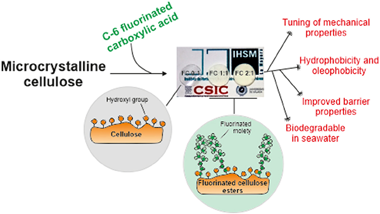
Greaseproof, hydrophobic, and biodegradable food packaging bioplastics from C6-fluorinated cellulose esters

Tridecafluorononanoic acid (TFNA), a C6-fluorinated carboxylic acid, was esterified with cellulose at different molar ratios (0:1, 1:1, 2:1, and 3:1) in a trifluoroacetic acid (TFA):trifluoroacetic anhydride (TFAA):CHCl3 (2:1:1, v:v:v) solvent mixture. Free-standing films were obtained for all formulations and are presented as alternatives to composites and blends of paper with fluorinated molecules. Mechanical properties were…

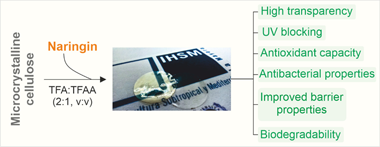
Transparent, UV-blocking, and high barrier cellulose-based bioplastics with naringin as active food packaging materials

Free-standing, robust, and transparent bioplastics were obtained by blending cellulose and naringin at different proportions. Optical, thermal, mechanical, antioxidant, and antimicrobial properties were systematically investigated. In general, the incorporation of naringin produced important UV blocking and plasticizer effects and good antioxidant and antibacterial properties. Moreover, the barrier properties were characterized by determination of their water and oxygen transmission rates, finding that both parameters decreased by increasing…