High-temperature mechanical behavior of polycrystalline yttrium-doped barium cerate perovskite

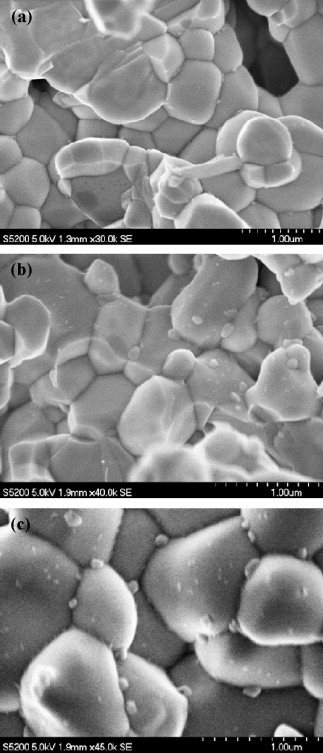
The high-temperature mechanical properties of the mixed ionic-electronic conductor perovskite BaCe0.95Y0.05O3−δ with average grain size of 0.40 μm have been studied in compression between 1100 and 1300 °C in air at different initial strain rates. The true stress–true strain curves display an initial stress drop, followed by an extended steady-state stage. As the temperature decreases…

Microstructural and mechanical evaluation of a Cu-based active braze alloy to join silicon nitride ceramics

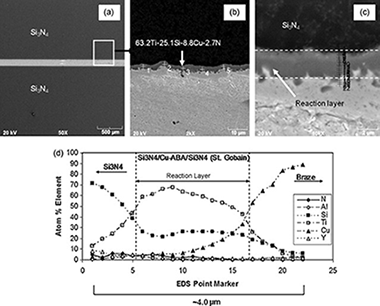
Self-joining of St. Gobain Si3N4 (NT-154) using a ductile Cu–Al–Si–Ti active braze (Cu-ABA) was demonstrated. A reaction zone (∼2.5–3.5 μm thick) developed at the interface after 30 min brazing at 1317 K. The interface was enriched in Ti and Si. The room temperature compressive shear strengths of Si3N4/Si3N4 and Inconel/Inconel joints (the latter created to…

Microstructural and mechanical evaluation of porous biomorphic silicon carbide for high temperature filtering applications

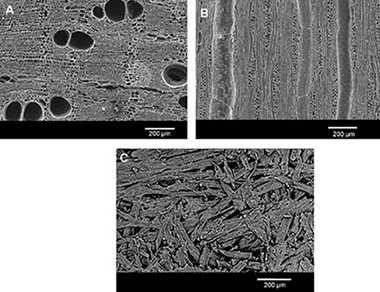
Biomorphic SiC (bioSiC) is a low cost SiC/Si composite obtained by melt infiltration of carbon preforms obtained from the pyrolysis of cellulose precursors. The porosity and pore size distribution of bioSiC can be tailored for specific applications by adequate selection of the wood precursor. Natural and artificial industrial woods were explored as possible bioSiC precursors.…

Compressive strength degradation in ZrB2-based ultra-high temperature ceramic composites

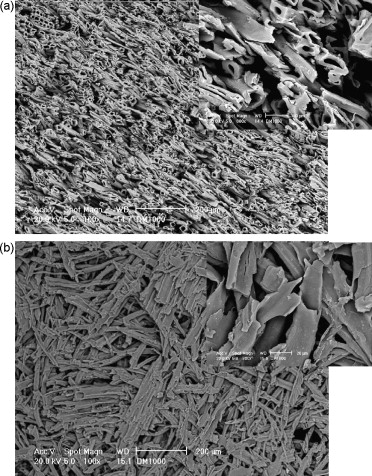
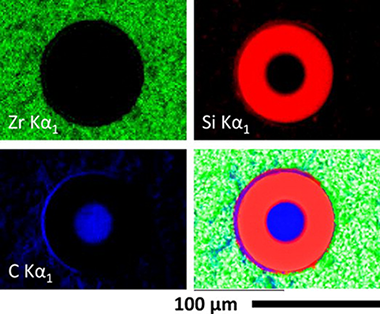
The high temperature compressive strength behavior of zirconium diboride (ZrB2)-silicon carbide (SiC) particulate composites containing either carbon powder or SCS-9a silicon carbide fibers was evaluated in air. Constant strain rate compression tests have been performed on these materials at room temperature, 1400, and 1550°C. The degradation of the mechanical properties as a result of atmospheric…

Structure and support induced structure disruption of soft nanoparticles obtained from hydroxylated fatty acids

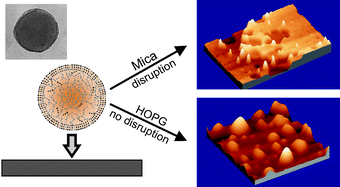
Soft and spherical nanoparticles, named as cutinsomes, have been prepared from concentrated 9(10),16-dihydroxypalmitic acid (diHPA) in aqueous solution. After isolation, cutinsomes have been chemically and structurally characterized by ATR-FTIR, TEM and dynamic atomic force microscopy (dynamic AFM). The nanoparticle can be described as a lipidic, liquid-like and mostly esterified core surrounded by a polar shell…

Stability of Rare-Earth Disilicates: Ionic Radius Effect

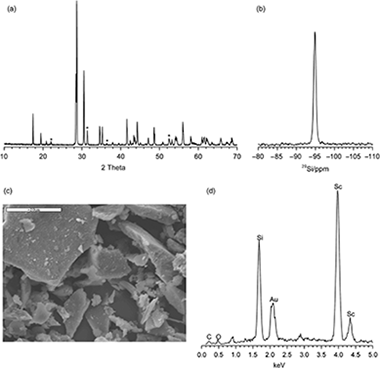
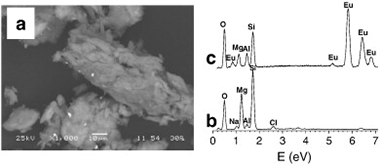
Rare-earth (RE) disilicates, of general formula RE2Si 2O7, are one of the products of the chemical reaction between RE (elements), which are actinide simulators, and the silicates used in the engineered barrier systems of deep geological repositories (DGPs). The aim of this paper is to establish the stability range of the disilicate phase as function…

Structural, chemical surface and transport modifications of regenerated cellulose dense membranes due to low-dose γ-radiation

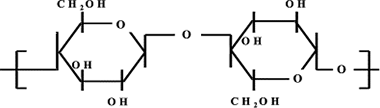
Modifications caused in commercial dense regenerated cellulose (RC) flat membranes by low-dose γ-irradiation (average photons energy of 1.23 MeV) are studied. Slight structural, chemical and morphological surface changes due to irradiation in three films with different RC content were determined by ATR-FTIR, XRD, XPS and AFM. Also, the alteration of their mechanical elasticity has been…

Bulk and Adsorbed Monolayer Phase Behavior of Binary Mixtures of Undecanoic Acid and Undecylamine: Catanionic Monolayers

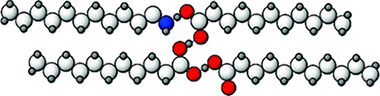
Differential scanning calorimetry (DSC) and X-ray powder diffraction (PXRD) have been used to determine the phase behavior of the binary mixtures of undecanoic acid (A) and undecylamine (B) in the bulk. In addition, we report DSC data that indicates very similar behavior for the solid monolayers of these materials adsorbed on the surface of graphite.…