Optical Responses of Localized and Extended Modes in a Mesoporous Layer on Plasmonic Array to Isopropanol Vapor

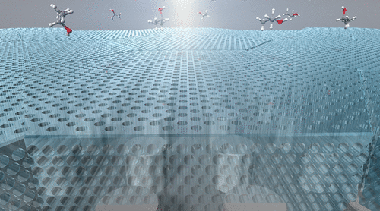
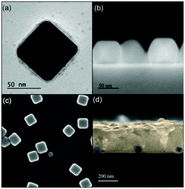
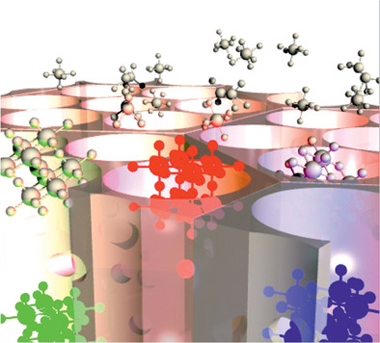
Mesoporous silica features open and accessible pores that can intake substances from the outside. The combination of mesoporous silica with plasmonic nanostructures represents an interesting platform for an optical sensor based on the dependence of plasmonic modes on the refractive index of the medium in which metallic nanoparticles are embedded. However, so far only a…

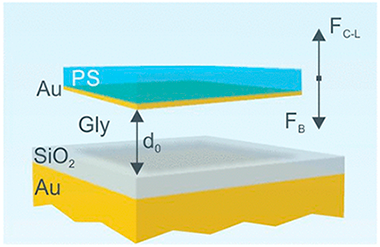
Optical interference effects on the Casimir-Lifshitz force in multilayer structures

The Casimir-Lifshitz force F(C-L) between planar objects when one of them is stratified at the nanoscale is herein investigated. Layering results in optical interference effects that give rise to a modification of the optical losses, which, as stated by the fluctuation-dissipation theorem, should affect the Casimir-Lifshitz interaction. On these grounds, we demonstrate that, by nanostructuring…

Localized surface plasmon effects on the photophysics of perovskite thin films embedding metal nanoparticles

Herein we provide direct experimental evidence that proves that the photophysical properties of thin methylammonium lead iodide perovskite films are significantly enhanced by localized surface plasmon resonances (SPRs). Observations are well supported by rigorous calculations that prove that improved light harvesting can be unequivocally attributed to plasmonic scattering and near field reinforcement effects around silver…

Dipole reorientation and local density of optical states influence the emission of light-emitting electrochemical cells

Herein, we analyze the temporal evolution of the electroluminescence of light-emitting electrochemical cells (LECs), a thin-film light-emitting device, in order to maximize the luminous power radiated by these devices. A careful analysis of the spectral and angular distribution of the emission of LECs fabricated under the same experimental conditions allows describing the dynamics of the…

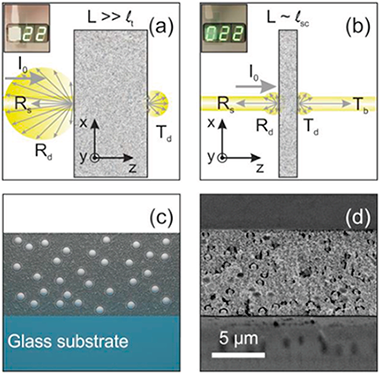
Finite Size Effects on Light Propagation throughout Random Media: Relation between Optical Properties and Scattering Event Statistics

This work introduces a thorough analysis of light transport in thin optically disordered media. The diffusive properties of a turbid material are generally dictated by the transport mean free path, lt. For depths larger than this characteristic length, light propagation can be considered fully randomized. There is however a range of thicknesses for which light becomes…

Casimir-Lifshitz Force Based Optical Resonators

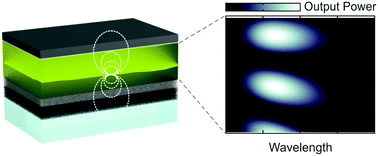
We theoretically investigate the building of optical resonators based on the levitation properties of thin films subjected to strong repulsive Casimir-Lifshitz forces when immersed in an adequate medium and confronted with a planar substrate. We propose a design in which cavities supporting high Q-factor optical modes at visible frequencies can be achieved by means of…

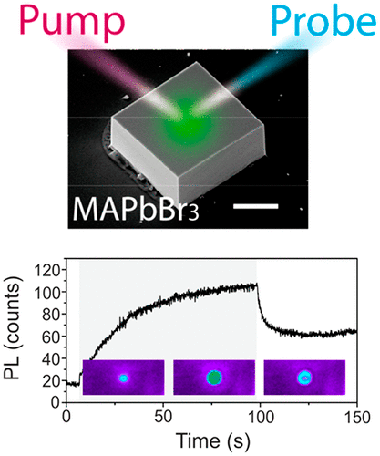
Spatially Resolved Analysis of Defect Annihilation and Recovery Dynamics in Metal Halide Perovskite Single Crystals

The spectacular advances in efficiency of optoelectronic devices based on lead-halide perovskites have been accompanied by detailed structural and optical studies regarding the instability presented by these materials, which constitute their main bottleneck for commercialization. Following a pump and probe scheme in a laser scanning confocal microscope, we resolve the photoinduced emission activation/deactivation dynamics in…

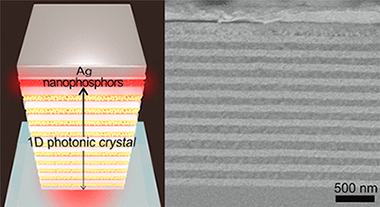
Tamm Plasmons Directionally Enhance Rare-Earth Nanophosphor Emission

Rare-earth-based phosphors are the materials on which current solid-state lighting technology is built. However, their large crystal size impedes the tuning, optimization, or manipulation of emitted light that can be achieved by their integration in nanophotonic architectures. Herein we demonstrate a hybrid plasmonic-photonic architecture capable of both channeling in a specific direction and enhancing by…