Impact of Tb4+ and morphology on the thermal evolution of Tb-doped TiO2 nanostructured hollow spheres and nanoparticles

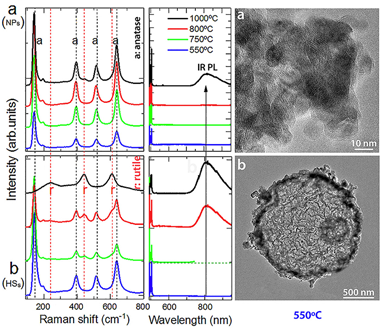
Tb-doped TiO2 hollow spheres (HSs) in the range 0.0-2.0 at.% have been synthesized by the first time to the best of our knowledge. The HSs are compared with nanoparticles (NPs) to evaluate the impact of morphology on their physicochemical and photoluminescence (PL) behavior upon increasing calcination temperature. After calcination at 550 degrees C, the particles…

Enhanced Directional Light Extraction from Patterned Rare-Earth Phosphor Films

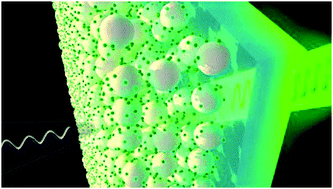
The combination of light‐emitting diodes (LEDs) and rare earth (RE) phosphors as color‐converting layers comprises the basis of solid‐state lighting. Indeed, most LED lamps include a photoluminescent coating made of phosphor material, i.e., crystalline matrix suitably doped with RE elements, to produce white light from a blue or ultraviolet LED chip. Transparent phosphor‐based films constitute…

Disentangling Electron–Phonon Coupling and Thermal Expansion Effects in the Band Gap Renormalization of Perovskite Nanocrystals

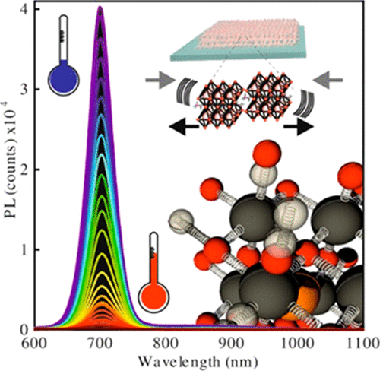
The complex electron–phonon interaction occurring in bulk lead halide perovskites gives rise to anomalous temperature dependences, like the widening of the electronic band gap as temperature increases. However, possible confinement effects on the electron–phonon coupling in the nanocrystalline version of these materials remain unexplored. Herein, we study the temperature (ranging from 80 K to ambient)…

Efficient third harmonic generation from FAPbBr(3) perovskite nanocrystals

The development of versatile nanostructured materials with enhanced nonlinear optical properties is relevant for integrated and energy efficient photonics. In this work, we report third harmonic generation from organic lead halide perovskite nanocrystals, and more specifically from formamidinium lead bromide nanocrystals, ncFAPbBr(3), dispersed in an optically transparent silica film. Efficient third order conversion is attained…

Internal quantum efficiency and time signals from intensity-modulated photocurrent spectra of perovskite solar cells

Intensity Modulated Photocurrent Spectroscopy (IMPS) is a small-perturbation optoelectronic technique that measures the quantum efficiency of a photoelectrochemical device as a function of optical excitation frequency. Metal Halide Perovskites (MHPs) are mixed electronic-ionic semiconductors with an extraordinary complex optoelectronic behavior and a record efficiency surpassing 25%. In this paper, we propose a simplified procedure to…

Local Rearrangement of the Iodide Defect Structure Determines the Phase Segregation Effect in Mixed-Halide Perovskites

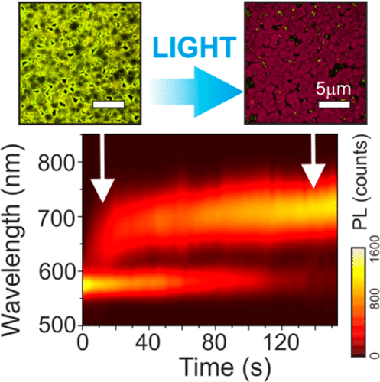
Mixed-halide perovskites represent a particularly relevant case within the family of lead-halide perovskites. Beyond their technological relevance for a variety of optoelectronic devices, photoinduced structural changes characteristic of this type of material lead to extreme photophysical changes that are currently the subject of intense debate. Herein we show that the conspicuous photoinduced phase segregation characteristic…

Premelting of ice adsorbed on a rock surface

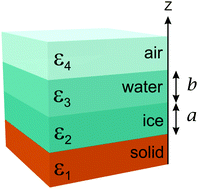
Considering ice-premelting on a quartz rock surface (i.e. silica) we calculate the Lifshitz excess pressures in a four layer system with rock-ice-water-air. Our calculations give excess pressures across (1) ice layer, (2) water layer, and (3) ice-water interface for different ice and water layer thicknesses. We analyse equilibrium conditions where the different excess pressures take…

Dibenzo-tetraphenyl diindeno perylene as hole transport layer for high-bandgap perovskite solar cells

Semi-transparent perovskite solar cells have the competitive edge of being employed for building integrated photovoltaics due to their esthetic benefits as light harvesting windows/facades. Perovskites have received considerable attention in recent years as a thin film photovoltaic alternative, that can also be tweaked for its transparency, evolving from potentially high bandgaps that are suited for…

Monitoring, Modeling, and Optimization of Lead Halide Perovskite Nanocrystal Growth within Porous Matrices

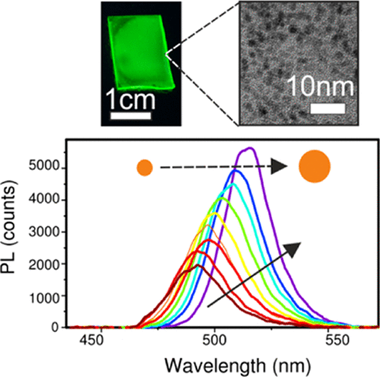
The growth of lead halide perovskites within metal-oxide nanoporous films has been recently considered as a means to obtain chemically and photostable ligand-free high-quality nanocrystals (NCs). The growth process, governed by the reactions taking place in nanoreactors dictated by the matrix pore size, has not been explored so far. In this work, we use photoluminescence…