Persistent luminescent nanoparticles: Challenges and opportunities for a shimmering future

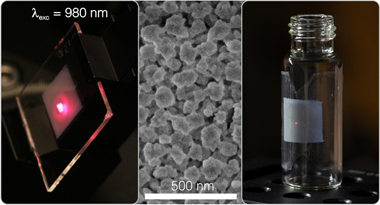
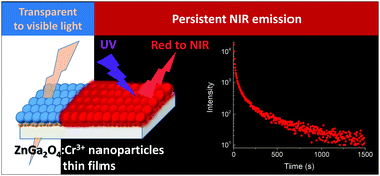
Persistent phosphors are luminescent sources based on crystalline materials doped with rare-earth or transition metal cations able to produce light after the excitation source vanishes. Although known for centuries, these materials gained renewed interest after the discovery of Eu2+,RE3+ co-doped aluminates and silicates in the late 1990s due to their unprecedented afterglow properties. In contrast,…

Light-Harvesting Properties of a Subphthalocyanine Solar Absorber Coupled to an Optical Cavity

Herein, both from the experimental and theoretical point of view, the optical absorption properties of a subphthalocyanine (SubPc), an organic macrocycle commonly used as a sunlight harvester, coupled to metallic optical cavities are analyzed. How different electronic transitions characteristic of this compound and specifically those that give rise to excitonic (Q band) and charge transfer…

Ligand-Free MAPbI(3) Quantum Dot Solar Cells Based on Nanostructured Insulating Matrices

The stability, either chemical or thermal, and performance of colloidal quantum dot (CQD) devices are typically limited by the presence of surface-bonded organic ligands required to stabilize the nanocrystals. In addition, optimization of charge transport implies lengthy ligand exchange processing. Herein, evidence of efficient charge transport through a network of ligand-free perovskite quantum dots (PQDs)…

The Role of the Atmosphere on the Photophysics of Ligand-Free Lead-Halide Perovskite Nanocrystals

Lead halide perovskite (LHP) nanocrystals (NCs) have gained attention over the past decade due to their outstanding optoelectronic properties, making them a suitable material for efficient photovoltaic and light emitting devices. Due to its soft nature, these nanostructures undergo strong structural changes upon irradiation, where these light-induced processes are strongly influenced by the environment. Since…

Self-preserving ice layers on CO2 clathrate particles: Implications for Enceladus, Pluto, and similar ocean worlds

Context. Gas hydrates can be stabilised outside their window of thermodynamic stability by the formation of an ice layer – a phenomenon termed self-preservation. This can lead to a positive buoyancy for clathrate particles containing CO2 that would otherwise sink in the oceans of Enceladus, Pluto, and similar oceanic worlds.Aims. Here we investigate the implications…

Highly Versatile Upconverting Oxyfluoride-Based Nanophosphor Films

Fluoride-based compounds doped with rare-earth cations are the preferred choice of materials to achieve efficient upconversion, of interest for a plethora of applications ranging from bioimaging to energy harvesting. Herein, we demonstrate a simple route to fabricate bright upconverting films that are transparent, self-standing, flexible, and emit different colors. Starting from the solvothermal synthesis of…

Toward Commercialization of Stable Devices: An Overview on Encapsulation of Hybrid Organic-Inorganic Perovskite Solar Cells

Perovskite solar cells (PSCs) represent a promising technology for energy harvesting due to high power conversion efficiencies up to 26%, easy manufacturing, and convenient deposition techniques, leading to added advantages over other contemporary competitors. In order to promote this technology toward commercialization though, stability issues need to be addressed. Lately, many researchers have explored several…

The Complex Interplay of Lead Halide Perovskites with Their Surroundings

Photoexcitation of lead halide perovskites induces a restructuration of the material that simultaneously enhances its emission properties and triggers its degradation. These concomitant processes are strongly dependent on the surroundings of the perovskite, both while and after being processed, underlining the relevance the environment and the interfacial design have in the stability and performance of…