Room-temperature cavity exciton-polariton condensation in perovskite quantum dots

The exploitation of the strong light-matter coupling regime and exciton-polariton condensates has emerged as a compelling approach to introduce strong interactions and nonlinearities into numerous photonic applications. The use of colloidal semiconductor quantum dots with strong three-dimensional confinement as the active material in optical microcavities would be highly advantageous due to their versatile structural and…

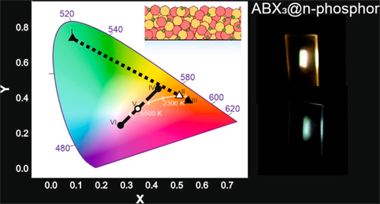
Tunable White Light Emission from Transparent Nanophosphor Films Embedding Perovskite Lead Halide Nanostructures

Exploring synergistic interactions between nanomaterials that can enhance their collective properties in ways that individual components cannot achieve represents an avenue for advancing beyond the current state of the art. This approach is particularly relevant in the context of ABX(3) nanocrystals, where pursuing cooperation could help to overcome current challenges associated with light generation. Transparent…

Photoinduced Spin Centers in Photocatalytic Metal-Organic Framework UiO-66

Metal-Organic frameworks (MOFs) are promising candidates for advanced photocatalytically active materials. These porous crystalline compounds have large active surface areas and structural tunability and are thus highly competitive with oxides, the well-established material class for photocatalysis. However, due to their complex organic and coordination chemistry composition, photophysical mechanisms involved in the photocatalytic processes in MOFs…

Quantification of Emission Efficiency in Persistent Luminescent Materials

Accurate quantification of efficiency enables rigorous comparison between different photoluminescent materials, providing an optimization path critical to the development of next-generation light sources. Persistent luminescent materials exhibit delayed and long-lasting luminescence due to the temporary storage of optical energy in engineered structural defects. Standard characterization methods do not provide a universal comparison of phosphor performance,…

Intense and Stable Blue Light Emission From CsPbBr3/Cs4PbBr6 Heterostructures Embedded in Transparent Nanoporous Films

Lead halide perovskite nanocrystals are attractive for light emitting devices both as electroluminescent and color-converting materials since they combine intense and narrow emissions with good charge injection and transport properties. However, while most perovskite nanocrystals shine at green and red wavelengths, the observation of intense and stable blue emission still remains a challenging target. In…

Strong Grain Boundary Passivation Effect of Coevaporated Dopants Enhances the Photoemission of Lead Halide Perovskites

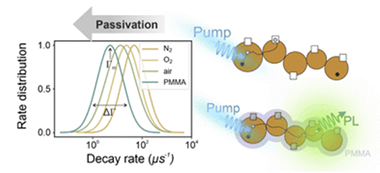
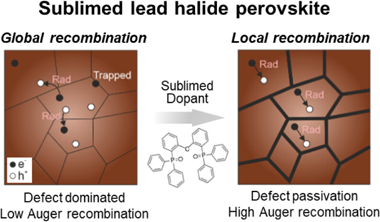
Herein, we demonstrate that coevaporated dopants provide a means to passivate buried interfacial defects occurring at perovskite grain boundaries in evaporated perovskite thin films, thus giving rise to an enhanced photoluminescence. By means of an extensive photophysical characterization, we provide experimental evidence that indicate that the codopant acts mainly at the grain boundaries. They passivate…