Design and realization of transparent solar modules based on luminescent solar concentrators integrating nanostructured photonic crystals

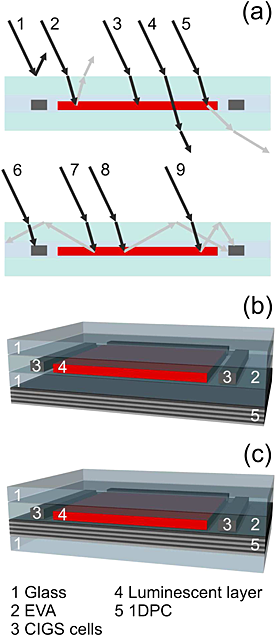
Herein, we present a prototype of a photovoltaic module that combines a luminescent solar concentrator integrating one-dimensional photonic crystals and in-plane CuInGaSe2 (CIGS) solar cells. Highly uniform and wide-area nanostructured multilayers with photonic crystal properties were deposited by a cost-efficient and scalable liquid processing amenable to large-scale fabrication. Their role is to both maximize light…

Adaptable Ultraviolet Reflecting Polymeric Multilayer Coatings of High Refractive Index Contrast

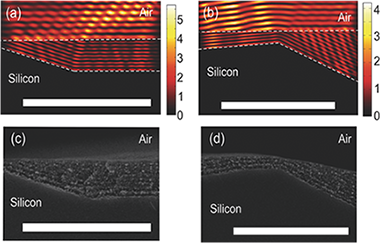
A synthetic route is demonstrated to build purely polymeric nanostructured multilayer coatings, adaptable to arbitrary surfaces, and capable of efficiently blocking by reflection a targeted and tunable ultraviolet (UV) range. Reflection properties are determined by optical interference between UV light beams reflected at the interfaces between polystyrene layers of different porosity and hence refractive index.…

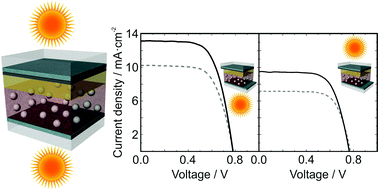
Synergistic strategies for the preparation of highly efficient dye-sensitized solar cells on plastic substrates: combination of chemical and physical sintering

Preparation of well-interconnected TiO2 electrodes at low temperature is critical for the fabrication of highly efficient dye-sensitized solar cells (DSCs) on plastic substrates. Herein we explore a synergistic approach using a combination of chemical and physical sintering. We formulate a binder-free TiO2 paste based on “nanoglue” as the chemical sintering agent, and use it to…

Biocompatible Films with Tailored Spectral Response for Prevention of DNA Damage in Skin Cells

A hybrid nanostructured organic–in­organic biocompatible film capable of efficiently blocking a preselected range of ultraviolet light is designed to match the genotoxic action spectrum of human epithelial cells. This stack protects cultured human skin cells from UV-induced DNA lesions. As the shielding mechanism relies exclusively on reflection, the secondary effects due to absorption harmful radiation are…

Absorption Enhancement in Organic-Inorganic Halide Perovskite Films with Embedded Plasmonic Gold Nanoparticles

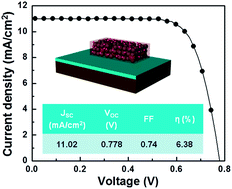
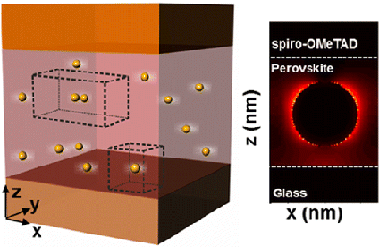
We report on the numerical analysis of solar absorption enhancement in organic-inorganic halide perovskite films embedding plasmonic gold nanoparticles. The effect of particle size and concentration is analyzed in realistic systems in which random particle location within the perovskite film and the eventual formation of dimers are also taken into account. We find a maximum…

Fine Tuning the Emission Properties of Nanoemitters in Multilayered Structures by Deterministic Control of their Local Photonic Environment

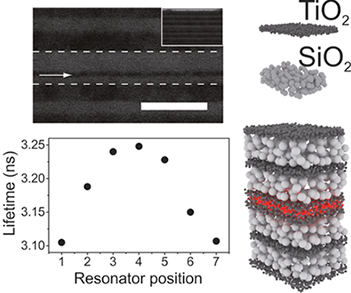
Deterministic control on the dynamics of organic nanoemitters is achieved through precise control of its photonic environment. Resonators are fabricated by a combination of spin- and dip-coating techniques, which allows placement of the emitters at different positions within the sample, thus acting as a probe of the local density of states.

Environmental Effects on the Photophysics of Organic-Inorganic Halide Perovskites

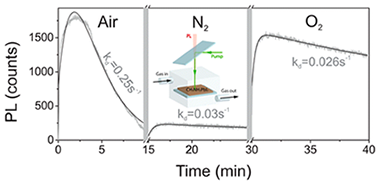
The photophysical properties of films of organic-inorganic lead halide perovskites under different ambient conditions are herein reported. We demonstrate that their luminescent properties are determined by the interplay between photoinduced activation and darkening processes, which strongly depend on the atmosphere surrounding the samples. We have isolated oxygen and moisture as the key elements in each…