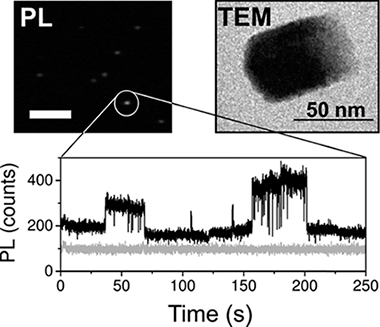
Mechanism of Photoluminescence Intermittency in Organic-Inorganic Perovskite Nanocrystals

Lead halide perovskite nanocrystals have demonstrated their potential as active materials for optoelectronic applications over the past few years. Nevertheless, one issue that hampers their applicability has to do with the observation of photoluminescence intermittency, commonly referred to as «blinking», as in their inorganic counterparts. Such behavior, reported for structures well above the quantum confinement…

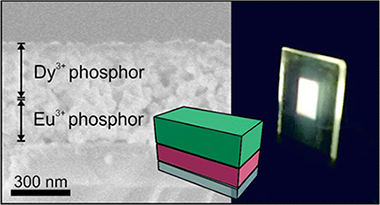
Highly Efficient Transparent Nanophosphor Films for Tunable White-Light-Emitting Layered Coatings

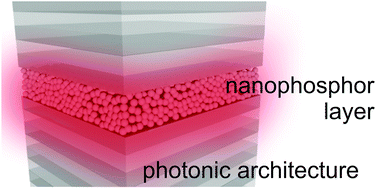
Bright luminescence in rare-earth (RE) nanocrystals, the so-called nanophosphors, is generally achieved by choosing a host that enables an effective excitation of the RE activator through charge or energy transfer. Although tungstate, molybdate, or vanadate compounds provide the aforementioned transfer, a comparative analysis of the efficiency of such emitters remains elusive. Herein, we perform a…

Flexible nanophosphor films doped with Mie resonators for enhanced out-coupling of the emission

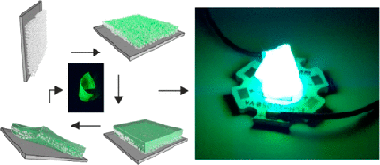
Herein, we present a general method to prepare self-standing flexible photoluminescent coatings of controlled opacity for integration into light-emitting diodes (LEDs) employing cost-effective solution-processing methods. From colloidal suspensions of nano-sized phosphors, we fabricate light-emitting transparent films that can be doped with spherical scatterers, which act as Mie resonators that trigger a controlled photoluminescence enhancement, evidenced…

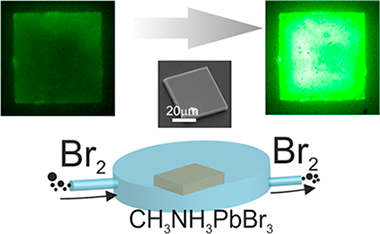
Improving the Bulk Emission Properties of CH3NH3PbBr3 by Modifying the Halide-Related Defect Structure

The peculiar defect chemistry of hybrid organic–inorganic lead halide perovskites is believed to be partially responsible for the outstanding performance of this solution-processed material in optoelectronic devices. While most effort has been put on the management of halide defects (the ones presenting the highest mobility) for CH3NH3PbI3, its bromide counterpart has not been so widely…

High voltage vacuum-deposited CH3NH3PbI3–CH3NH3PbI3 tandem solar cells

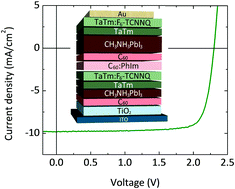
The recent success of perovskite solar cells is based on two solid pillars: the rapid progress of their power conversion efficiency and their flexibility in terms of optoelectrical properties and processing methods. That versatility makes these devices ideal candidates for multi-junction photovoltaics. We report an optically optimized double junction CH3NH3PbI3-CH3NH3PbI3 tandem solar cell where the…

Highly Efficient and Environmentally Stable Flexible Color Converters Based on Confined CH3NH3PbBr3 Nanocrystals

In this work, we demonstrate a synthetic route to attain methylammonium lead bromide (CH3NH3PbBr3) perovskite nanocrystals (nc-MAPbBr(3), 1.5 nm < size < 3 nm) and provide them with functionality as highly efficient flexible, transparent, environmentally stable, and adaptable color converting films. We use nanoparticle metal oxide (MOx) thin films as porous scaffolds of controlled nanopores…

Absorption enhancement in methylammonium lead iodide perovskite solar cells with embedded arrays of dielectric particles

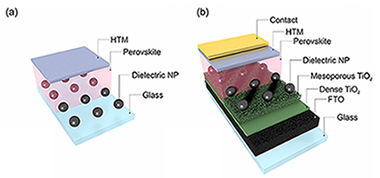
In the field of hybrid organic-inorganic perovskite based photovoltaics, there is a growing interest in the exploration of novel and smarter ways to improve the cells light harvesting efficiency at targeted wavelength ranges within the minimum volume possible, as well as in the development of colored and/or semitransparent devices that could pave the way both…

Origin of Light-Induced Photophysical Effects in Organic Metal Halide Perovskites in the Presence of Oxygen

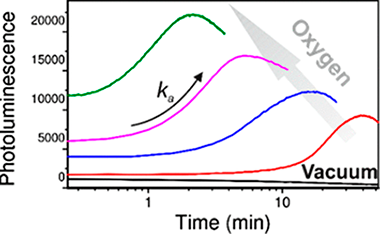
Herein we present a combined study of the evolution of both the photoluminescence (PL) and the surface chemical structure of organic metal halide perovskites as the environmental oxygen pressure rises from ultrahigh vacuum up to a few thousandths of an atmosphere. Analyzing the changes occurring at the semiconductor surface upon photoexcitation under a controlled oxygen…