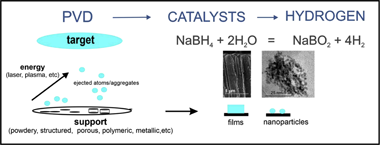
Advances in the implementation of PVD-based techniques for the preparation of metal catalysts for the hydrolysis of sodium borohydride

Sodium borohydride constitutes a safe alternative for the storage of hydrogen with a high gravimetric content. Catalytic hydrolysis of sodium borohydride permits on-demand hydrogen generation for multiple applications. In this field, the rational design of efficient metal catalysts deposited on structured supports is highly desirable. For most reactions, chemical methods are the most commonly used…

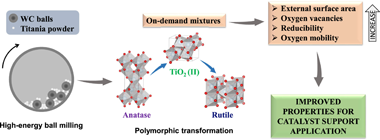
Tailoring materials by high-energy ball milling: TiO2 mixtures for catalyst support application

We carried out a rational design of catalyst supports by high-energy ball milling. Tailored mixtures of TiO2 crystalline phases were obtained using rotational speed and milling time as variable parameters. Polymorphic transformation from anatase to rutile through high-pressure TiO2 (II) as intermediate was confirmed by X-ray Diffraction (XRD), Raman Spectroscopy and Transmission Electron Microscopy (TEM).…

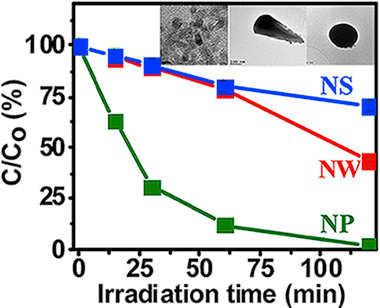
Morphological effects on the photocatalytic properties of SnO2 nanostructures

The photocatalytic properties of SnO2 nanocrystals are tuned by varying their morphology and microstructure. SnO2 nanoparticles and nanowedges have been synthesized using hydrothermal methods, while microwave irradiation techniques have given nanospheres. Detailed structural and chemical characterization of these different morphologies has been accomplished. The influence of SnO2 morphology on photocatalytic activity has been examined by…

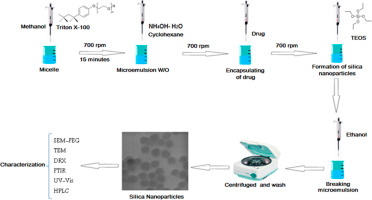
Microemulsion Assisted Sol-Gel Method as Approach to Load a Model Anticancer Drug inside Silica Nanoparticles for Controlled Release Applications

Silica nanoparticles are attractive carriers due to their improved safety and effectiveness in drug delivery. Silica nanoparticles were synthesized by using microemulsion assisted sol-gel method, and a model anticancer drug 5-fluorouracil (5-FU) was added to the silica precursor before hydrolysis and condensation reactions start. The obtained materials were characterized by Transmission Electron Microscopy (TEM) and…

Biodegradabiliy of spherical mesoporous silica particles (MCM-41) in simulated body fluid (SBF)

Mesoporous silica particles of type MCM-41 (Mobile Composition of Matter No. 41), exhibiting highly ordered mesoporosity (pores with diameter between 2 and 50 nm) and surface roughness, are developed and used as a functional coating on bioactive glass-based scaffolds for bone tissue engineering. The degradability and the mesostructure stability of these novel MCM-41 particles were…

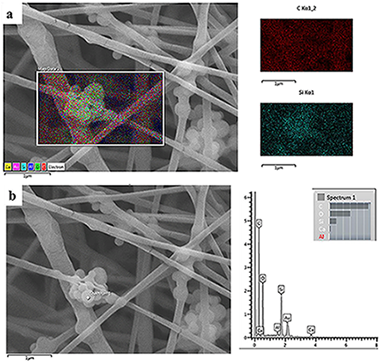
Incorporation of Calcium Containing Mesoporous (MCM-41-Type) Particles in Electrospun PCL Fibers by Using Benign Solvents

The electrospinning technique is a versatile method for the production of fibrous scaffolds able to resemble the morphology of the native extra cellular matrix. In the present paper, electrospinning is used to fabricate novel SiO2particles (type MCM-41) containing poly(epsilon-caprolactone) (PCL) fibers. The main aims of the present work are both the optimization of the particle…