Long-lasting low fluorinated stainless steel hierarchical surfaces for omniphobic, anti-fouling and anti-icing applications

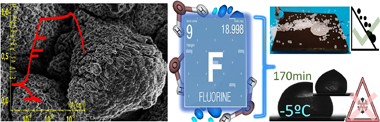
Stainless steel (SS) alloys are prevalent in many industries, household appliances or other commodities, where a strict control of surface properties is required to tailor their interaction with the environment. In this work we report a new procedure of stainless steel surface processing that provides a multifunctional response including superhydrophobicity, omniphobicity, self-cleaning, anti-fouling and effective…

Microstructural evolution and properties of He-charged a-Si coatings prepared by magnetron sputtering

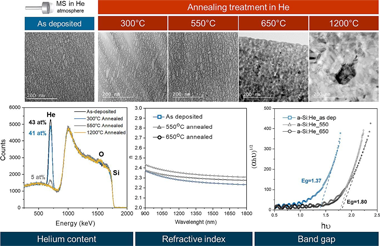
The introduction of porosity in nanomaterials via magnetron sputtering in helium atmospheres is an interesting strategy for the design of functional materials. Amorphous silicon coatings, with high concentration of He incorporated in the form of overpressurized nano-bubbles, present modified optical properties in comparison with dense coatings of similar composition. In this work, annealing process in…

Understanding the Problem of Hydrogen Storage Using a Demonstration: Coupling a Hydrogen Generator Based on the Hydrolysis of Sodium Borohydride to a Fuel-Cell Kit

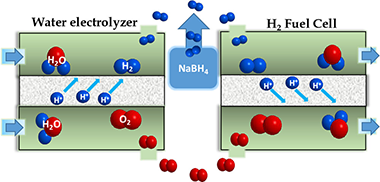
In the context of a green global energy paradigm, hydrogen (H-2) is a very promising energy carrier. In fuel cells, hydrogen can be used to generate electricity to drive an electric motor, producing water as its only byproduct. However, to implement hydrogen as an energy vector, developing methods for its production, storage, distribution, and use…

Preparation, characterization and activation of Pd catalysts supported on CNx foam for the liquid phase decomposition of formic acid

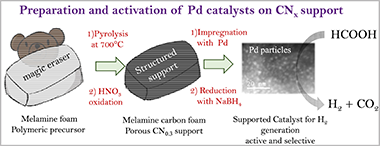
In this work, we have prepared a series of Pd catalysts on a CNx support for the liquid phase decomposition of formic acid. The structured CNx support was obtained through thermal pyrolysis of melamine foam and the pyrolysis conditions were optimized to achieve high surface area. The resulting support contains high amount of nitrogen with…

Microstructure and activity of Pd catalysts prepared on commercial carbon support for the liquid phase decomposition of formic acid

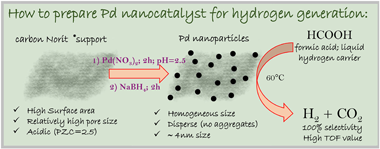
In this work, a series of Pd catalysts supported on commercially available activated carbon (Norit (R)) were prepared by employing different metal precursors (Pd(NO3)2 and Na2PdCl4) by the impregnation-reduction method at different pH. Catalysts were tested for the liquid phase decomposition of formic acid to generate hydrogen. The best results, in terms of small particle…

Pd supported on defective TiO2 polymorphic mixtures: Effect of metal-support interactions upon glycerol selective oxidation

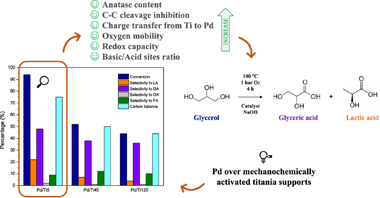
Palladium catalysts supported on defective mixes of anatase, TiO2 (II) and rutile crystalline phases, previously obtained by high-energy ball milling, were synthesized and tested for glycerol selective oxidation. A deep characterization of these unusual materials was carried out to elucidate catalytic and physicochemical features. Electron density transfer from support to metal or vice versa, depending…

Pd supported on defective TiO2 polymorphic mixtures: Effect of metal-support interactions upon glycerol selective oxidation

Palladium catalysts supported on defective mixes of anatase, TiO2 (II) and rutile crystalline phases, previously obtained by high-energy ball milling, were synthesized and tested for glycerol selective oxidation. A deep characterization of these unusual materials was carried out to elucidate catalytic and physicochemical features. Electron density transfer from support to metal or vice versa, depending…

Ultrathin Plasma Polymer Passivation of Perovskite Solar Cells for Improved Stability and Reproducibility

Despite the youthfulness of hybrid halide perovskite solar cells, their efficiencies are currently comparable to commercial silicon and have surpassed quantum-dots solar cells. Yet, the scalability of these devices is a challenge due to their low reproducibility and stability under environmental conditions. However, the techniques reported to date to tackle such issues recurrently involve the use of solvent methods that would further complicate their transfer to industry. Herein a reliable…

Influence of helium incorporation on growth process and properties of aluminum thin films deposited by DC magnetron sputtering

The effect of helium content on the morphology, crystallinity, and composition of aluminum films was investigated by depositing He-loaded Al films onto Si substrates via direct current (DC) magnetron sputtering in different Ar/He plasma mixtures. Three different plasma regimes were identified depending on the percentage of He in the gas phase. For a low He to total gas ratio…