Bonding Structure and Mechanical Properties of Ti-B-C Coatings

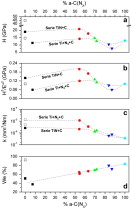
Nanocomposite coatings combining hard phases (TiB2, TiC) with an amorphous carbon (a-C) were developed to provide a good compromise between mechanical and tribological properties for M2 steels used in a wide variety of applications such as cutting tools, bearings and gear mechanisms. A combined d.c.-pulsed and r.f.-magnetron deposition process was used to deposit nanocomposite TiBC/a-C…

Comparative investigation of TiAlC(N), TiCrAlC(N), and CrAlC(N) coatings deposited by sputtering of МАХ-phase Ti2 − хCrхAlC targets

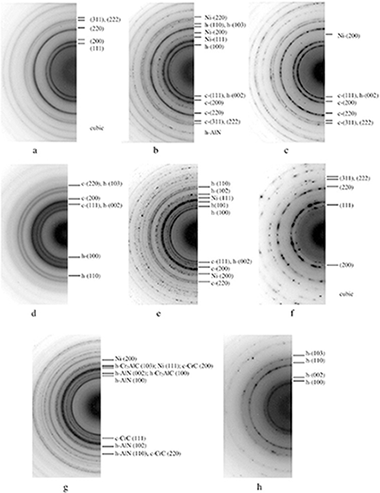
A comparative investigation of the structure and properties of TiAlC(N), TiCrAlC(N), and CrAlC(N) coatings deposited by sputtering of МАХ-phase Ti2 − хCrхAlC targets (where x = 0, 0.5, 1.5, and 2) in an Ar atmosphere or in a gaseous mixture of Ar + N2 is presented. The coatings were characterized in terms of their structure,…

Chemical and electronic interface structure of spray pyrolysis deposited undoped and Al-doped ZnO thin films on a commercial Cz-Si solar cell substrate

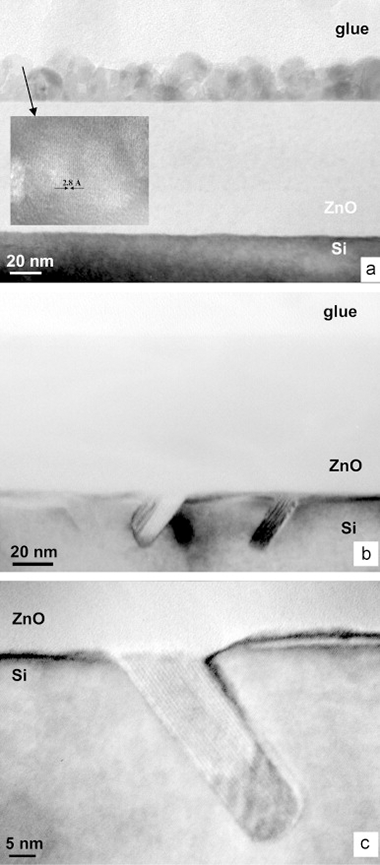
We have studied differences in the interface between undoped and Al-doped ZnO thin films deposited on commercial Si solar cell substrates. The undoped ZnO film is significantly thicker than the Al-doped film for the same deposition time. An extended silicate-like interface is present in both samples. Transmission electron microscopy (TEM) and photoelectron spectroscopy (PES) probe…

High deposition rates of uniform films in tetramethylsilane-based plasmas generated by elementary microwave sources in matrix configuration

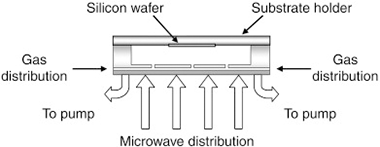
Plasma scaling up can be achieved by distributing elementary microwave plasma sources on planar rectangular networks. These so-called matrix plasmas can generate uniform sheets of plasma over a wide argon pressure range, from 7.5 to 750 Pa, with densities between 1012 and 1013 cm− 3. In order to estimate the capabilities of matrix plasmas for…

Thermal Stability and Oxidation Resistance of Nanocomposite TiC/a-C Protective Coatings

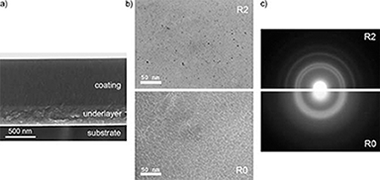
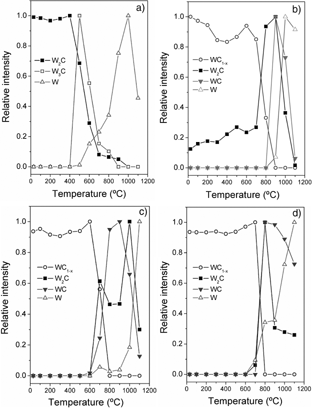
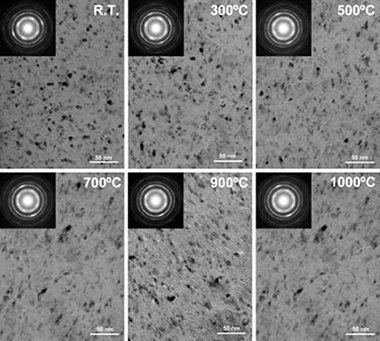
Nanocomposite films composed by small crystallites of hard phases embedded in an amorphous lubricant matrix have been extensively studied as protective coatings. These kinds of coatings have often to work in extreme environments, exposed to high temperatures (above 800–900 °C), and/or oxidizing/corrosive atmospheres, which may resist. As a result, it is important to study the behavior…

Tribological carbon-based coatings: An AFM and LFM study

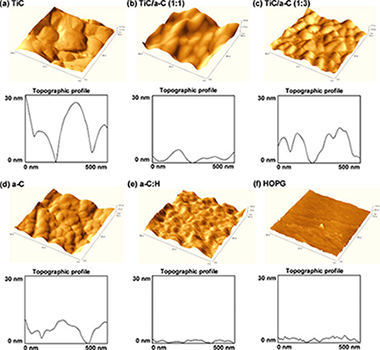
In this work some carbon-based coatings were studied by atomic force microscopy (AFM) and lateral force microscopy (LFM) techniques in order to evaluate their microstructure and friction properties at the micro and nanoscale. With this aim, four samples were prepared by magnetron sputtering: an amorphous carbon film (a–C), two nanocomposites TiC/a–C with different phase ratio…

Properties of Ti(C,N) cermets synthesized by mechanically induced self-sustaining reaction

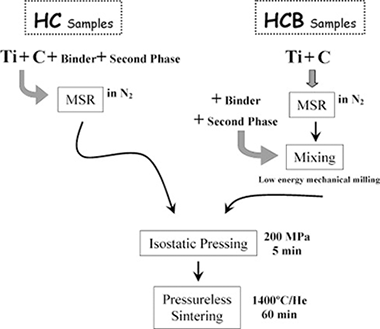
The properties of TiCxN1−x/(Ni or Co) cermets sintered by a pressureless method from powder mixtures, and obtained for the first time by a mechanically induced self-sustaining reaction process (MSR), were studied. The hardness, toughness, friction and wear coefficients, and oxidation resistance were determined. It was shown that cermets obtained from powdered materials synthesized in one…

Duplex SiCN/DLC coating as a solution to improve fretting—Corrosion resistance of steel

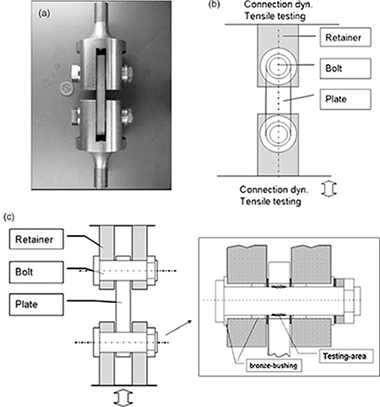
Fretting corrosion damages are commonly observed when two metallic bodies, which are in contact with each other, are subjected to oscillatory motions of low amplitude. Such kind of degradation mode is often responsible for limited durability of aeronautical joints. In the present paper, a multifunctional duplex coating based on Si–C–N and diamond-like carbon (DLC) materials,…