


Multifunctional Eu-doped NaGd(MoO4)(2) nanoparticles functionalized with poly(L-lysine) for optical and MRI imaging

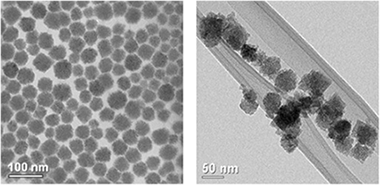
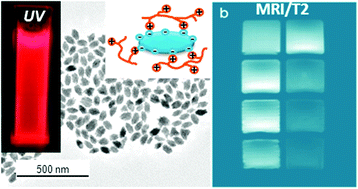
A method for the synthesis of non-aggregated and highly uniform Eu3+ doped NaGd(MoO4)(2) nanoparticles is reported for the first time. The obtained particles present tetragonal structure, ellipsoidal shape and their size can be varied by adjusting the experimental synthesis parameters. These nanoparticles, which were coated with citrate anions and functionalised with PLL, have also been…
Quantitative uptake of colloidal particles by cell cultures

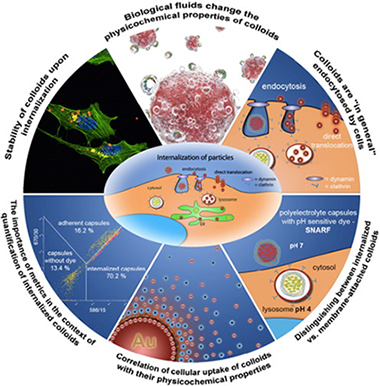
The use of nanotechnologies involving nano-and microparticles has increased tremendously in the recent past. There are various beneficial characteristics that make particles attractive for a wide range of technologies. However, colloidal particles on the other hand can potentially be harmful for humans and environment. Today, complete understanding of the interaction of colloidal particles with biological…

Microstructural, spectroscopic, and antibacterial properties of silver-based hybrid nanostructures biosynthesized using extracts of coriander leaves and seeds

Coriander leaves and seeds have been highly appreciated since ancient times, not only due to their pleasant flavors but also due to their inhibitory activity on food degradation and their beneficial properties for health, both ascribed to their strong antioxidant activity. Recently, it has been shown that coriander leaf extracts can mediate the synthesis of…

Confinement and surface effects on the physical properties of rhombohedral-shape hematite (alpha-Fe2O3) nanocrystals

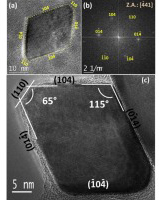
Morphological, microstructural and vibrational properties of hematite (alpha-Fe2O3) nanocrystals with a rhombohedral shape and rounded edges, obtained by forced hydrolysis of iron(III) solutions under a fast nucleation, have been investigated in detail as a function of aging time. These studies allowed us to propose a detailed formation mechanism and revealed that these nanocrystals are composed of four {104} side facets, two {110} faces at the edges of the long diagonal of the nanocrystals and two…

Luminescent Rare-earth-based Nanoparticles: A Summarized Overview of their Synthesis, Functionalization, and Applications

Rare-earth-based nanoparticles are currently attracting wide research interest in material science, physics, chemistry, medicine, and biology due to their optical properties, their stability, and novel applications. We present in this review a summarized overview of the general and recent developments in their synthesis and functionalization. Their luminescent properties are also discussed, including the latest advances…

Synthesis and functionalization of monodisperse near-ultraviolet and visible excitable multifunctional Eu3+, Bi3+:REVO4 nanophosphors for bioimaging and biosensing applications

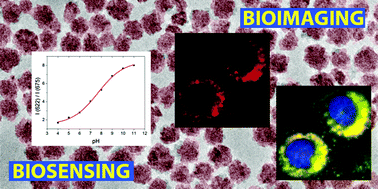
Near-ultraviolet and visible excitable Eu- and Bi-doped NPs based on rare earth vanadates (REVO4, RE = Y, Gd) have been synthesized by a facile route from appropriate RE precursors, europium and bismuth nitrate, and sodium orthovanadate, by homogeneous precipitation in an ethylene glycol/water mixture at 120 °C. The NPs can be functionalized either by a…

Transparent polycrystalline SrREGa3O7 melilite ceramics: potential phosphors for tuneable solid state lighting

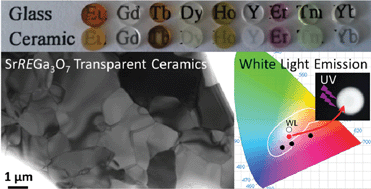
Full and congruent crystallization from glass is applied to the SrREGa3O7 melilite family (RE = Eu, Gd, Tb, Dy, Ho, Er, Tm, Yb and Y). This innovative process enables the synthesis of polycrystalline ceramics exhibiting high transparency both in the visible and near infrared regions, despite tetragonal crystal structures and micrometer scale grain sizes. Moreover, glass crystallization…

Ligand-Free Synthesis of Tunable Size Ln:BaGdF5 (Ln = Eu3+ and Nd3+) Nanoparticles: Luminescence, Magnetic Properties, and Biocompatibility

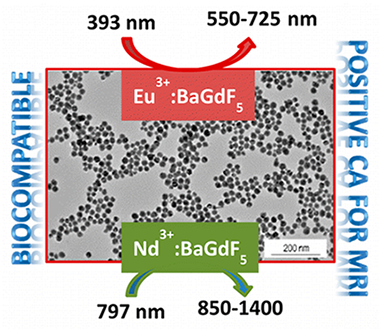
Bifunctional and highly uniform Ln:BaGdF5 (Ln = Eu3+ and Nd3+) nanoparticles have been successfully synthesized using a solvothermal method consisting of the aging at 120 degrees C of a glycerol solution containing the corresponding Lanthanide acetylacetonates and butylmethylimidazolium tetrafluoroborate. The absence of any surfactant in the synthesis process rendered hydrophilic nanospheres (with tunable diameter from…

Deposition of silica protected luminescent layers of Eu:GdVO4 nanoparticles assisted by atmospheric pressure plasma jet

Eu:GdVO4 nanophosphors with an average size of 60 nm, synthesized by a facile solvothermal method, were deposited on monocrystalline silicon wafers by a spray-coating technique with artworks anti-counterfeiting applications in mind. Atmospheric pressure plasma jet (APPJ) was used to deposit a silica-based layer on top of the nanometric luminescent layer, in order to improve its adhesion to…

Gold-Based Nanomaterials for Applications in Nanomedicine

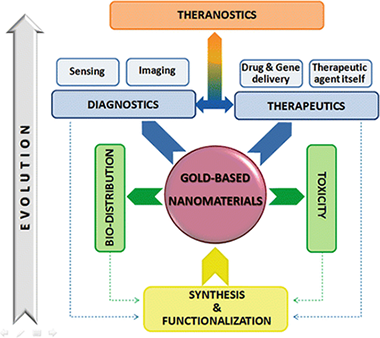
In this review, an overview of the current state-of-the-art of gold-based nanomaterials (Au NPs) in medical applications is given. The unique properties of Au NPs, such as their tunable size, shape, and surface characteristics, optical properties, biocompatibility, low cytotoxicity, high stability, and multifunctionality potential, among others, make them highly attractive in many aspects of medicine.…