Biocompatibility assessment of up-and down-converting nanoparticles: implications of interferences with in vitro assays

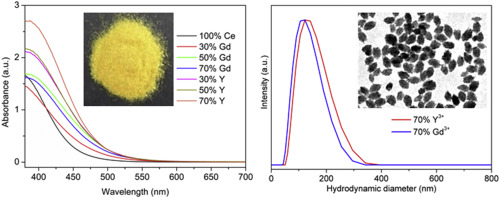
The safety assessment of nanoparticles (NPs) is crucial during their design and development for biomedicine. One of the prerequisite steps during this evaluation is in vitro testing that employs cell-based assays not always validated and well-adapted for NPs. Interferences with in vitro assays may arise due to the nano-related optical, oxidative, fluorescent, surface and catalytic properties of NPs. Thus,…

Enhancing Luminescence and X-ray Absorption Capacity of Eu3+:LaF3 Nanoparticles by Bi3+ Codoping

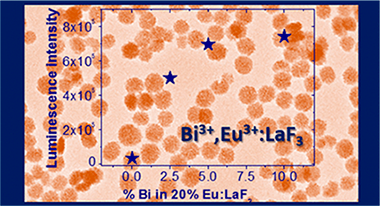
Bi3+ codoping has been proposed in this work with a twofold objective, namely, enhancing the luminescence emission of Eu3+:LaF3 nanoparticles (NPs) and increasing their X-ray attenuation capacity, with the purpose of obtaining a bimodal bioprobe for luminescence bioimaging and X-ray computed tomography. The synthesis method, reported here for the first time for LaF3 particles, allowed…

Photoluminescence quenching of dye molecules near a resonant silicon nanoparticle

Luminescent molecules attached to resonant colloidal particles are an important tool to study light-matter interaction. A traditional approach to enhance the photoluminescence intensity of the luminescent molecules in such conjugates is to incorporate spacer-coated plasmonic nanoantennas, where the spacer prevents intense non-radiative decay of the luminescent molecules. Here, we explore the capabilities of an alternative…

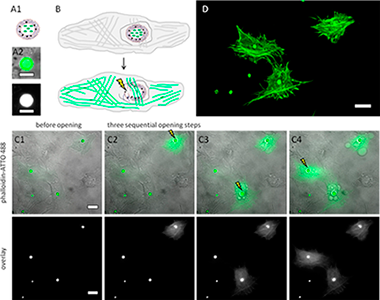
Laterally and Temporally Controlled Intracellular Staining by Light-Triggered Release of Encapsulated Fluorescent Markers

Fluorescent molecular markers were encapsulated. The capsules were additionally modified with plasmonic nanoparticles. The encapsulated markers were endocytosed by cells. Upon light stimulation the plasmonic nanoparticles generated heat, which opened the encapsulation and transiently perforated the endosomal/lysosomal membrane surrounding the capsule, thus allowing for release of the marker into the cytosol. Fluorescence labeling of different…

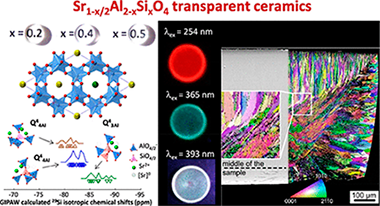
Local Disorder and Tunable Luminescence in Sr1–x/2Al2–xSixO4 (0.2 ≤ x ≤ 0.5) Transparent Ceramics

Eu-doped Sr1–x/2Al2–xSixO4 (x = 0.2, 0.4, and 0.5) transparent ceramics have been synthesized by full and congruent crystallization from glasses prepared by aerodynamic levitation and laser-heating method. Structural refinements from synchrotron and neutron powder diffraction data show that the ceramics adopt a 1 × 1 × 2 superstructure compared to the SrAl2O4 hexagonal polymorph. While the observed superstructure…

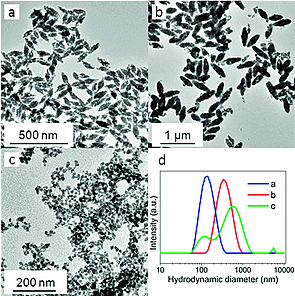
Microemulsion-Mediated Synthesis and Properties of Uniform Ln:CaWO4 (Ln = Eu, Dy) Nanophosphors with Multicolor Luminescence for Optical and CT Imaging

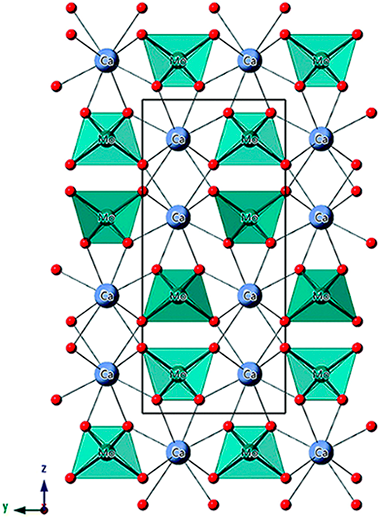
A new room-temperature method has been developed that yields, for the first time in the literature, uniform and well-dispersed CaWO4 nanospindles. This method is based on the use of microemulsions consisting of aqueous solutions of Ca2+ and WO42- precursors, cyclohexane as the organic medium, Triton X-100 as the surfactant, and n-octanol as the cosurfactant. We…