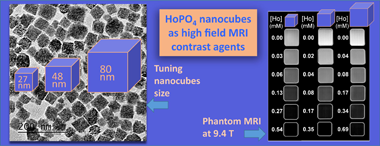
Holmium phosphate nanoparticles as negative contrast agents for high-field magnetic resonance imaging: Synthesis, magnetic relaxivity study and in vivo evaluation

The increasing use of high magnetic fields in magnetic resonance imaging (MRI) scanners demands new contrast agents, since those used in low field instruments are not effective at high fields. In this paper, we report the synthesis of a negative MRI contrast agent consisting of HoPO4 nanoparticles (NPs). Three different sizes (27 nm, 48 nm and 80 nm) of…

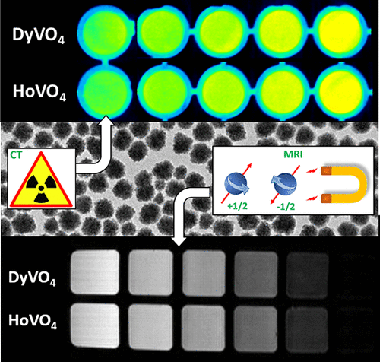
Dysprosium and Holmium Vanadate Nanoprobes as High-Performance Contrast Agents for High-Field Magnetic Resonance and Computed Tomography Imaging

We describe a wet chemical method for the synthesis of uniform and well-dispersed dysprosium vanadate (DyVO4) and holmium vanadate (HoVO4) nanoparticles with an almost spherical shape and a mean size of ∼60 nm and their functionalization with poly(acrylic acid). The transverse magnetic relaxivity of both systems at 9.4 T is analyzed on the basis of…

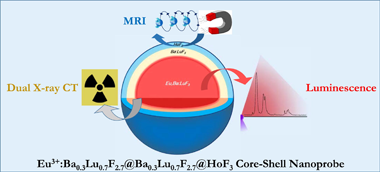
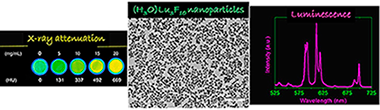
Design of a nanoprobe for high field magnetic resonance imaging, dual energy X-ray computed tomography and luminescent imaging

The combination of different bioimaging techniques, mainly in the field of oncology, allows circumventing the defects associated with the individual imaging modalities, thus providing a more reliable diagnosis. The development of multimodal endogenous probes that are simultaneously suitable for various imaging modalities, such as magnetic resonance imaging (MRI), X-ray computed tomography (CT) and luminescent imaging…

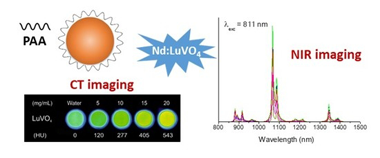
Bimodal Nd-Doped LuVO4 Nanoprobes Functionalized with Polyacrilic Acid for X-Ray Computed Tomography and NIR Luminescent Imaging

Uniform Nd3+-doped LuVO4 nanophosphors have been synthesized for the first time in literature by using a poliol-based method at 120 degrees C from Nd3+ and vanadate precursors. After optimizing the Nd doping level, these phosphors present intense luminescence in the near-infrared biological windows. The X-ray attenuation capacity of the optimum nanophosphor has been found to…

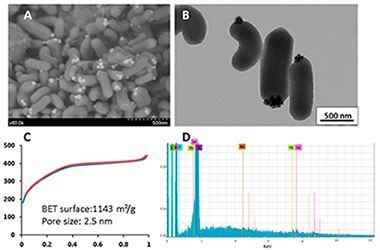
Encapsulation of Upconversion Nanoparticles in Periodic Mesoporous Organosilicas

(1) Background: Nanomedicine has recently emerged as a promising field, particularly for cancer theranostics. In this context, nanoparticles designed for imaging and therapeutic applications are of interest. We, therefore, studied the encapsulation of upconverting nanoparticles in mesoporous organosilica nanoparticles. Indeed, mesoporous organosilica nanoparticles have been shown to be very efficient for drug delivery, and upconverting…

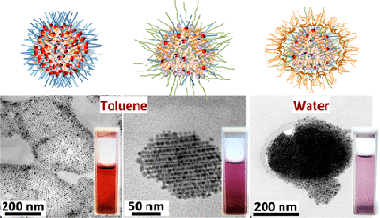
Monodisperse Gold Cuboctahedral Nanocrystals Directly Synthesized in Reverse Micelles: Preparation, Colloidal Dispersion in Organic Solvents and Water, Reversible Self-Assembly and Plasmonic Properties

The synthesis of organic-solvent-dispersible gold nanoparticles in reverse micelles of didodecyldimethylammonium bromide (DDAB) is revisited in the present investigation. Some parameters of synthesis, specifically the reaction volume and the concentration of the reducing agent, were slightly modified obtaining directly monodisperse gold nanocrystals (AuNCs) without the need to use additional active surfactants or additional treatments such…

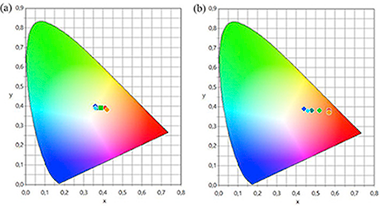
From structure to luminescence investigation of oxyfluoride transparent glasses and glass-ceramics doped with Eu3+/Dy3+ ions

Glasses and glass-ceramics with nominal composition 73 TeO2- 4BaO-3Bi(2)O(3)-18SrF(2)-2RE(2)O(3) (where RE = Eu, Dy) have been synthesized by conventional melt-quenching technique and subsequent heat treatment at 370 degrees C for 24 h in air atmosphere. Various Eu3+ to Dy3+ molar ratio have been applied to investigate luminescence properties in both glass and glass-ceramic matrices. Especially,…

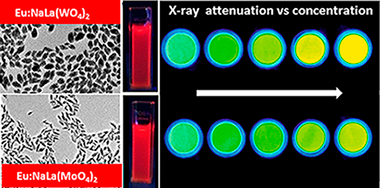
Synthesis, functionalization and properties of uniform europium-doped sodium lanthanum tungstate and molybdate (NaLa(XO4)(2), X = Mo,W) probes for luminescent and X-ray computed tomography bioimaging

A one-pot simple procedure for the synthesis of uniform, ellipsoidal Eu3+-doped sodium lanthanum tungstate and molybdate (NaLa(XO4)(2), X = W, Mo) nanophosphors, functionalized with carboxylate groups, is described. The method is based on a homogeneous precipitation process at 120 degrees C from appropriate Na+ Ln(3+) and tungstate or molybdate precursors dissolved in ethylene glycol/water mixtures…