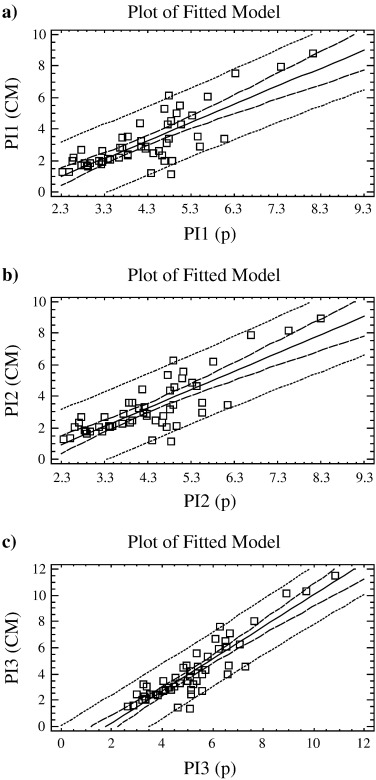
An improved method for determining the external specific surface area and the plasticity index of clayey samples based on a simplified method for non-swelling fine-grained soils

Previous studies have used the clay content of soils for estimating the specific surface areas and different correlations have been found, including plasticity-value correlations. Based on several assumptions, Dolinar (2012) proposed a simplified method for determining the external specific surface area of non-swelling fine-grained soils. An equation relates the external specific surface area (BET-nitrogen) with…

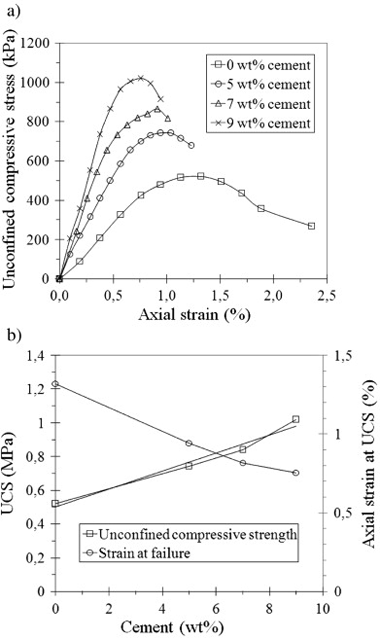
Phyllite clay-cement composites having improved engineering properties and material applications

Phyllite clays contain clay minerals (chlorite, illite and mixed-layer illite smectite), quartz and feldspars. In this experimental laboratory study, new composites of phyllite clay and cement (5, 7 and 9 wt.%) were prepared and tested to determine their Atterberg limits, dry density and optimum water content for modified Proctor (MP) compaction, California Bearing ratio, swelling potential…

Planning collection and solid waste flow (construction and demolition, concrete, ceramics and others) by utilizing a computerized tool for sustainable management

Se presenta un procedimiento para la planificación de recogida y flujo de los residuos sólidos (de construcción y demolición, hormigón, cerámica, vidrio y otros) basado en la utilización de una herramienta informatizada, para conseguir una optimización de su gestión. Dicho procedimiento parte de normativa establecida según un Plan Director Territorial de la Gestión de Residuos…

Historic preservation, GIS, & rural development: The case of Almería province, Spain

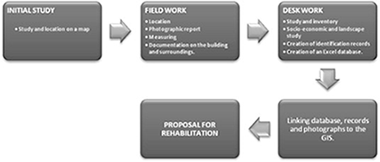
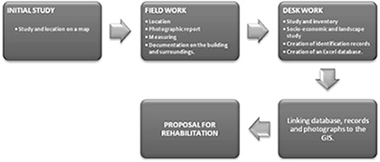
A computerized database was created, based on a Geographic Information System (GIS), with hyperlinks to the website for a Rural Development Association (Almería province, Andalusia, Spain). Thus, a catalogue of traditional rural buildings in this particular area was compiled, identifying and characterizing each one, establishing criteria for a dynamic and rational selection. The purpose to…

Historic preservation, GIS, & rural development: The case of Almería province, Spain

A computerized database was created, based on a Geographic Information System (GIS), with hyperlinks to the website for a Rural Development Association (Almería province, Andalusia, Spain). Thus, a catalogue of traditional rural buildings in this particular area was compiled, identifying and characterizing each one, establishing criteria for a dynamic and rational selection. The purpose to…

Estudio in-situ de la transformación térmica de limonita utilizada como pigmento procedente de Perú

Se ha realizado un estudio cinético de la transformación térmica de limonita [FeO(OH).nH2O] mediante análisis térmico gravimétrico (TGA), termodifracción de rayos X (DRX) y espectroscopía μ-Raman. La muestra estudiada fue extraída de un yacimiento en el distrito de Taraco, provincia de Huancané, Región de Puno (Perú). La técnica DRX en polvo identificó la fase goetita…

Physical and geotechnical properties of clay phyllites

An experimental programme is presented with the aim of characterising – from physical, microstructural and geotechnical perspectives – the main properties of compacted clay phyllites. These clay phyllites are widely used as waterproofing material for roofs in the Alpujarra (Andalusia, Spain), as sealing liners in irrigation ponds, and as core material of small earthen zoned…

Phyllites used as waterproofing layer materials for greenhouses crops in Spain: multivariate statistical analysis applied to their classification based on X-ray fluorescence analysis

The results are presented for the chemical characterization carried out with 53 raw material samples with phyllosilicates from outcrops located between the provinces of Almería and Granada (SE Spain) in order to use them as waterproof layers under the floors of greenhouses. For this purpose, the samples have been studied by these techniques: X-Ray Diffraction…

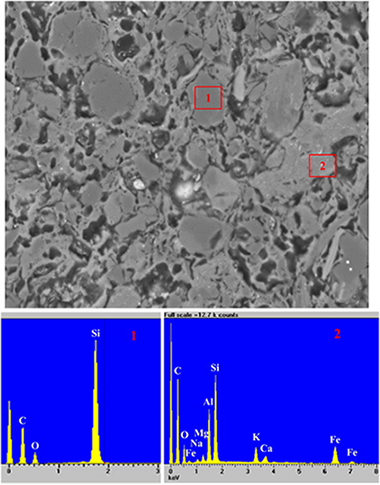
Microanalysis of Gothic mural paintings (15th century) in Slovenia: Investigation of the technique used by the Masters

The present article focuses on an interdisciplinary research on cultural heritage concerning the microanalysis of Gothic mural paintings made during the 15th century in Slovenia. The samples were chosen from the churches of Crngrob (1453), Mirna (1463-1465), Mevkuz (1465) and Mate (1467), attributed to two of the most important Gothic painters of that period of time: Master Bolfgang and Master of Mate. The chemical and phase composition of all the mortars, number of their layers and selection of the pigments were of interest. For this purpose, fragments of mural paintings were studied with several instrumental techniques: optical microscopy (OM), SEM-EDX, x-ray powder…