Microbiological induced carbonate (CaCO3) precipitation using clay phyllites to replace chemical stabilizers (cement or lime)

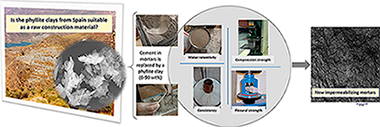
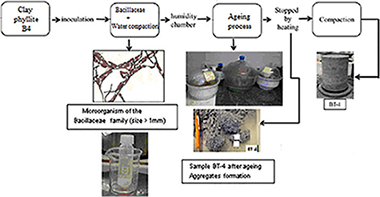
The objective of the present study is to develop a biotechnological tool for a new application of clay phyllites as stabilized materials in linear works replacing chemical stabilizer (e.g. cement or lime) by natural cement, formed by precipitated calcium carbonate generated by microorganisms of the Bacillaceae family (Bacilluspasteurii). Part of the development process conducting a chemical and mineralogical characterization and an examination of physical and hydromechanical properties. The…

Manufacture of sustainable clay ceramic composite with composition SiO2-Al2O3-CaO-K2O materials valuing biomass ash from olive pomace

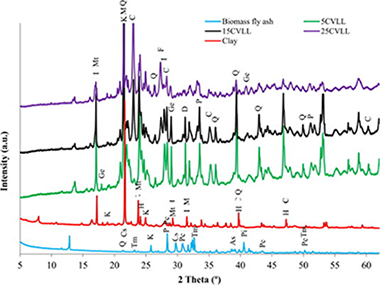
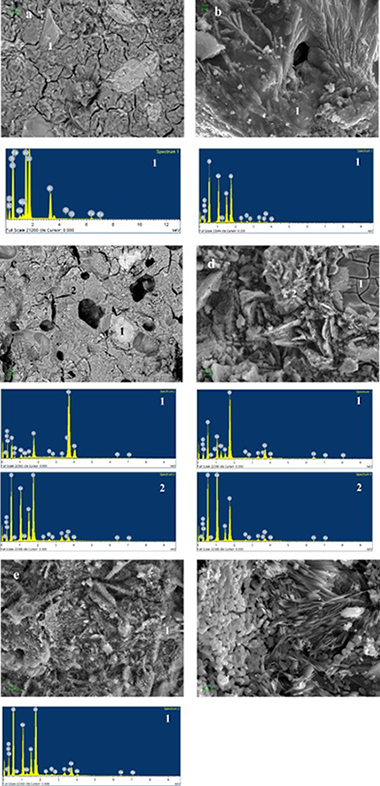
Fly ash is a biomass combustion by-product produced by dragging ash from the base of the furnace. Disposing of ash is a growing economic and environmental burden. Based on physical and chemical properties, fly ash could be used in the manufacture of construction materials. This paper investigates the influence of biomass fly ash from olive…

Biomass fly ash and aluminium industry slags-based geopolymers

Geopolymers are a new class of non-Portland cements produced using an alumino-silicate material and an activating solution, which is mainly composed of sodium or potassium and waterglass to be subsequently cured at relatively low temperatures. Those can be formulated by adding natural minerals, waste and/or industrial by-products. The study investigates the microstructural properties of geopolymers…

An approach to the heating dynamics of residues from greenhouse-crop plant biomass originated by tomatoes (Solanum lycopersicum, L.)

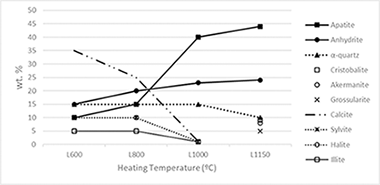
The most representative of greenhouse-crop plant biomass residues of tomatoes (Solanum lycopersicum L.) were selected for this study by using X-ray fluorescence spectrometry (XRF) and X-ray powder diffraction (XRD). The heating dynamics in air in the 600-1150 degrees C range of these residues for the production of renewable energy and the resultant ashes have been…

Vitrification and derived glass-ceramics from mining wastes containing vermiculite and lithium aluminium phosphate

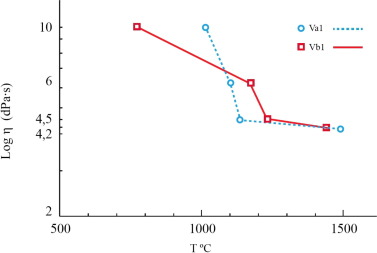
The waste vitrification of abandoned open sky vermiculite deposits has been considered by combining with a natural phosphate mineral residue. Several batches haven been designed from the composition system: Li2O-MgO-Al2O3-P2O5-SiO2 including some Fe2O3 and Fluoride. The resulting glasses are transparent and smooth green coloured, giving rise after TTT treatments to several opal, opaque glass-ceramics with…

The effect of vitreous phase on mullite and mullite-based ceramic composites from kaolin wastes as by-products of mining, sericite clays and kaolinite

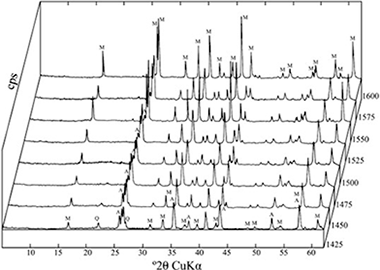
Mullite precursors were prepared using kaolin waste, sericite clay containing kaolinite and industrial kaolin with addition of alumina in a wet medium to synthesize mullite (72 wt% Al2O3 and 28 wt% SiO2). Uniaxial pressed bars of the powdered mullite precursors were fired in the range 1400-1600 degrees C with soaking times 30-120 min. The resultant…

Thermal behaviour of sericite clays as precursors of mullite materials

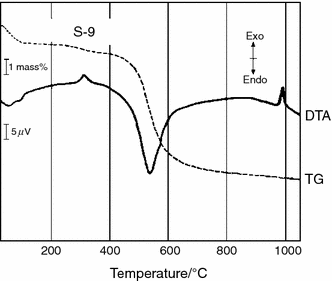
Thermal analysis of some sericite clays, from several deposits in Spain, which are not exploited at this time, has been studied. The samples have been previously characterized by mineralogical and chemical analysis. Sericite clays have interesting properties, with implications in ceramics and advanced materials, in particular concerning the formation of mullite by heating. According to…

Synthesis of vaterite CaCO3 as submicron and nanosized particles using inorganic precursors and sucrose in aqueous medium

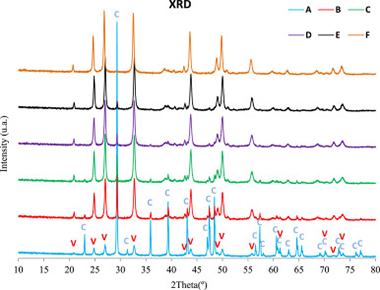
It is reported the synthesis of CaCO3 vaterite as stable nanoparticles and submicron-sized by a simple and relatively rapid procedure. XRD, SEM and FTIR techniques have been used to characterize the precipitated products. The synthesis is based on chemical precipitation of inorganic salt precursors, calcium nitrate tetra hydrate and sodium bicarbonate, and using the disaccharide…