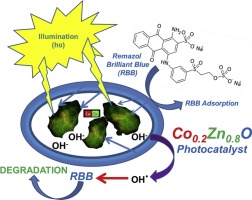
Extraordinary visible photocatalytic activity of a Co0.2Zn0.8O system studied in the Remazol BB oxidation

Nanoparticles of CoxZn1-xO system with a nominal composition of x=0.2 were synthesized by the Solution Combustion Method (SCM). Structural and morphological studies as well as the chemical composition of the material were widely investigated by different techniques. Photocatalytic activity under UV and Visible illumination was studied by means of the Remazol Brilliant Blue dye (RBB)…

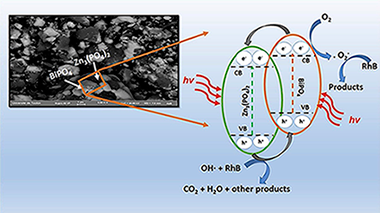
Preparation, characterization and photocatalytic degradation of Rhodamine B dye over a novel Zn3(PO4)2/BiPO4 catalyst

In this work, a facile method was used to synthesize the Zn3(PO4)2/BiPO4 composite photocatalysts with different Bi contents followed by heat treatment at 900 °C for 3 h. The as-prepared samples were studied by a variety of characterization techniques including X-ray diffraction (XRD), Scanning Electron Microscopy (SEM) combined with energy dispersive X-ray diffraction (EDX), Transmission electron microscopy…

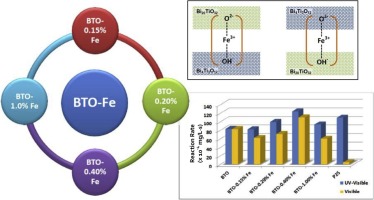
BixTiyOz-Fe multiphase systems with excellent photocatalytic performance in the visible

New photocatalysts based on bismuth titanates doped with iron with outstanding visible photocatalytic activity were prepared by a facile hydrothermal method followed by incipient wetness impregnation. The starting material was composed by three phases; majority of Bi20TiO32 closely interconnected to Bi4Ti3O12 and amorphous TiO2. Fe doping increased the already very high visible activity of the original material.…

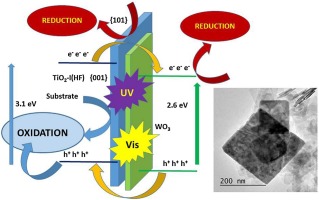
Coupling of WO3 with anatase TiO2 sample with high {001} facet exposition: Effect on the photocatalytic properties

A highly faceted {001} TiO2 catalyst was hydrothermally synthesized by using Ti(IV)-isopropoxide precursor with aqueous HF addition. WO3 was synthesized by following a reported method. Coupled TiO2-WO3 samples were synthesized by adding the corresponding amount of WO3 to fluorinated TiO2 gel followed by a hydrothermal treatment. Additionally the synthesized systems were characterized by using X-ray powder diffraction (XRD), X-ray fluorescence spectrometry (XRF),…

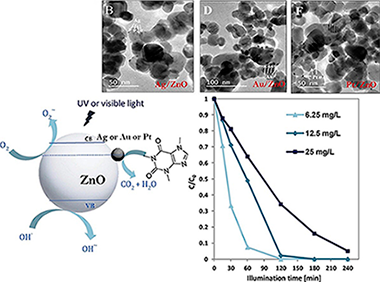
UV and visible-light driven photocatalytic removal of caffeine using ZnO modified with different noble metals (Pt, Ag and Au)

In this work, ZnO photocatalyst was modified with different noble metals (Pt, Ag and Au) through photodeposition method and then characterized by different techniques (XRD, XRF, BET, UV–vis DRS, FESEM, and XPS). The addition of noble metals produces important changes in the light absorption properties with a significant absorbance in the visible region due to…

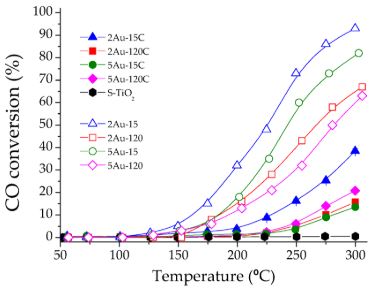
Differences in the Catalytic Behavior of Au-Metalized TiO2 Systems During Phenol Photo-Degradation and CO Oxidation

For this present work, a series of Au-metallized TiO2 catalysts were synthesized and characterized in order to compare their performance in two different catalytic environments: the phenol degradation that occurs during the liquid phase and in the CO oxidation phase, which proceeds the gas phase. The obtained materials were analyzed by different techniques such as XRF,…

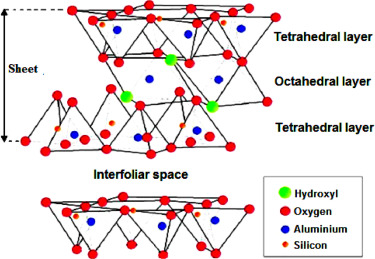
Synthesis of sol-gel pyrophyllite/TiO2 heterostructures: Effect of calcination temperature and methanol washing on photocatalytic activity

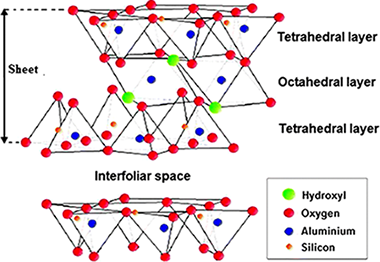
We successfully synthesized an efficient photoactive pyrophyllite/TiO2 heterostructures using a sol-gel route at ambient temperature. The samples were prepared by exfoliation of a pyrophyllite layered-type clay by TiO2. The prepared samples exhibited strong photocatalytic activity for the degradation of phenol. The heterostructure PTi750 (SBET = 16.58 m2/g) calcined at 750 °C, in which the mixed phases of anatase and rutile exist (52.2% anatase/10.7% rutile), showed the highest photocatalytic activity against commercial…

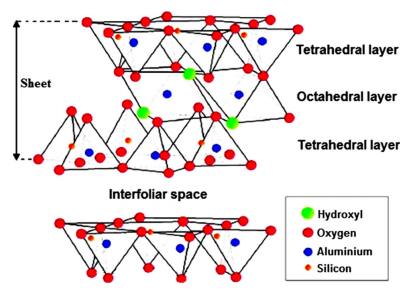
Catalytic Efficiency of Cu-Supported Pyrophyllite in Heterogeneous Catalytic Oxidation of Phenol

The copper-impregnated pyrophyllite (Cu/RC) was prepared and used as catalyst in catalytic wet peroxide oxidation (CWPO) of phenol. The catalyst was prepared by impregnation of copper (2.5 wt%) into pyrophyllite-type clay and characterized by X-ray diffraction, X-ray fluorescence, X-ray photoelectron spectroscopy, Fourier transform infrared spectroscopy, and transmission electron microscopy. The optimum operation conditions for CWPO of…

Mesoporous pyrophyllite–titania nanocomposites: synthesis and activity in phenol photocatalytic degradation

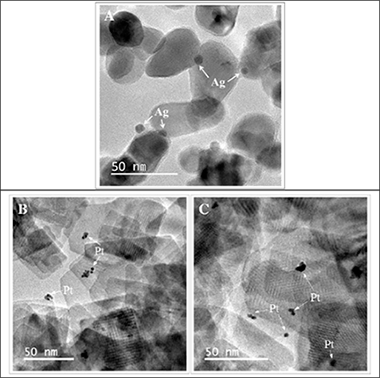
Pyrophyllite–TiO2 nanocomposite PTi750 was successfully synthesized using a sol–gel method at ambient temperature based on exfoliation of the pyrophyllite layered clay by incorporation of the TiO2 precursor titanium(IV) t-butoxide. PTi750 exhibited higher photocatalytic activity in phenol degradation compared with commercial TiO2 Aeroxide P25. Ag-photodeposited PTi750 was more photoactive than PTi750, exhibiting detoxification, total degradation, and good mineralization of polluted…