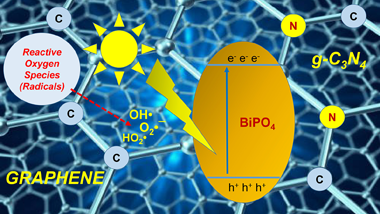
Recent progress on the enhancement of photocatalytic properties of BiPO4 using π–conjugated materials

Semiconductor photocatalysis is regarded as most privileged solution for energy conversion and environmental application. Recently, photocatalysis methods using bismuth-based photocatalysts, such as BiPO4, have been extensively investigated owing to their superior efficacy regarding organic pollutant degradation and their further mineralization into CO2 and H2O. It is well known that BiPO4 monoclinic phase exhibited better photocatalytic…

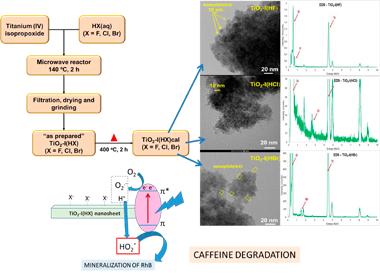
Microwave-assisted sol-gel synthesis of TiO2 in the presence of halogenhydric acids. Characterization and photocatalytic activity

The synthesis of mesoporous TiO2 nanosheets is reported using Ti(IV) Isopropoxide as Ti(IV) precursor. A sol-gel process combined with microwave activation is used. Three different halogenhydric acids (HX), were used to peptise the sol: HF(ac), HCl (ac) and HBr (ac). The three obtained TiO2-I(HX) samples were characterized by XRD, XRF, N2-adsorption, SEM, TEM, DRS and…

Fotocatálisis Heterogénea

Catálisis para el Medioambiente y la Energía Vestibulum ante ipsum primis in faucibus orci luctus et ultrices posuere cubilia commodo tellus rhoncus congue. Etiam vitae felis eget lacus interdum feugiat. Suspendisse aliquam, vulputate magna. Etiam vitae felis eget lacus interdum feugiat. Suspendisse aliquam odio ante, sit amet vulputate magna malesuada idraesent dapibus ultricies odio porta…

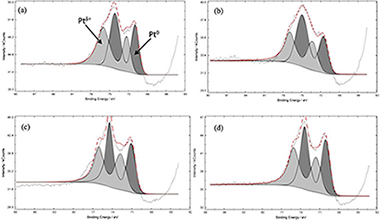
Pt–TiO2–Nb2O5 heterojunction as effective photocatalyst for the degradation of diclofenac and ketoprofen

Pt–TiO2–Nb2O5 heterojunction was synthetized and studied for the photocatalytic removal of diclofenac (DCF) and ketoprofen (KTF) under UV light irradiation. The physical-chemical properties of the prepared catalysts were analysed by different characterization techniques revealing that the lowest platinum nanoparticle size and the better metal distribution was observed in Pt–TiO2–Nb2O5 sample. The Pt–TiO2–Nb2O5 heterojunction possessed the best photocatalytic activity…

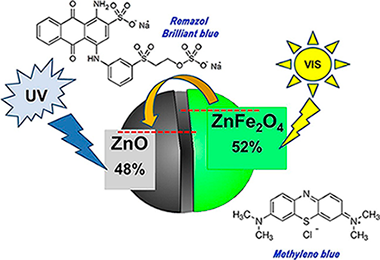
Preparation of ZnFe2O4/ZnO composite: Effect of operational parameters for photocatalytic degradation of dyes under UV and visible illumination

An ZnFe2O4/ZnO composite catalyst was prepared by solution combustion method. In this study, one nominal molar percentage of iron was used in the synthesis, corresponding to 20 % molar relative to ZnO. The samples were characterized by X-ray diffraction (XRD), X-ray photoelectron spectroscopy (XPS), X-ray Fluorescence (XRF), Scanning Electronic Microscopy (SEM), Transmission Electronic Microscopy (TEM)…

Role of Fe(III) in aqueous solution or deposited on ZnO surface in the photoassisted degradation of rhodamine B and caffeine

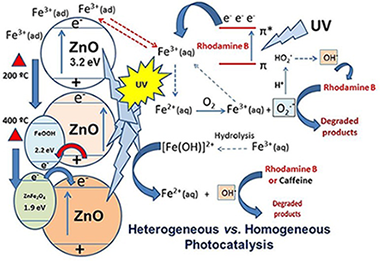
Iron (III) was incorporated, to the surface of a synthesized ZnO, using two nominal molar percentages of Fe (III): 1% and 5% Fe relative to ZnO. Samples dried and calcined at 200 °C and 400 °C for 2 h, were characterized by XRD, XPS, XRF, N2-adsorption-BET and (UV–vis)-DRS. Photocatalytic activities of the catalysts were assessed based on the…

Hybrid ZnO/Ag3PO4 photocatalysts, with low and high phosphate molar percentages

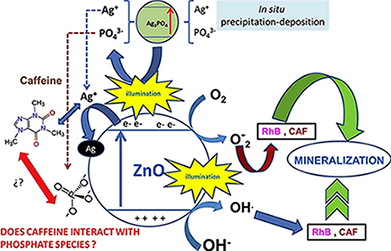
In this work, a previously optimized synthesized ZnO photocatalyst was modified with different molar percentages of Ag3PO4 through a facile in situ precipitation–deposition method and then characterized by different techniques (XRD, XRF, BET, UV–vis DRS, SEM, TEM and XPS). The incorporation of Ag3PO4 produces important changes in the light absorption properties with a significant absorbance in the…

Effect of synthesis pH on the physicochemical properties of a synthesized Bi2WO6 and the type of substrate chosen, in assessing its photo-catalytic activities

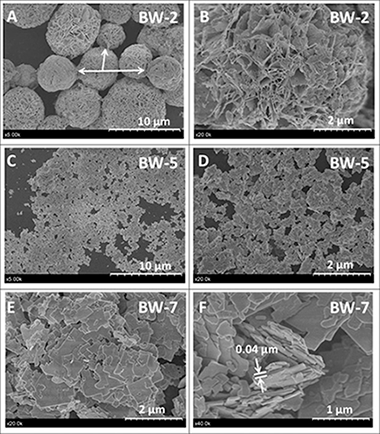
Crystalline orthorhombic Bi2WO6 powders were synthesized by a hydrothermal method from aqueous solutions of Bi(NO3)35H2O and Na2WO42H2O over a range of three selected pH values (2.0, 5.0 and 7.0), using NaOH as precipitating agent. The as-prepared catalysts were characterized by XRD, BET, FE-SEM, TEM, XPS and UV-vis spectroscopy. The effect of pH-synthesis on crystallinity,  morphologies,…

Comparison of the effects generated by the dry-soft grinding and the photodeposition of Au and Pt processes on the visible light absorption and photoactivity of TiO2

The influence of dry-soft grinding and photodeposition of gold (Au) or platinum (Pt) in the improvement of the photoactivity of TiO2 synthesized by an integrated sol-gel and solvothermal method was studied. TiO2 was modified by a dry-soft grinding process in a planetary ball mill (TiO2(G)). Subsequently, Au or Pt particles were photodeposited in both unmodified…