Photocatalytic treatment based on TiO2 for a coal mining drainage

The aim of the present work was to evaluate the effectiveness of a heterogeneous photocatalyst based on TiO2 in the treatment of coal mining drainage which contains a variety of heavy metals and high concentration sulfates and sulfides. The photocatalytic behavior of the commercial reference Sigma Aldrich and the different materials synthesized using the Sol-gel…

Boosting the photocatalytic properties of NaTaO3 by coupling with AgBr

AgBr/NaTaO3 composites, with different molar % of NaTaO3 (Br/NTO(X%)), have been synthesized by simple precipitation methods; bare NaTaO3 was synthesized by hydrothermal procedure, while AgBr was synthesized by a precipitation procedure using cetyl-tri-methyl-ammonium bromide (CTAB) and AgNO3. Samples have been characterized by X-ray diffraction (XRD), N2 adsorption, UV–vis diffuse reflectance spectroscopy (DRS), Fourier-transform infrared spectroscopy (FT-IR), Transmission electron microscopy…

CO2 Methanation over Nickel Catalysts: Support Effects Investigated through Specific Activity and Operando IR Spectroscopy Measurements

Renewed interest in CO2 methanation is due to its role within the framework of the Power-to-Methane processes. While the use of nickel-based catalysts for CO2 methanation is well stablished, the support is being subjected to thorough research due to its complex effects. The objective of this work was the study of the influence of the…

Effect of phenol concentration on the photocatalytic performance of ZnO nanoparticles

BACKGROUND: Phenol and its derivatives are considered toxic compounds, even at low concentrations. Their accumulation in water effluents has become a serious problem that could be resolved by using zinc oxide (ZnO)-based photocatalysts.RESULTS: ZnO nanoparticles were synthesized through the precipitation method, using zinc nitrate and sodium carbonate as reagents. The as-synthesized powder was calcined for…

Effective photocatalytic conversion of formic acid using iron, copper and sulphate doped TiO2

In this paper, the combined addition of copper or iron and sulphate ions onto TiO2 prepared by a simple sol-gel method is studied for formic acid photocatalytic conversion. A wide structural and morphological characterization of the different photocatalysts was performed by X-ray diffraction (XRD), N2-physisorption for BET surface area measurements, scanning and transmission electronic microscopies (SEM…

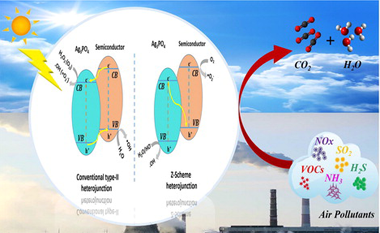
Photocatalytic oxidation of pollutants in gas-phase via Ag3PO4-based semiconductor photocatalysts: Recent progress, new trends, and future perspectives

Air pollution has become a significant challenge for both developing and developed nations. due to its close association with numerous fatal diseases such as cancer, respiratory, heart attack, and brain stroke. Over recent years, heterogeneous semiconductor photocatalysis has emerged as an effective approach to air remediation due to the ease of scale-up, ready application in…

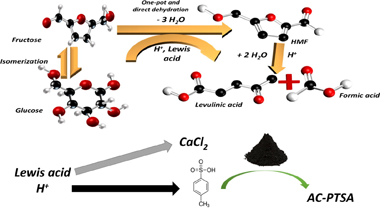
Pursuing efficient systems for glucose transformation to levulinic acid: Homogeneous vs. heterogeneous catalysts and the effect of their co-action

Exploring available catalytic systems to understand their behavior is a must to properly design efficient catalysts aiming to definitively drive biomass from laboratory to industrial scale. Glucose transformation to levulinic acid involves cascade reactions with specific requirements, different active sites in each case and secondary reactions hard to avoid which are intrinsically linked to the…

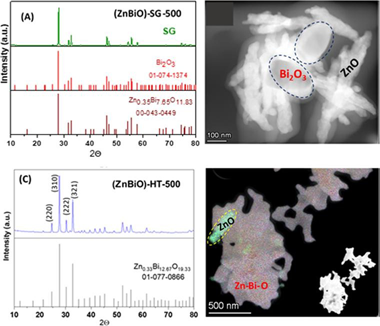
Insights into the structural and physicochemical properties of Zn-Bi-O composites for efficient photodegradation of caffeic acid, rhodamine B and methyl orange

Different Zn-Bi-O composites were synthesized following the starting chemical molar composition of ZnBi2O4 spinels by a sol–gel method, (ZnBiO)-SG, and its subsequent hydrothermal treatment, (ZnBiO)-HT. The acquired X-ray diffractograms after sequential thermal treatments at a programmed rate indicate that both precursors evolved, after calcination at 500 °C, to materials (ZnBiO) with different stoichiometry. The use of different…

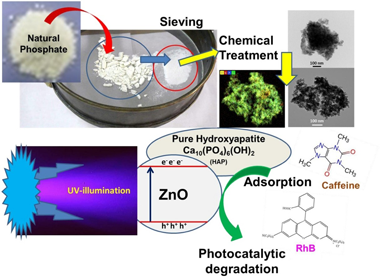
Fast photodegradation of rhodamine B and caffeine using ZnO-hydroxyapatite composites under UV-light illumination

Zinc oxide-hydroxyapatite composites were prepared using wet impregnation method. Firstly, a natural phosphate ore rich in silica and calcium phosphate was sieved to separate silica phase from phosphate phase. Then, through a chemical precipitation method, a pure hydroxyapatite (HAP) was obtained, which was used as a support for ZnO immobilization and applied for the photodegradation…