


Novel heterostructured NaTaO3/WO3 systems with improved photocatalytic properties for water decontamination under UV and Visible illumination

In this work, we present the preparation of NaTaO3/WO3 systems, a broad-bandgap and a narrow-bandgap semiconductor, respectively, for photocatalytic applications. The samples were prepared by two different methods, microwave-assisted and conventional hydrothermal method, with different NaTaO3/WO3 molar ratios. All samples were extensively characterized, and the photocatalytic behavior was studied in the degradation reaction of rhodamine B under…
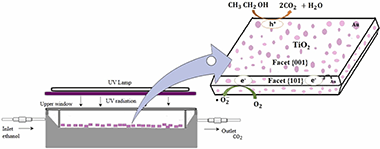
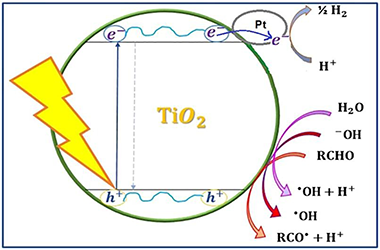
Photocatalytic activity enhancement by noble metal deposition on faceted F-TiO2 synthesised by microwave assisted method. A study of selective oxidation of gas-phase ethanol in a FBPR reactor

In the present work, fluorinated titanium dioxide (TiO2-F) with high exposition of facet {001} was prepared by following a facile and high yield hydrothermal method assisted by microwave. This faceted TiO2 was then modified by Au or Ag deposition at two different metal loadings (0.125 and 0.25 wt%). A wide physicochemical characterisation of the materials was performed.…

Evaluation of Pt/TiO2-Nb2O5 systems in the photocatalytic reforming of glucose for the generation of H2 from industrial effluents

Different Pt-TiO2-Nb2O5 systems were synthesized and studied in the photocatalytic reforming of glucose for the generation of H2. The physicochemical properties of the synthesized photocatalysts were analyzed using different characterization techniques from which it was found that fluoridation and sulphation have different effects on the oxides under study such as a protective effect on the crystalline…

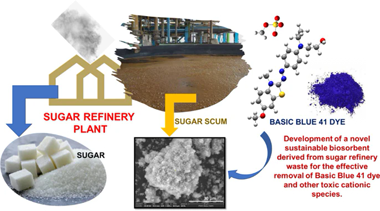
Insights into the physicochemical properties of Sugar Scum as a sustainable biosorbent derived from sugar refinery waste for efficient cationic dye removal

The objective of this study was to determine the ability of sugar scum (SS), an industrial waste, as a novel biosorbent for the removal of Basic Blue 41 (BB 41) from aqueous solutions. The biosorbent was characterized by SEM/EDS, BET, FTIR, and pHpzc measurements, respectively. To reach a maximum adsorption capacity of 26.45 mg.g–1, impacting operational factors…

Ba3(PO4)2 Photocatalyst for Efficient Photocatalytic Application

Barium phosphate (Ba-3(PO4)(2)) is a class of material that has attracted significant attention thanks to its chemical stability and versatility. However, the use of Ba-3(PO4)(2) as a photocatalyst is scarcely reported, and its use as a photocatalyst has yet to be reported. Herein, Ba-3(PO4)(2) nanoflakes synthesis is optimized using sol-gel and hydrothermal methods. The as-prepared Ba-3(PO4)(2) powders are investigated…

Investigating the room- and cryo-milling impact in lignocellulosic biomass and its consequence over pyrolysis and oxidative treatments

The lignocellulosic biomass recalcitrance is the uppermost factor for the utilization of this renewable resource. The development of new pre -treatments, addressed to enhance performance in lignocellulosic biomass conversion into biofuels, fine chemicals, and as potential sources of building blocks for materials, must be focus in two main areas: effectiveness (cost-effective and chemical effective) and…

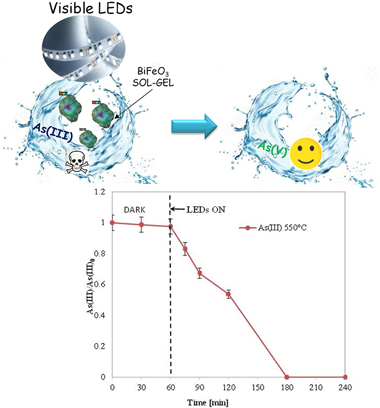
Bismuth ferrite as innovative and efficient photocatalyst for the oxidation of As(III) to As(V) under visible light

The presence of As in drinking water is a problem felt all over the world. In particular, arsenic is present in +3 (As(III)) and +5 (As(V)) oxidation states. However, As(III) is the most toxic and difficult to remove with conventional adsorption processes. A pre-oxidation process is therefore necessary. In this work, we report, for the first time, the…

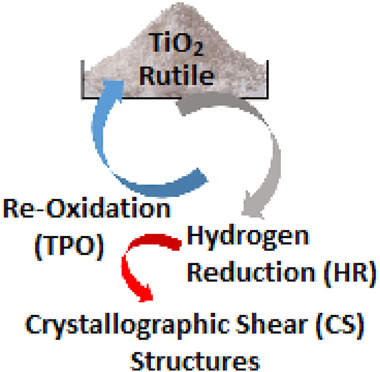
Mechanistic aspects of the reduction of rutile titanium dioxide and its Re-oxidation. Development and destruction of crystallographic shear structures

A model is presented giving the mean dimensions of acicular octadecahedral microcrystallites of a rutile titanium dioxide powder. Reduction at 823 K, in conjunction with ESR, electrical conductivity and controlled re-oxidation has enabled the model to be applied to reduced microcrystallites. At 300 K they contain <0.1% of paramagnetic [Ti3+↑ VO: ↑Ti3+] reduced edge sites and >99.9% of reduced spin-paired [Ti3+↑↓ Ti3+ VO:] sites. These sites are situated…

Effect of Alkaline Salts on Pyrolyzed Solid Wastes in Used Edible Oils: An Attenuated Total Reflectance Analysis of Surface Compounds as a Function of the Temperature

Biochars obtained via the pyrolysis of biomass are very attractive materials from the point of view of their applications and play key roles in the current energy context. The characterization of these carbonaceous materials is crucial to determine their field of application. In this work, the pyrolysis of a non-conventional biomass (solid wastes in used…

ZnO/TiO2 and ZnO/Nb2O5 as effective systems for the treatment of enteric bacteria and commercial dyes

In this study, ZnO/TiO2 and ZnO/Nb2O5 photocatalysts were evaluated in the river pollution remediation and wastewater treatment from textile factories, thus, the target pollutants selected for this study were enteropathogenic bacteria and commercial dyes. The mixed oxide systems were extensively analyzed in order to explore their physicochemical properties. From this analysis, it was found that the coupling of two oxides did not modify the crystallinity of the pristine semiconductors. As a result, XRD Wurtzite phase, hexagonal phase, and anatase phases were identified for ZnO, Nb2O5, and TiO2 photocatalyst, respectively. Using UV-Vis…