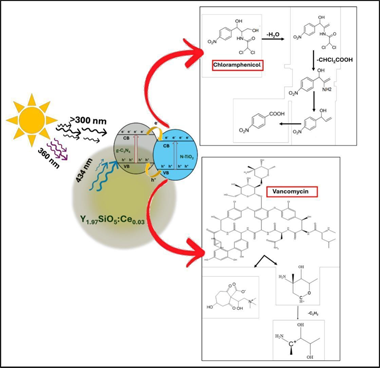
Enhanced photocatalytic degradation of organic pollutants in water by g-C3N4/N-TiO2/Y1.97SiO5:Ce0.03 heterostructure

A novel ternary heterostructure based on g-C3N4/N-TiO2/Y1.97SiO5:Ce-0.03 was synthesized via thermal treatment and evaluated for the photocatalytic degradation of two antibiotic pollutants, chloramphenicol (CAP) and vancomycin (VAN), in aqueous solution. The composite was designed to function as a photoactive platform, in which Ce3+-doped Y2SiO5 acts as an internal light converter, emitting at similar to 430…

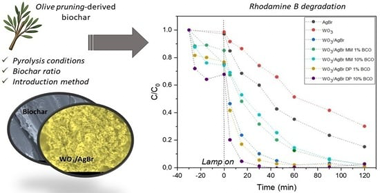
Enhancing the Photocatalytic Performance of WO3/AgBr Composites Through the Incorporation of Olive Waste-Derived Biochar Obtained Under Controlled Pyrolysis Conditions

The integration of biochars into photocatalytic systems to increase their efficiency in the degradation of different pollutants in water has gained attention in recent years. However, systematic studies on optimizing biochar properties for photocatalysis remain limited. This work explores the incorporation of biochar from olive pruning (BCO), produced via CO2 pyrolysis at 800 °C, into WO3/AgBr…

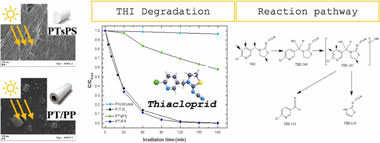
Solar light-driven degradation of thiacloprid by polymer composites based on P-doped TiO2 as photoactive phase: Theoretical and experimental assessment of the reaction mechanism and degradation pathway

In this paper, visible light-activated phosphorus-doped TiO2 (P-TiO2) was used as a photoactive phase to prepare polymer composites for the degradation of the pesticide thiacloprid under direct sunlight irradiation. In particular, a monolithic composite aerogel, consisting of P-TiO2 embedded in syndiotactic polystyrene (PTsPS), and a composite polymer film, consisting of P-TiO2 immobilized on the surface…

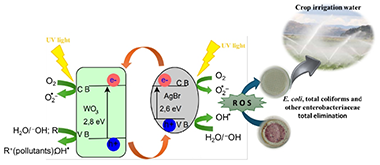
Treatment of Dairy Industry Wastewater and Crop Irrigation Water Using AgBr-Coupled Photocatalysts

This work describes the application of three different AgBr heterojunctions with TiO2, SnO2 and WO3 in the treatment of two water sources: wastewater from a dairy industry facility (WDI) and water from a polluted river (WPR). All heterojunctions were widely characterised, and it was observed that the physicochemical properties of all the coupled materials were similar; however,…

Towards the effective removal of environmental strains of bacteria from real wastewater by heterostructured photocatalysts

Access to clean water is crucial for human health, yet microbial contamination poses significant challenges. This study investigates the effectiveness of novel photocatalytic catalysts: heterostructured TiO2/AgBr and faceted titanium dioxide, for microbial inactivation under ultraviolet and visible light. Both catalysts were synthesized and characterized. Performance was evaluated using real wastewater samples and saline solutions, targeting…

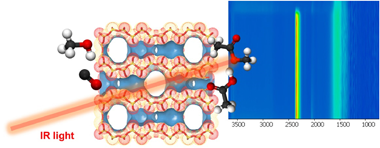
Controlling copper location on exchanged MOR-type aluminosilicate zeolites for methanol carbonylation: In situ/operando IR spectroscopic studies

Replacing homogeneous catalytic processes by heterogeneous routes based on the utilization of solid catalysts is of great interest from an environmental point of view. Owing to their genuine pore structure, zeolites such as mordenites (MOR) have emerged as game-changing materials to enable the heterogenization of catalytic processes including methanol carbonylation. Cu-exchange zeolites take the edge over pristine zeolites, leading to enhanced…

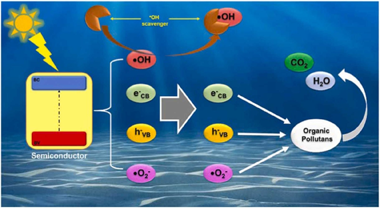
A critical view about use of scavengers for reactive species in heterogeneous photocatalysis

In heterogeneous photocatalysis, different reactive species generated from the excitation of the semiconductor are responsible for the degradation of different contaminants in aqueous solution. In order to evaluate the influence of each of these reactive species on the photocatalysis process, it is common to perform an analysis using different chemical compounds, which (in theory) react…

Levofloxacin Degradation, Antimicrobial Activity Decrease, and Potential for Water Disinfection Using Peroxydisulfate Activation by Ag/TiO2 under Sunlight

Water quality and usability are global concerns due to microbial and chemical pollution resulting from anthropogenic activities. Therefore, strategies for eliminating contaminants are required. In this context, the removal and decrease in antibiotic activity (AA) associated with levofloxacin (LEV), using TiO2 and Ag/TiO2 catalysts, with and without sunlight and peroxydisulfate, was evaluated. Additionally, the disinfection capacity of…