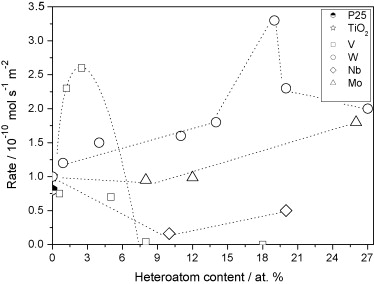
Cationic (V, Mo, Nb, W) doping of TiO2–anatase: A real alternative for visible light-driven photocatalysts

In this article we investigate the structure–activity link of anatase-type Ti–M (M = V, Mo, Nb, and W) mixed oxides used for toluene photo-oxidation under sunlight-type excitation. An analysis of the local and long-range structural and electronic characteristics of the mixed oxides show that only structurally highly homogeneous anatase-type oxides with electronic properties exclusively leading…

Functionalisation versus mineralisation of some N-heterocyclic compounds upon UV-illumination in the presence of un-doped and iron-doped TiO2 photocatalysts

Heterogeneous photocatalytic oxidation of some N-heterocyclic compounds (4-picoline, and 6- and 8-methylquinoline) in oxygenated solvents (water or acetonitrile), containing dispersed photocatalyst (un-doped or iron-doped titanium dioxide), was investigated under UV-illumination in a photochemical reactor. This work aimed to correlate experimental parameters such as structural aspects of the substrates, photocatalyst chemical and surface properties. illumination times,…

Functionalisation versus mineralisation of some N-heterocyclic compounds upon UV-illumination in the presence of un-doped and iron-doped TiO2 photocatalysts

Heterogeneous photocatalytic oxidation of some N-heterocyclic compounds (4-picoline, and 6- and 8-methylquinoline) in oxygenated solvents (water or acetonitrile), containing dispersed photocatalyst (un-doped or iron-doped titanium dioxide), was investigated under UV-illumination in a photochemical reactor. This work aimed to correlate experimental parameters such as structural aspects of the substrates, photocatalyst chemical and surface properties. illumination times,…

Degradation of phenylmercury compounds by heterogeneous photocatalysis over alpha-Fe2O3

We report here on the degradation of diphenylmercury and monophenylmercury chloride in air-equilibrated aqueous solutions by heterogeneous photocatalysis over alpha-Fe2O3. Photocatalysis proceeded via sequential de-phenylation leaving inorganic mercury. GC-MS analysis of the products revealed that photocatalytic degradation involved hydroxylation of the phenyl rings. Mechanistic features and photocatalytic activity were also studied and are reported upon.

Titania-supported gold catalysts: Comparison between the photochemical phenol oxidation and gaseous CO oxidation performances

A series of Au/TiO2 samples with gold loadings ranging from 0.11% to 1.26% have been prepared by deposition-precipitation, characterised by means of XRD, S-BET, XRF, TEM, XPS and DR UV-Vis techniques and tested in the gaseous CO oxidation and photocatalytic degradation of phenol in aqueous media. The catalytic performances of the solids on both reactions…

Degradation of phenylmercury compounds by heterogeneous photocatalysis over alpha-Fe2O3

We report here on the degradation of diphenylmercury and monophenylmercury chloride in air-equilibrated aqueous solutions by heterogeneous photocatalysis over alpha-Fe2O3. Photocatalysis proceeded via sequential de-phenylation leaving inorganic mercury. GC-MS analysis of the products revealed that photocatalytic degradation involved hydroxylation of the phenyl rings. Mechanistic features and photocatalytic activity were also studied and are reported upon.

Modification of the photocatalytic activity of Pd/TiO2 and Zn/TiO2 systems through different oxidative and reductive calcination treatments

Two different solids consisting of Pd or Zn-containing titania systems (metal/titanium nominal ratio of 1%) were submitted to diverse oxidative and reductive calcination treatments and tested for gas-phase selective photooxidation of 2-propanol. As regards the Pd system, reduction at low temperature (<= 500 degrees) resulted in a gradual increase in catalytic activity which was ascribed…