


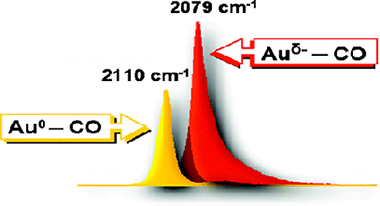
A Au/SiO2 sample was prepared by ammonia-assisted grafting using HAuCl4 as a gold precursor. Gold on the sample evacuated at 673 K is essentially in metallic form: adsorption of CO at 100 K results in formation of Au0-CO species (IR band at 2122 cm-1 shifting to 2103 cm-1 at high coverage). Coadsorption of CO and O2 even at ambient temperature leads to creation of Auδ+ sites and oxidation of CO. On the contrary, increase of the contact time between CO and the sample leads to a gradual reduction of Au0 to Au δ- species. The process is slightly favored by the presence of water and strongly enhanced in the presence of hydrogen. Back oxidation of Auδ- to Au0 and to Auδ+ occurs in the presence of oxygen. The Auδ- sites strongly adsorb CO and form different interconverting carbonyls observed in the 2080-2050 cm -1 region. On the basis of adsorption of CO-13CO and CO-13C18O isotopic mixtures, it is concluded that all Auδ–CO species are linear, and probably ordered structures are formed. Intensity transfer phenomena are nicely monitored during adsorption of CO isotopic mixtures. The eventual role of negatively charged gold in catalysis is discussed.