


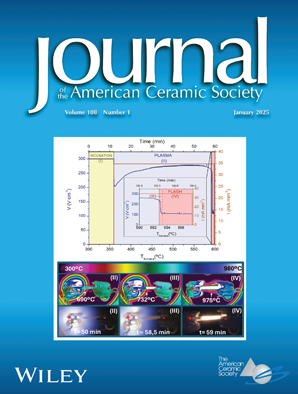
The first demonstration of plasma-flash sintering (PFS) is presented in this work. PFS is performed under a low-pressure atmosphere that consecutively generates plasma and flash events. It is shown, by using several combined characterization techniques, that PFS stabilizes metastable phases on the surface of the material, which may be partially, but not solely, attributed to the generation of oxygen vacancies, and induces the absorption of ionized species, if a reactive atmosphere is employed. Even though additional research is required to understand the fundamentals of PFS, it is evidenced its potential to be used as a material surface engineering tool, which may widen the technological capabilities of flash sintering.
Cover Photograph: Plasma-Flash Sintering (PFS) is performed under low-pressure atmosphere that consecutively generates plasma and flash events. This study shows that PFS stabilizes metastable phases on the surface of the material and enables absorption of ionized species generated in the plasma, giving this technique potential to be used as a surface engineering tool. Read more in the rapid communication in this issue,