


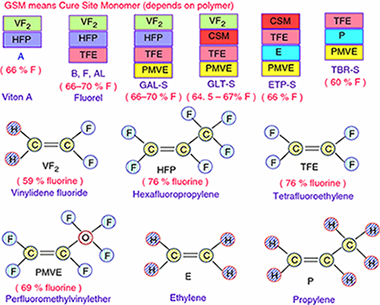
In this paper, the thermal degradation properties of Viton A and Fluorel are investigated by both isoconversional and combined kinetic analysis methods using non-isothermal thermogravimetry technique. It has been found that the heating rate has little affect on the degradation residue of Fluorel and Viton A, where around 1.3% char was formed for Fluorel and 3.5% for Viton A. Different from the literature, the decomposition of Viton A should be considered as an overlapped dehydrofluorination and carbon chain scission process, with activation energy of 214 +/- 11 and 268 +/- 13 kJ mol(-1), respectively. The effect of dehydrofluorination on degradation of Fluorel is not so significant due to low content of H, and hence, it could be considered as a single-step mechanism with average activation energy of 264 +/- 14 kJ mol(-1). The thermal stability of Fluorel is much better than that of Viton A, and the predicted half-life is around 218 min for Fluorel and 49 min for Viton A at 420 A degrees C, which are consistent with experimental values. If using a single-step model as in the literature for Viton A, its half-life at 420 A degrees C would be underestimated for > 20%.