


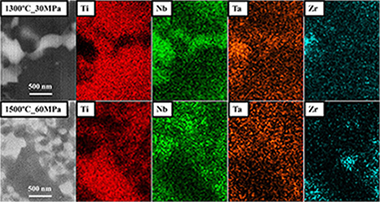
An original (beta + gamma)-TiNbTa material was manufactured by an optimised powder metallurgy treatment, based on a mechanical alloying (MA) synthesis, carried out at low energy, and a subsequently field assisted consolidation technique, the pulsed electric current sintering (PECS). The successful development of this (beta + gamma)-TiNbTa material was possible by the optimisation of the milling time (60 h) for the MA synthesis and the load and sintering temperature for the PECS (30 MPa and 1500 degrees C), as key parameters. Furthermore, the selected heating and cooling rates were 500 degrees C min(-1) and free cooling, respectively, to help maintain the lowest particle size and to avoid the formation of a detrimental high stiffness, hexagonal (alpha)-Ti alloy. All these optimised experimental conditions enabled the production of a full densified (beta + gamma)-TiNbTa material, with partially nanostructured areas and two TiNbTa alloys, with a body centred cubic (beta) and a novel face-centred cubic (gamma) structures. The interesting microstructural characteristics gives the material high hardness and mechanical strength that, together with the known low elastic modulus for the beta-Ti alloys, makes them suitable for their use as potential biomaterials for bone replacement implants.