Engineering TNZT-coated titanium scaffolds via additive manufacturing and magnetron sputtering for bone tissue replacement

The biomechanical behavior and corrosion phenomena of porous metallic implants can compromise their clinical success. This work proposes modifying the surface of c.p. titanium scaffolds manufactured by 3D-printing (Direct Ink Writing), depositing a thin film of a beta-Ti alloy (Ti-35Nb-7Zr-5Ta) using the High-Power Impulse Magnetron Sputtering (HiPIMS) technique. The versatility of this technique has enabled…

Microstructural and mechanical properties of TiN/CrN and TiSiN/CrN multilayer coatings deposited in an industrial-scale HiPIMS system: Effect of the Si incorporation

Surface engineering through the deposition of advanced coatings, particularly multilayer coatings has gained significant interest for enhancing the performance of coated parts. The incorporation of Si into TiN coatings has shown promise for improving hardness, oxidation resistance, and thermal stability, while high-power impulse magnetron sputtering (HiPIMS) has emerged as a technique to deposit coatings with…

Setting a comprehensive strategy to face the runback icing phenomena

The development of anti-icing robust surfaces is a hot topic nowadays and particularly crucial in the aeronautics or wind energy sectors as ice accretion can compromise safety and power generation efficiency. However, the current performance of most anti-icing strategies has been proven insufficient for such demanding applications, particularly in large unprotected zones, which located downstream…

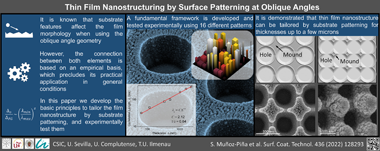
Thin film nanostructuring at oblique angles by substrate patterning

It is demonstrated that, besides classical nanocolumnar arrays, the oblique angle geometry induces the growth of singular structures in the nanoscale when using wisely designed patterned substrates. Well-ordered array of crosses, cylindrical nanorods or hole structures arranged in square or hexagonal regular geometries are reported as examples, among others. The fundamental framework connecting substrate topography…

Influence of helium incorporation on growth process and properties of aluminum thin films deposited by DC magnetron sputtering

The effect of helium content on the morphology, crystallinity, and composition of aluminum films was investigated by depositing He-loaded Al films onto Si substrates via direct current (DC) magnetron sputtering in different Ar/He plasma mixtures. Three different plasma regimes were identified depending on the percentage of He in the gas phase. For a low He to total gas ratio…

Nb-C thin films prepared by DC-MS and HiPIMS: Synthesis, structure, and tribomechanical properties

Nanostructured Nb-C thin films were prepared by direct current magnetron sputtering (DC-MS) and high-power impulse magnetron sputtering (HiPIMS). The films were characterized in depth by X-ray diffraction (XRD), grazing incidence X-ray diffraction, scanning electron microscopy, atomic force microscopy, electron probe microanalysis, and Raman spectroscopy. The mechanical properties were measured by nanoindentation, and the tribological properties…

Effect of Al content on the hardness and thermal stability study of AlTiN and AlTiBN coatings deposited by HiPIMS

The microstructure, mechanical properties and thermal stability of AT(x)Ti(1-x)N and Al1Ti1-xBN coatings grown by reactive high-power impulse magnetron sputtering (HiPIMS) have been analyzed as a function of Al/(Al + Ti) ratio (x) between 0.5 and 0.8. The coatings were predominantly formed by a face-centered cubic Ti(Al)N crystalline phase, both with and without B, even for…