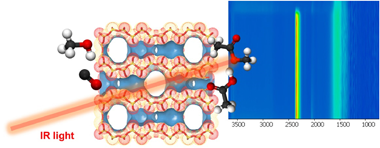
Controlling copper location on exchanged MOR-type aluminosilicate zeolites for methanol carbonylation: In situ/operando IR spectroscopic studies

Replacing homogeneous catalytic processes by heterogeneous routes based on the utilization of solid catalysts is of great interest from an environmental point of view. Owing to their genuine pore structure, zeolites such as mordenites (MOR) have emerged as game-changing materials to enable the heterogenization of catalytic processes including methanol carbonylation. Cu-exchange zeolites take the edge over pristine zeolites, leading to enhanced…

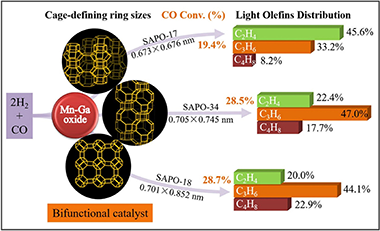
Effect of zeolite topological structure in bifunctional catalyst on direct conversion of syngas to light olefins

Bifunctional catalyst composed of metal oxide and zeolite (OX-ZEO) is a promising strategy for the direct conversion of syngas to light olefins (STO), where the structure of zeolite plays a vital role in determining the selectivity of product. Herein, three kinds of silicoaluminophosphate zeolites with different topological structures, i.e., the ERI(SP17), AEI(SP18) and CHA(SP34), were…

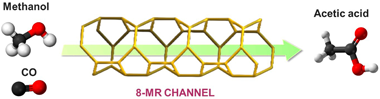
Impact of topology framework of microporous solids on methanol carbonylation: An operando DRIFTS-MS study

Methanol carbonylation was evaluated over heterogeneous catalysts based on Cu-exchanged zeolitic materials with different topology: Cu@MOR, Cu@FER, and Cu@ZSM-5. Despite the similar Si/Al ratios, it is crucial to acknowledge that the acid strength is influenced by the framework topology, as supported by the NH3-TPD results. This, along with other characterization techniques allowed us to estimate…

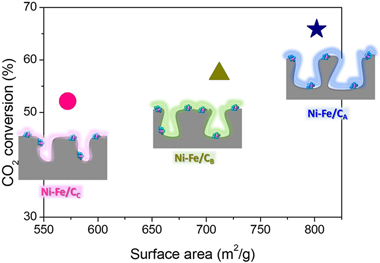
Assessing the impact of textural properties in Ni-Fe catalysts for CO2 methanation performance

In heterogeneous catalysis, the benefits of employing adequate textural properties on the catalytic performances are usually stated. Nevertheless, the quantification of the extent of improvement is not an easy task since variations on the catalysts’ specific areas and pore structures might involve modifications on a number of other surface catalytic features. This study establishes the impact of the…

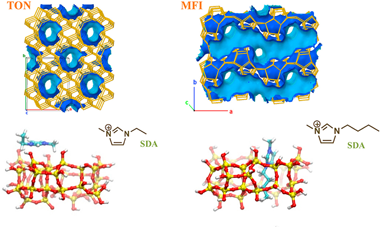
How a small modification in the imidazolium-based SDA can determine the zeolite structure? MFI vs. TON

The present study proposes an important contribution to the understanding of ionic liquid role as structure directing agent for zeolite synthesis. A series of imidazolium based ionic liquids are used for this purpose. While the anionic counterpart influences the micellar organization during the synthesis, the imidazolium cation clearly directs the structure to one or another…

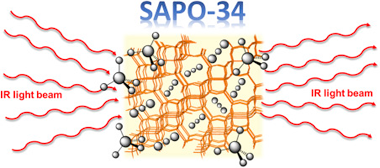
Time-resolved operando DRIFTS-MS study of the moisture tolerance of small-pore SAPO-34 molecular sieves during CH4/CO2 separation

This study pretends to evaluate and understand the effect of moisture presence during CO2/CH4 separation on small-pore SAPO-34 molecular sieves. Two SAPO-34 samples with different physicochemical properties (composition, crystal size and texture) were prepared by hydrothermal synthesis using either one or a mixture of two templates. Transient operando DRIFTS-MS measurements revealed that the sample’s hydrophobic…

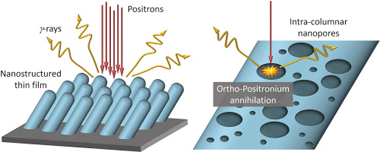
Positron annihilation analysis of nanopores and growth mechanism of oblique angle evaporated TiO2 and SiO2 thin films and multilayers

The nano-porosity embedded into the tilted and separated nanocolumns characteristic of the microstructure of evaporated thin films at oblique angles has been critically assessed by various variants of the positron annihilation spectroscopy. This technique represents a powerful tool for the analysis of porosity, defects and internal interfaces of materials, and has been applied to different…

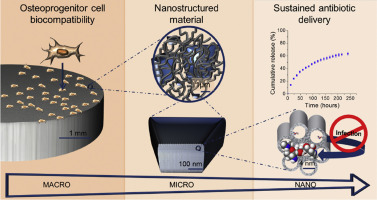
Nanostructured hybrid device mimicking bone extracellular matrix as local and sustained antibiotic delivery system

A fluidic permeable and stable in wet media, MBG-NfGel, device consisting of a mesoporous ceramic embodied in a nanofibrillar biodegradable polymer has been processed using appropriate thermally induced phase separation (TIPS) processing variables of 5.4% (wt/v) gelatin in 50/50 water/ethanol (v/v) ratio. The device comprises high surface area mesoporous bioactive glass (MBG) microparticles within a…

In vitro stimulation of MC3T3-E1cells and sustained drug delivery by a hierarchical nanostructured SiO2-CaO-P2O5 scaffold

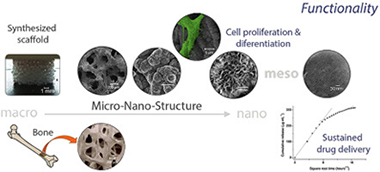
A hierarchical scaffold, SP1_h_HA, consisting of a biomimetic nano-hydroxyapatite surface coating growth onto a reticulated structure having a nano-organized porous texture was fabricated and functionally studied in vitro using osteoprogenitor cells. Three scaffold materials (designated as SP0_l, SP0_h and SP1_h) were also prepared through modifications of the processing variables as control materials. The scaffolds were characterized showing well-interconnected…