Microwave-Assisted Synthesis of Biocompatible Europium-Doped Calcium Hydroxyapatite and Fluoroapatite Luminescent Nanospindles Functionalized with Poly(acrylic acid)

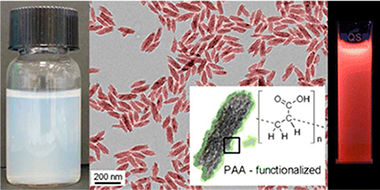
Europium-doped calcium hydroxyapatite and fluoroapatite nanophosphors functionalized with poly(acrylic acid) (PAA) have been synthesized through a one-pot microwave-assisted hydrothermal method from aqueous basic solutions containing calcium nitrate, sodium phosphate monobasic, and PAA, as well as sodium fluoride in the case of the fluoroapatite particles. In both cases a spindlelike morphology was obtained, resulting from an…

Following the Wetting of One-Dimensional Photoactive Surfaces

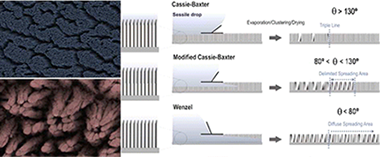
This article aims toward a full description of the wetting conversion from superhydrophobicity to superhydrophilicity under illumination with UV light of high-density ZnO nanorods surfaces by (i) following the evolution of the clusters and superstructures formed by the nanocarpet effect as a function of the water contact angle (WCA); (ii) characterization of the superhydrophobic and…

Integration of Gold Nanoparticles in Optical Resonators

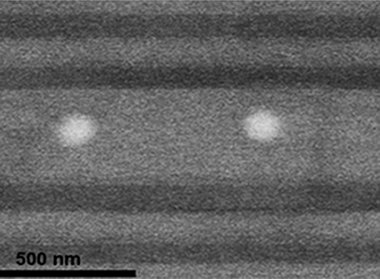
The optical absorption of one-dimensional photonic crystal based resonators containing different types of gold nanoparticles is controllably modified by means of the interplay between planar optical cavity modes and localized surface plasmons. Spin-casting of metal oxide nanoparticle suspensions was used to build multilayered photonic structures that host (silica-coated) gold nanorods and spheres. Strong reinforcement and…

Synthetic high-charge organomica: Effect of the layer charge and alkyl chain length on the structure of the adsorbed surfactants

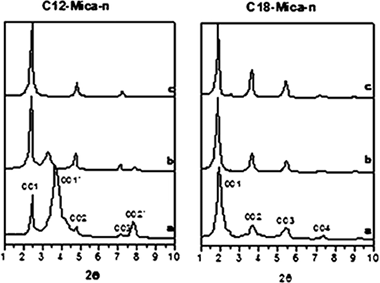
A family of organomicas was synthesized using synthetic swelling micas with high layer charge (NanSi8-nAlnMg6F4O20 center dot XH2O, where n = 2, 3, and 4) exchanged with dodecylammonium and octadecylammonium cations. The molecular arrangement of the surfactant was elucidated on the basis on XRD patterns and DTA. The ordering conformation of the surfactant molecules into…

Formation of organo-highly charged mica

The interlayer space of the highly charged synthetic Na-Mica-4 can be modified by ion-exchange reactions involving the exchange of inorganic Na + cations by surfactant molecules, which results in the formation of an organophilic interlayer space. The swelling and structural properties of this highly charged mica upon intercalation with n-alkylammonium (RNH 3) + cations with…

Aspects of heterogeneous enantioselective catalysis by metals

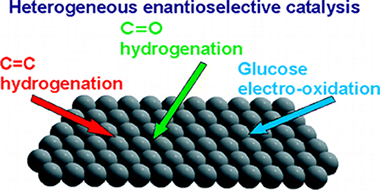
Some aspects of metal-catalyzed heterogeneous enantioselective reactions are reviewed with specific reference to four different systems where the phenomena that control enantioselection appear to be very different. In the case of glucose electro-oxidation, it is clear that any intrinsic chirality present at the metal surface plays a vital role. With α-keto hydrogenation, achiral surfaces modified…

Novel guests for porous columnar thin films: The switchable perchlorinated trityl radical derivatives

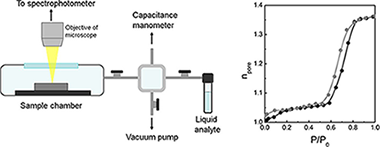
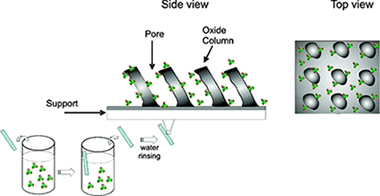
TiO2 and SiO2 porous thin films consisting of tilted nanocolumns prepared by glancing angle evaporation (GLAD) have been infiltrated with guest derivatives belonging to the family of perchlorinated trityl radicals, novel guest molecules presenting an open-shell electronic configuration associated with paramagnetism, fluorescence, and electroactivity. The main driving forces for infiltration from aqueous solutions of the…

Bulk and Adsorbed Monolayer Phase Behavior of Binary Mixtures of Undecanoic Acid and Undecylamine: Catanionic Monolayers

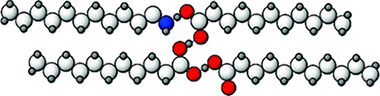
Differential scanning calorimetry (DSC) and X-ray powder diffraction (PXRD) have been used to determine the phase behavior of the binary mixtures of undecanoic acid (A) and undecylamine (B) in the bulk. In addition, we report DSC data that indicates very similar behavior for the solid monolayers of these materials adsorbed on the surface of graphite.…

Wetting Properties of Polycrystalline TiO2 Surfaces: A Scaling Approach to the Roughness Factors

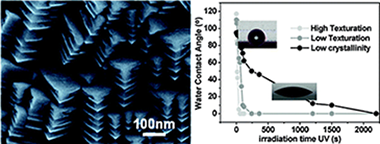
This work presents a thorough study on the wettability of polycrystalline anatase TiO2 thin films prepared at 250 degrees C in a microwave plasma enhanced chemical vapor deposition (MW-PECVD) reactor with Ar/O-2 plasmas. Anatase polycrystalline thin films with different microstructures, textures, and surface roughness were obtained as a function of their thickness. The water contact…