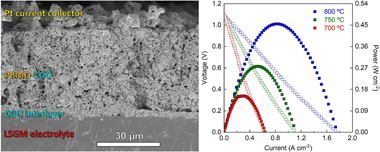
Optimising anode supported BaZr1-xYxO3-δ electrolytes for solid oxide fuel cells: Microstructure, phase evolution and residual stresses analysis

Yttrium-doped BaZrO3 is a promising electrolyte for intermediate-temperature protonic ceramic fuel cells. In the anode-supported configuration, a slurry containing the electrolyte is deposited on the surface of a calcined porous anode and sintered. Differences in sintering behaviour and thermal expansion coefficients for the anode and electrolyte result in elastic residual stresses that can impact the long-term…

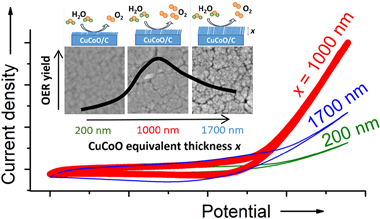
Active sites and optimization of mixed copper-cobalt oxide anodes for anion exchange membrane water electrolysis

The optimization of the catalysts incorporated to the electrodes for anion exchange membrane water electmlysers is a key issue to maximize their performance through the improvement of the oxygen evolution reaction (OER) yield. In this work, we show that the modification of the microstructure and the chemical properties of a mixed copper-cobalt oxide anode may…

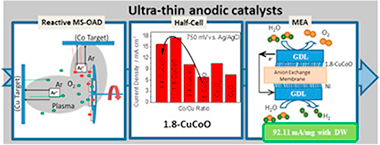
CuxCo3-xO4 ultra-thin film as efficient anodic catalysts for anion exchange membrane water electrolysers

CuxCo3-xO4 ultra-thin films, deposited by magnetron sputtering at oblique angles have been used as anodic catalysts in anion exchange membrane water electrolysers. It has been demonstrated that the used deposition procedure provides porous and amorphous samples with a strict control of the total catalyst load and Co/Cu ratio. Electrocatalytic tests showed a maximum performance for…

CuxCo3-xO4 ultra-thin film as efficient anodic catalysts for anion exchange membrane water electrolysers

CuxCo3-xO4 ultra-thin films, deposited by magnetron sputtering at oblique angles have been used as anodic catalysts in anion exchange membrane water electrolysers. It has been demonstrated that the used deposition procedure provides porous and amorphous samples with a strict control of the total catalyst load and Co/Cu ratio. Electrocatalytic tests showed a maximum performance for…

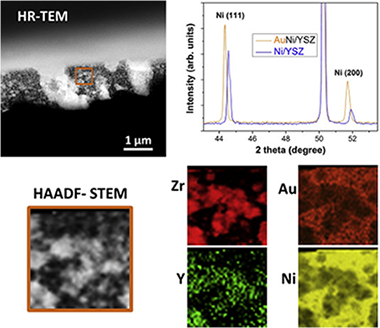
High performance novel gadolinium doped ceria/yttria stabilized zirconia/nickel layered and hybrid thin film anodes for application in solid oxide fuel cells

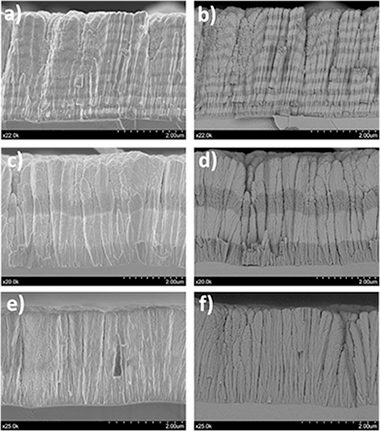
Magnetron sputtering under oblique angle deposition was used to produce Ni-containing ultra thin film anodes comprising alternating layers of,gadolinium doped ceria (GDC) and yttria stabilized zirconia (YSZ) of either 200 nm or 1000 nm thickness. The evolution of film structure from initial deposition, through calcination and final reduction was examined by XRD, SEM, TEM and…

Synthesis, characterization and performance of robust poison resistant ultrathin film yttria stabilized zirconia nickel anodes for application in solid electrolyte fuel cells

We report on the synthesis of undoped ∼5 μm YSZ-Ni porous thin films prepared by reactive pulsed DC magnetron sputtering at an oblique angle of incidence. Pre-calcination of the amorphous unmodified precursor layers followed by reduction produces a film consisting of uniformly distributed tilted columnar aggregates having extensive three-phase boundaries and favorable gas diffusion characteristics. Similarly…

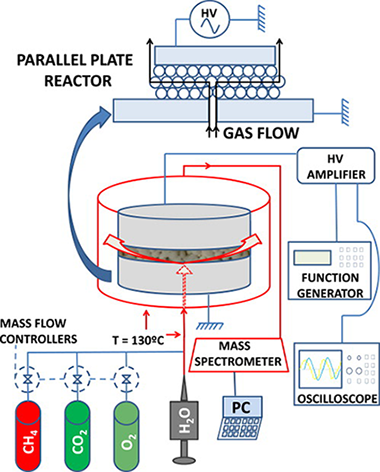
Plasma reforming of methane in a tunable ferroelectric packed-bed dielectric barrier discharge reactor

In a tunable circular parallel plate dielectric barrier discharge reactor with pellets of a ferroelectric material separating the electrodes we investigate the plasma reforming of methane trying to maximize both the reaction yield and the energetic efficiency of the process. The geometrical configuration of the reactor (gap between electrodes, active electrode area) and the ferroelectric…

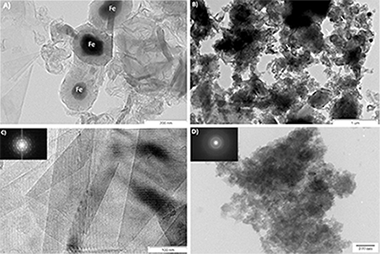
Effect of catalytic graphitization on the electrochemical behavior of wood derived carbons for use in supercapacitors

Porous graphitic carbons were successfully obtained from wood precursors through pyrolysis using a transition metal as catalyst. Once the catalyst is removed, the resulting material mimics the microstructure of the wood and presents high surface area, open and interconnected porosity and large pore volume, high crystallinity and good electrical conductivity, making these carbons interesting for…