Unraveling Thermal Interactions in Lanthanide-Doped Phosphors: A Frequency-Domain Analysis Approach

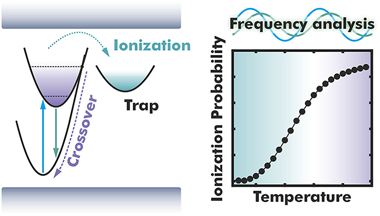
Ensuring the thermal reliability of luminescent materials is a key requirement for next-generation lighting, display, and sensing technologies. The intricate interplay of thermal crossover and thermal ionization in lanthanide-doped phosphors often obscures their individual contributions. We present a frequency-domain photoluminescence analysis that disentangles these competing mechanisms. Using single crystals of SrAl2O4:Eu2+,Dy3+ (SAO:Eu,Dy) and (Gd0.33Y0.67)3Al2.4Ga2.6O12:Ce3+,Cr3+ (GYAGG:Ce,Cr)…

Synergetic Near- and Far-Field Plasmonic Effects for Optimal All-Perovskite Tandem Solar Cells with Maximized Infrared Absorption

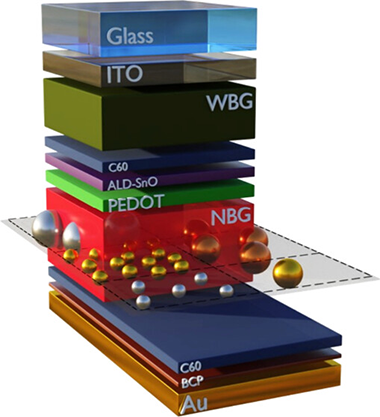
The efficiency and reliability of perovskite solar cells have rapidly increased in conjunction with the proposition of advanced single-junction and multi-junction designs that allow light harvesting to be maximized. However, Sn-based compositions required for optimized all-perovskite tandem devices have reduced absorption coefficients, as opposed to pure Pb perovskites. To overcome this, we investigate near- and…

Effect of Spatial Inhomogeneity on Quantum Trapping

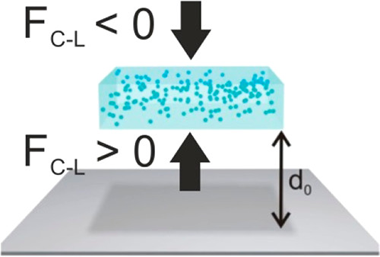
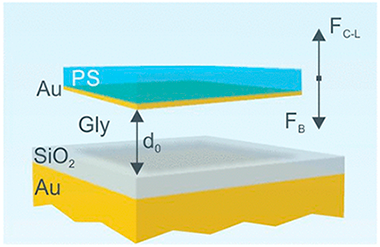
An object that is immersed in afluid and approaching a substrate mayfind apotential energy minimum at a certain distance due to the balance between attractive and repulsiveCasimir-Lifshitz forces, a phenomenon referred to as quantum trapping. This equilibriumdepends on the relative values of the dielectric functions of the materials involved. Herein, westudy quantum trapping effects in…

Paving the Way to Establish Protocols: Modeling and Predicting Mechanochemical Reactions

Parametrization of mechanochemical reactions, or relating the evolution of the reaction progress to the supplied input power, is required both to establish protocols and to gain insight into mechanochemical reactions. Thus, results could be compared, replicated, or scaled up even under different milling conditions, enlarging the domains of application of mechanochemistry. Here, we propose a…

Disentangling Electron–Phonon Coupling and Thermal Expansion Effects in the Band Gap Renormalization of Perovskite Nanocrystals

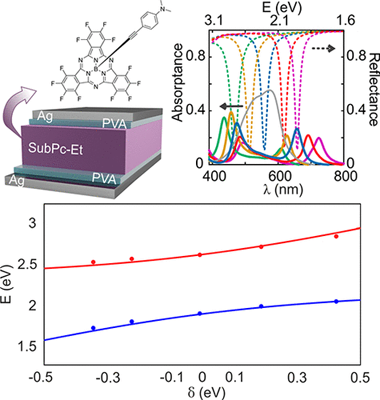
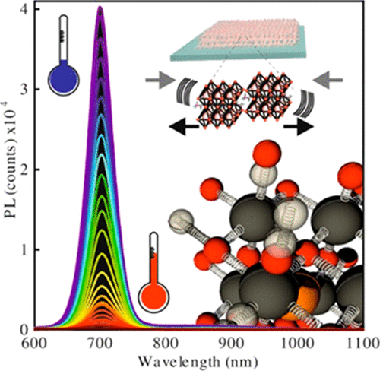
The complex electron–phonon interaction occurring in bulk lead halide perovskites gives rise to anomalous temperature dependences, like the widening of the electronic band gap as temperature increases. However, possible confinement effects on the electron–phonon coupling in the nanocrystalline version of these materials remain unexplored. Herein, we study the temperature (ranging from 80 K to ambient)…

Local Rearrangement of the Iodide Defect Structure Determines the Phase Segregation Effect in Mixed-Halide Perovskites

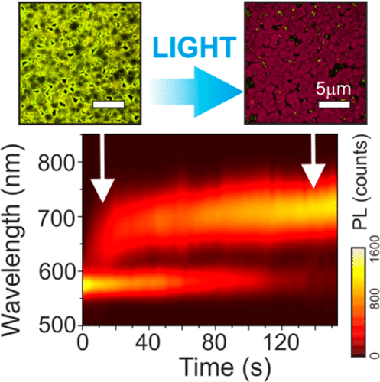
Mixed-halide perovskites represent a particularly relevant case within the family of lead-halide perovskites. Beyond their technological relevance for a variety of optoelectronic devices, photoinduced structural changes characteristic of this type of material lead to extreme photophysical changes that are currently the subject of intense debate. Herein we show that the conspicuous photoinduced phase segregation characteristic…

Casimir-Lifshitz Force Based Optical Resonators

We theoretically investigate the building of optical resonators based on the levitation properties of thin films subjected to strong repulsive Casimir-Lifshitz forces when immersed in an adequate medium and confronted with a planar substrate. We propose a design in which cavities supporting high Q-factor optical modes at visible frequencies can be achieved by means of…

Origin of Light-Induced Photophysical Effects in Organic Metal Halide Perovskites in the Presence of Oxygen

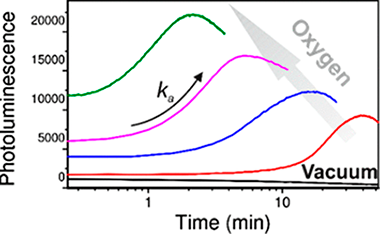
Herein we present a combined study of the evolution of both the photoluminescence (PL) and the surface chemical structure of organic metal halide perovskites as the environmental oxygen pressure rises from ultrahigh vacuum up to a few thousandths of an atmosphere. Analyzing the changes occurring at the semiconductor surface upon photoexcitation under a controlled oxygen…

The Role of Metal Halide Perovskites in Next-Generation Lighting Devices

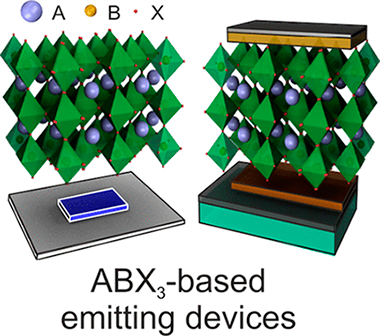
The development of smart illumination sources represents a central challenge for current technology. In this context, the quest for novel materials that enable efficient light generation is essential. Metal halide compounds with perovskite crystalline structure (ABX(3)) have gained tremendous interest in the last five years since they come as easy-to-prepare high performance semiconductors. Perovskite absorbers…