Bimetallic PdAu catalysts for formic acid dehydrogenation

A series of monometallic and bimetallic palladium gold catalyst were prepared and studied for the formic acid dehydrogenation reaction. Different Pd/Au compositions were employed (PdxAu100-x, where x = 25; 50 and 75) and their impact on alloy structure, particle size and dispersion was evaluated. Active phase composition and reaction parameters such as temperature, formic acid…

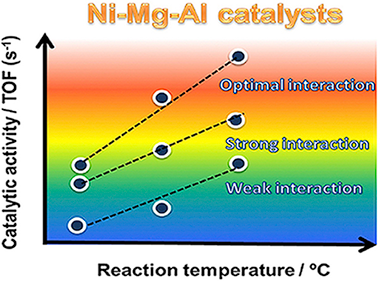
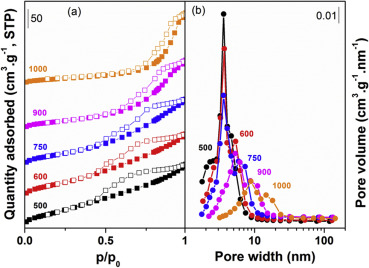
Influence of the preparation method in the metal-support interaction and reducibility of Ni-Mg-Al based catalysts for methane steam reforming

Ni-Mg-Al based catalysts were prepared using different preparation methods (impregnation, impregnation-coprecipitation and coprecipitation) and tested in steam reforming of methane. The differences observed in catalytic activity were directly correlated to the physicochemical properties and the different degree of Ni-Mg-Al interaction. The reducibility results showed that the catalyst prepared by the impregnation-coprecipitation method presented the most…

Nickel catalyst with outstanding activity in the DRM reaction prepared by high temperature calcination treatment

The catalytic performance of some Ni-Ce/Al2O3 catalytic systems (11 wt.% Ni and 3 wt.% Ce) were checked after being submitted to different calcination and reduction treatments. It was found that, the reduced Ni-Ce/Al2O3 catalysts were more active and stable in the dry reforming reaction of methane than thecorresponding not-reduced catalysts. This high activity was initially connected with the smaller size of pre-reduced Ni species, which at the same time leads on to the formation of filamentous…

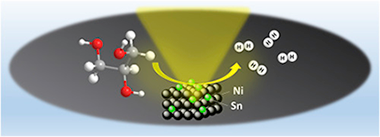
Promoting effect of Sn on supported Ni catalyst during steam reforming of glycerol

The promoting effect of Sn on the catalytic performance of supported Ni catalyst in the reaction of glycerol steam reforming was studied. The physico-chemical properties of the prepared samples were investigated by X-ray fluorescence (XRF), BET surface area, in situ X-ray diffraction (XRD), laser Raman spectroscopy, X-ray photoelectron spectroscopy (XPS), scanning electron microscopy (SEM) and temperature-programmed oxidation…

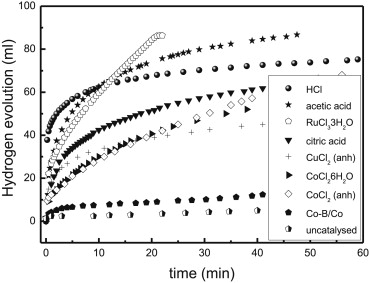
Hydrogen production through sodium borohydride ethanolysis

In this work, sodium borohydride (SB) ethanolysis was explored for the first time as a method to generate hydrogen for Polymer Exchange Membrane Fuel Cells. Ethanolysis by-product was characterized by Fourier Transform Infrared Spectroscopy, X-Ray Diffraction, and Nuclear Magnetic Resonance. Metal and acid catalysts were tested. RuCl3 center dot 3H(2)O was the best metal catalyst.…

Catalytic screening of Au/CeO2-MOx/Al2O3 catalysts (M = La, Ni, Cu, Fe, Cr, Y) in the CO-PrOx reaction

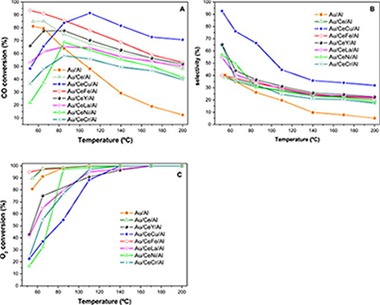
In this work, a series of Au/CeO2-MOx/Al2O3 catalysts has been prepared and evaluated in the PrOx reaction. Within the series of dopants Fe and Cu containing samples enhanced the catalytic performance of the parent Au/CeO2/Al2O3 catalyst being copper the most efficient promoter. For both samples an enhanced oxygen storage capacity (OSC) is registered and accounts…

Influence of the acid–base properties over NiSn/MgO–Al2O3 catalysts in the hydrogen production from glycerol steam reforming

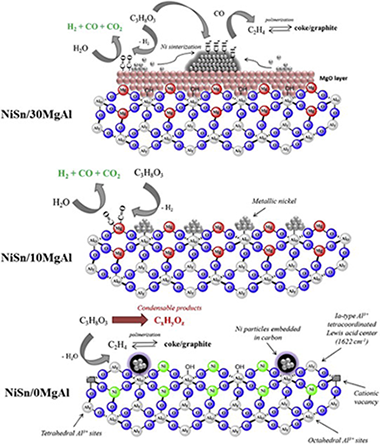
In this work we have investigated the hydrogen production from glycerol steam reforming. The effect of the acid-base properties was evaluated using four catalysts based in an alloy Ni-Sn as active phase supported over (Upsilon)-Al2O3 with different content in MgO, varying between 0 and 30 wt.% The incorporation of MgO results in the formation of…

Hydrogen production using Pt-loaded TiO2 photocatalysts

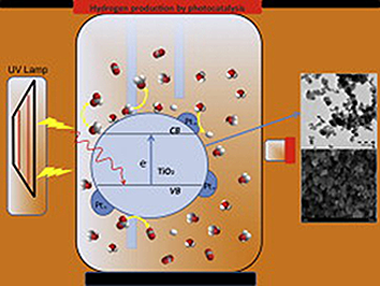
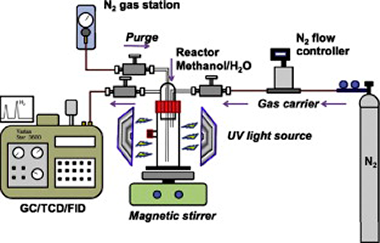
A series of synthesised TiO2-based and commercial photocatalysts were modified by Pt photodeposition and a study made of their photocatalytic activity in hydrogen production. The modified commercial photocatalysts were Evonik P25, Kronos vlp7000 and Hombikat UV-100, and the other modified photocatalysts were synthesised by our group using sol–gel and sol–gel hydrothermal processes (SG400, SG750 and…

Steam reforming of methanol over supported Ni and Ni–Sn nanoparticles

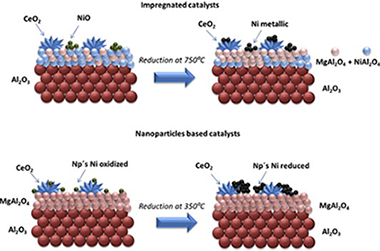
The influence of the synthesis method and Sn addition on Ni/CeO2–MgO–Al2O3 catalyst is correlated to its catalytic behavior in the reaction of methanol steam reforming. The catalysts prepared by impregnation method are compared to samples obtained by deposition of previously obtained nanoparticles by the polyol method. X-ray diffraction (XRD), specific surface area measurements and H2-temperature…

Efficient and affordable hydrogen production by water photo-splitting using TiO2-based photocatalysts

TiO2-based photocatalyst materials were synthesized through a sol–gel method, followed either by: (1) hydrothermal treatment (150 °C/24 h), or (2) heat treatment (calcination) in a temperature range between 400 and 900 °C. The resulting materials were characterized through BET, XRD, TEM, FTIR, RAMAN, laser diffraction and UV–Vis Diffuse Reflectance Spectroscopy. Photoactivity of the various materials…