Water-soluble silver nanoparticles stabilized by amino acid-derived N-heterocyclic carbenes: synthesis, properties and theoretical study of the nucleation process

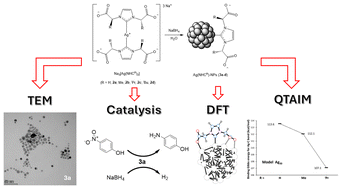
Silver nanoparticles stabilized by amino acid-derived N-heterocyclic carbenes, denoted as Ag(NHCR)-NPs (R = H, 3a; Me, 3b; iPr, 3c; and iBu, 3d), were synthesized by reducing the parent complexes Na3[Ag(NHCR)2] (2a-d) with NaBH4 under appropriate reaction conditions. The stability of the aqueous AgNP solutions was found to depend strongly on the presence of the NHC…

Sodium lanthanide tungstate-based nanoparticles as bimodal probes for T1-T2 magnetic resonance imaging and X-ray computed tomography

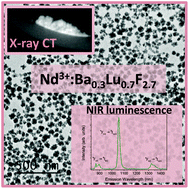
  Magnetic resonance imaging (MRI) is one of the most commonly used imaging techniques for diagnosis in clinics. Often, magnetically-active substances, called contrast agents (CAs), have to be used, which increase contrast by shortening the longitudinal (T1) (resulting in signal enhancement in T1-weighted images) and/or transverse (T2) (resulting in signal decay in T2-weighted images) relaxation…

New insights for valorization of polyolefins/light alkanes: catalytic dehydrogenation of n-alkanes by immobilized pincer-iridium complexes

This scientific review delves into the innovative realm of polyolefins/light alkanes valorization through their catalytic dehydrogenation employing pincer-ligated iridium organometallic complexes. These widely studied catalysts exhibit outstanding properties, although the intrinsic characteristics of homogeneous catalysis (such as challenging product–catalyst separation, poor applicability to continuous-flow processes and low recyclability) limit their activity and industrial application, as…

NaY(MoO4)(2)-based nanoparticles: synthesis, luminescence and photocatalytic properties

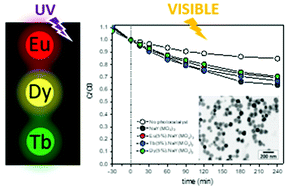
Abstract We report on a novel synthesis method, which produces NaY(MoO4)(2) nanoparticles having an almost spherical shape and hydrophilic character. The procedure is also suitable for the preparation of NaY(MoO4)(2)-based nanophosphors by doping this host with lanthanide cations (Eu3+, Tb3+ and Dy3+), which, under UV illumination, exhibit intense luminescence whose color is determined by the…

Europium-doped NaGd(WO4)(2) nanophosphors: synthesis, luminescence and their coating with fluorescein for pH sensing

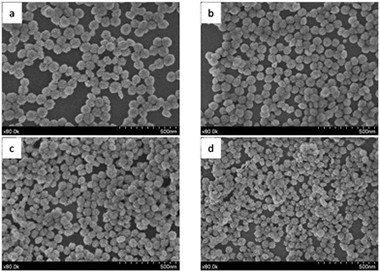
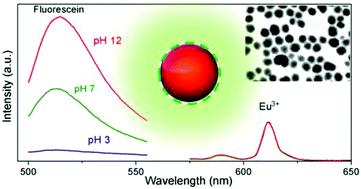
Uniform Eu-doped NaGd(WO4)(2) nanophosphors with a spherical shape have been synthesized for the first time by using a wet chemistry method based on a homogeneous precipitation process at low temperature (120 degrees C) in ethylene glycol/water mixtures. The obtained nanoparticles crystallized into the tetragonal structure and presented polycrystalline character. The europium content in such phosphors…

Multifunctional Eu-doped NaGd(MoO4)(2) nanoparticles functionalized with poly(L-lysine) for optical and MRI imaging

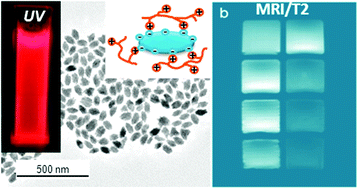
A method for the synthesis of non-aggregated and highly uniform Eu3+ doped NaGd(MoO4)(2) nanoparticles is reported for the first time. The obtained particles present tetragonal structure, ellipsoidal shape and their size can be varied by adjusting the experimental synthesis parameters. These nanoparticles, which were coated with citrate anions and functionalised with PLL, have also been…

A study of the optical properties of metal-doped polyoxotitanium cages and the relationship to metal-doped titania

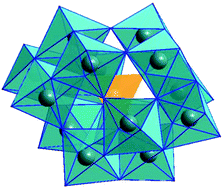
To what extent the presence of transition metal ions can affect the optical properties of structurally well-defined, metal-doped polyoxotitanium (POT) cages is a key question in respect to how closely these species model technologically important metal-doped TiO2. This also has direct implications to the potential applications of these organically-soluble inorganic cages as photocatalytic redox systems…

Exalted photocatalytic activity of tetragonal BiVO4 by Er3+ doping through a luminescence cooperative mechanism

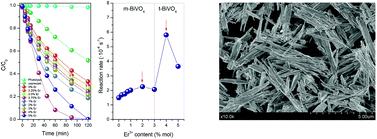
Er-doped BiVO4 are synthesized by means of a surfactant free microwave assisted hydrothermal method having good photoactivities under sun-like excitation for the degradation of methylene blue. From the structural and morphological characterization, it has been stated that the presence of Er3+ induces a slight stabilization of the tetragonal phase, probably due to its incorporation in…