Incorporation of a Metal Catalyst for the Ammonia Synthesis in a Ferroelectric Packed-Bed Plasma Reactor: Does It Really Matter?

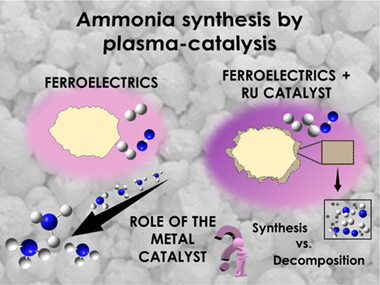
Plasma-catalysis has been proposed as a potential alternative for the synthesis of ammonia. Studies in this area focus on the reaction mechanisms and the apparent synergy existing between processes occurring in the plasma phase and on the surface of the catalytic material. In the present study, we approach this problem using a parallel-plate packed-bed reactor…

Zinc Polyaleuritate Ionomer Coatings as a Sustainable, Alternative Technology for Bisphenol A-Free Metal Packaging

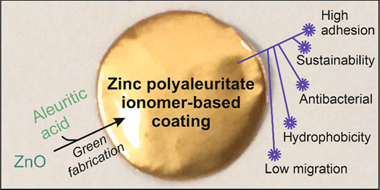
Sustainable coatings for metal food packaging were prepared from ZnO nanoparticles (obtained by the thermal decomposition of zinc acetate) and a naturally occurring polyhydroxylated fatty acid named aleuritic (or 9,10,16-trihydroxy-hexadecanoic) acid. Both components reacted, originating under specific conditions zinc polyaleuritate ionomers. The polymerization of aleuritic acid into polyaleuritate by a solvent-free, melt polycondensation reaction was…

Stepping toward Efficient Microreactors for CO2 Methanation: 3D-Printed Gyroid Geometry

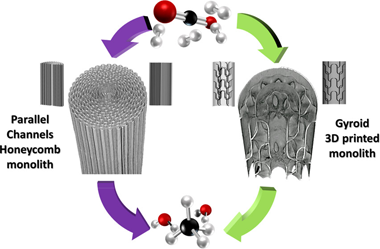
This work presents a comparative study toward the development of efficient microreactors based on three-dimensional (3D)-printed structures. Thus, the study evaluates the influence of the metal substrate geometry on the performance of structured catalysts for the CO2 methanation reaction. For this purpose, the 0.5%Ru-15%Ni/MgAl2O4 catalyst is washcoated over two different micromonolithic metal substrates: a conventional…

Unraveling Discharge and Surface Mechanisms in Plasma-Assisted Ammonia Reactions

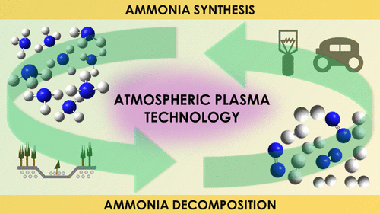
Current studies on ammonia synthesis by means of atmospheric pressure plasmas respond to the urgent need of developing less environmentally aggressive processes than the conventional Haber-Bosch catalytic reaction. Herein, we systematically study the plasma synthesis of ammonia and the much less investigated reverse reaction (decomposition of ammonia into nitrogen and hydrogen). Besides analyzing the efficiency…

Sustainable Fabrication of Plant Cuticle-Like Packaging Films from Tomato Pomace Agro-Waste, Beeswax, and Alginate

Plant cuticles have been used as models to produce hydrophobic films composed of sodium alginate, the fatty acid fraction of tomato pomace agrowaste, and beeswax. The fabrication process consisted of the blending of components in green solvents (water and ethanol) and a subsequent thermal treatment (150 degrees C, 8 h) to polymerize unsaturated and polyhydroxylated…

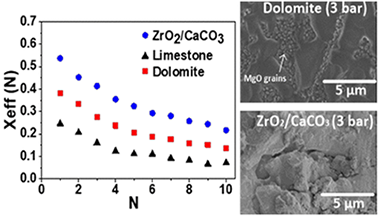
Pressure Effect on the Multicycle Activity of Natural Carbonates and a Ca/Zr Composite for Energy Storage of Concentrated Solar Power

This work is focused on the use of the Calcium-Looping process (CaL) in Concentrated Solar Power (CSP) plants for Thermochemical Energy Storage (TCES). Cheap, abundant and nontoxic natural carbonate minerals, such as limestone and dolomite, can be employed in this application to store energy through the cyclic calcination/carbonation of CaCO3. In a recent work, a…

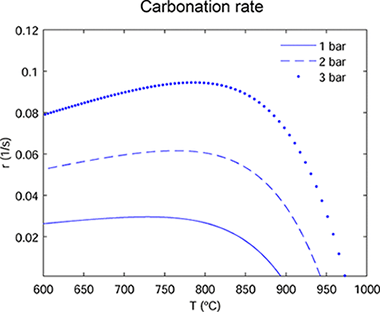
Carbonation of Limestone Derived CaO for Thermochemical Energy Storage: From Kinetics to Process Integration in Concentrating Solar Plants

Thermochemical energy storage (TCES) is considered as a promising technology to accomplish high energy storage efficiency in concentrating solar power (CSP) plants. Among the various possibilities, the calcium-looping (CaL) process, based on the reversible calcination–carbonation of CaCO3 stands as a main candidate due to the high energy density achievable and the extremely low price, nontoxicity, and…

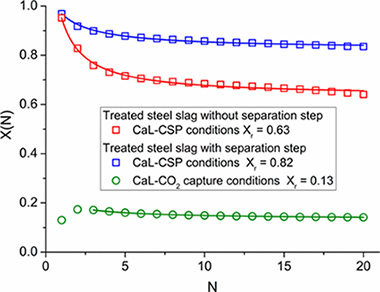
Large-Scale Storage of Concentrated Solar Power from Industrial Waste

Deep penetration of renewable energies into the grid relies on the development of large-scale energy storage technologies using cheap, abundant, and nontoxic materials. Concentrated solar power (CSP) is particularly suitable to massively store thermal energy for dispatchable electricity generation. This is currently accomplished in a few demonstration plants by using molten salts albeit in a…