


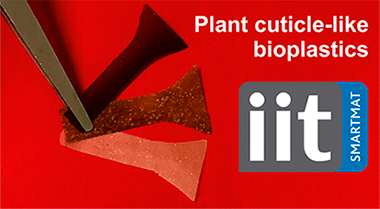
Plant cuticles have been used as models to produce hydrophobic films composed of sodium alginate, the fatty acid fraction of tomato pomace agrowaste, and beeswax. The fabrication process consisted of the blending of components in green solvents (water and ethanol) and a subsequent thermal treatment (150 degrees C, 8 h) to polymerize unsaturated and polyhydroxylated fatty acids from tomato pomace. When sodium alginate and tomato pomace fatty acids were blended, free-standing films were obtained. These films were characterized to evaluate their morphological (SEM), chemical (solid-state NMR, ATR-FTIR), mechanical (tensile tests), thermal (TGA), and hydrodynamic (water contact angle, uptake, and permeability) properties. A comparison between nonpolymerized and polymerized samples was carried out, revealing that the thermal treatment represents a sustainable route to create structured, composite networks of both components. Finally, beeswax was added to the blend with the same amounts of sodium alginate and tomato pomace fatty acids. The presence of the wax improved the hydrophobicity and the mechanical and water barrier properties as well as decreased the water uptake. These results indicate that polymerized plant cuticle-like films have valuable potential for packaging applications.