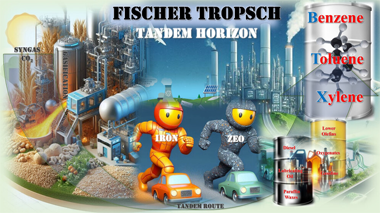
Redefining the Symphony of Light Aromatic Synthesis Beyond Fossil Fuels: A Journey Navigating through a Fe-Based/HZSM-5 Tandem Route for Syngas Conversion

The escalating concerns about traditional reliance on fossil fuels and environmental issues associated with their exploitation have spurred efforts to explore eco-friendly alternative processes. Since then, in an era where the imperative for renewable practices is paramount, the aromatic synthesis industry has embarked on a journey to diversify its feedstock portfolio, offering a transformative pathway…

Enroute to the Carbon-Neutrality Goals via the Targeted Development of Ammonia as a Potential Nitrogen-Based Energy Carrier

The reliance of a future carbon-free horizon is strongly aligned with the long-term energy storage avenues which are completely derived from renewable energy resources. Ammonia with its high energy content and density can perform as a decent candidate for buffering the short-term storage options. However, the current NH3 production majorly feeding the current huge desire for…

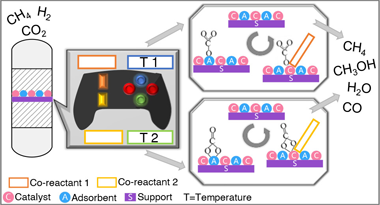
The Need for Flexible Chemical Synthesis and How Dual-Function Materials Can Pave the Way

Since climate change keeps escalating, it is imperativethat theincreasing CO2 emissions be combated. Over recent years,research efforts have been aiming for the design and optimizationof materials for CO2 capture and conversion to enable acircular economy. The uncertainties in the energy sector and the variationsin supply and demand place an additional burden on the commercializationand implementation…

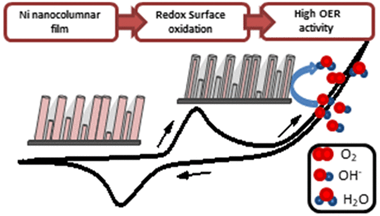
Chemistry and Electrocatalytic Activity of Nanostructured Nickel Electrodes for Water Electrolysis

Herein we have developed nanostructured nickel-based electrode films for anion exchange membrane water electrolysis (AEMWE). The electrodes were prepared by magnetron sputtering (MS) in an oblique angle configuration and under various conditions aimed at preparing metallic, oxide, or oxyhydroxide films. Their electrochemical analysis has been complemented with a thorough physicochemical characterization to determine the effect…

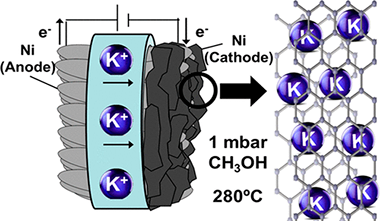
Graphene Formation Mechanism by the Electrochemical Promotion of a Ni Catalyst

In this work, we show that multilayer graphene forms by methanol decomposition at 280 degrees C on an electrochemically promoted nickel catalyst film supported on a K-beta Al2O3 solid electrolyte. In operando near ambient pressure photoemission spectroscopy and electrochemical measurements have shown that polarizing negatively the Ni electrode induces the electrochemical reduction and migration of…

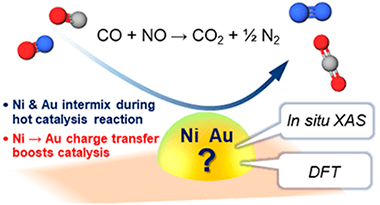
Comprehensive Experimental and Theoretical Study of the CO plus NO Reaction Catalyzed by Au/Ni Nanoparticles

The catalytic and structural properties of five different nanoparticle catalysts with varying Au/Ni composition were studied by six different methods, including in situ X-ray absorption spectroscopy and density functional theory (DFT) calculations. The as-prepared materials contained substantial amounts of residual capping agent arising from the commonly used synthetic procedure. Thorough removal of this material by…

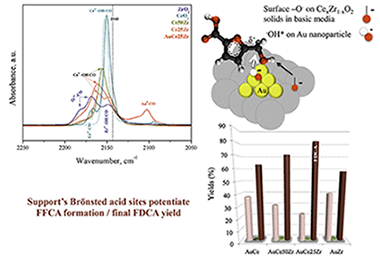
Understanding the Role of the Acid Sites in 5-Hydroxymethylfurfural Oxidation to 2,5-Furandicarboxylic Acid Reaction over Gold Catalysts: Surface Investigation on CexZr1-xO2 Compounds

A series of CexZr1-xO2 supports with different Ce/Zr molar ratios were utilized for the preparation of gold catalyst used in the selective oxidation of 5-hydroxymethyl-2-furfural to 2,5-furandicarboxylic acid. The used method of gold deposition allows the preparation of gold particles with homogeneous size and shape distribution, a formulation very useful for studies dedicated to revealing…

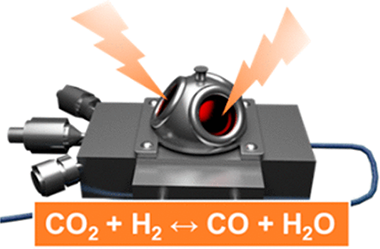
Unravelling the Role of Oxygen Vacancies in the Mechanism of the Reverse Water-Gas Shift Reaction by Operando DRIFTS and Ultraviolet-Visible Spectroscopy

The reaction mechanism of the reverse water gas shift (RWGS) reaction was investigated using two commercial gold-based catalysts supported on Al2O3 and TiO2. The surface species formed during the reaction and reaction mechanisms were elucidated by transient and steady-state operando DRIFTS studies. It was revealed that RWGS reaction over Au/Al2O3 proceeds through the formation of…

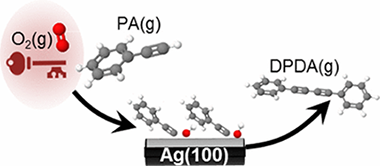
Critical Role of Oxygen in Silver-Catalyzed Glaser-Hay Coupling on Ag(100) under Vacuum and in Solution on Ag Particles

The essential role of oxygen in enabling heterogeneously catalyzed Glaser–Hay coupling of phenylacetylene on Ag(100) was elucidated by STM, laboratory and synchrotron photoemission, and DFT calculations. In the absence of coadsorbed oxygen, phenylacetylene formed well-ordered dense overlayers which, with increasing temperature, desorbed without reaction. In striking contrast, even at 120 K, the presence of oxygen…