Advanced CataLysts for H2-free hydrodeoxygenation – a rEVolutionary approach Enabling pRactical biomass upgrading to bioFUEL

The transition to low-carbon fuels is critical for a sustainable future. Despite their potential, current biomass-to-biofuel technologies mainly rely on high-pressure hydrogen – an expensive resource and difficult to handle. The ERC-funded CLEVER-FUEL project plans to develop a novel process to produce deoxygenated hydrocarbons – important biofuel components – using water as the hydrogen source…

Renewable methanol-based synthetic multifuel production

Europe’s green transition is slowed by the fact that renewables cannot easily replace the fuels that aviation, transport, and heavy industry still depend on. As fossil supplies become geopolitically risky and environmentally untenable, the question is not how to generate clean energy, but how to store and move it. The EU-funded METHCESFUEL aims to offer…

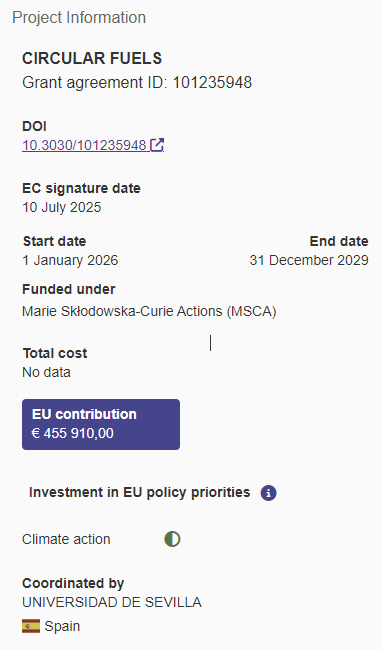
Innovative Biowaste Valorisation: Advancing Biomass Recycling through Technology and AI

The project CIRCULAR-FUEL is an integrated 4-year program focused on knowledge transfer and networking among seven partners. These include one Spanish university, the University of Sevilla (UoS); two Spanish companies, GREENE ENTERPRISE S.L (GreenE). and Vortico; one Italian university, the Polytechnic University of Milan (PoliMi); one German university, the University of Hohenheim (UHOH); one UK…

CO2 Valorisation NETwork – C-NET

C-NET, un proyecto de intercambio de personal del programa MSCA financiado por la UE, tiene como objetivo crear una red de expertos que trabajan en áreas científicas complementarias para impulsar avances en el amplio campo de las «cero emisiones netas de carbono». C-NET se concibe como un entorno propicio donde los investigadores pueden aprovechar las…

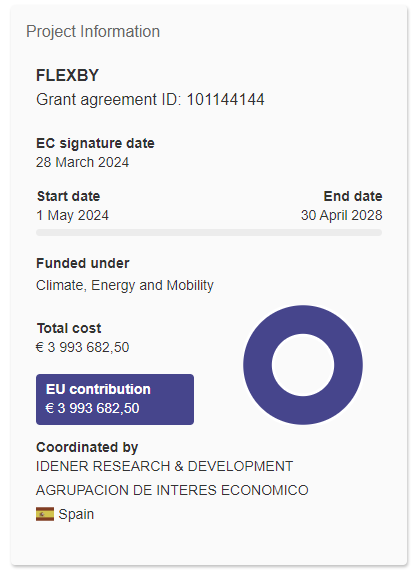
Flexible and advanced Biofuel technology through an innovative microwave pYrolysis & hydrogen-free hydrodeoxygenation process: FLEXBY

Biomass-derived liquid transportation fuels have been proposed as part of the solution to mitigate climate change and many countries are providing incentives to support the growth of bioenergy utilization. Nevertheless, most biofuels currently are made from food-related sources and have a negative impact on food production. The development of cost-effective solutions to minimize carbon waste…

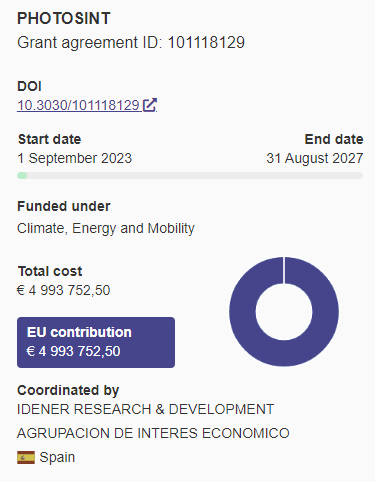
PHOTOelectrocatalytic systems for Solar fuels energy INTegration into the industry with local resources

The PHOTOSINT project presents solutions to the challenges chemical industries are facing in integrating renewable energy sources into their processes. The project will deliver sustainable processes to produce hydrogen and methanol as energy vectors using only sunlight as an energy source and wastewater and CO2 as feedstocks, making the industries more auto-sufficient. The pathway is…

Reactores estructurados no convencionales para el craqueo catalítico de metano libre de CO2

STORMING desarrollará reactores estructurados innovadores calentados con electricidad renovable, para convertir CH4 fósil en H2 libre de CO2 y en nanomateriales de carbono de alto valor para aplicaciones de baterías. Más específicamente, se desarrollarán catalizadores innovadores basados en Fe, altamente activos y fácilmente regenerables mediante procesos que no generen residuos, a través de un protocolo…

PERovskite SEmiconductors for PHOtoNics

Funded by the Marie Skłodowska-Curie programme, PERSEPHONe is a coordinated training network that aims to equip young researchers with new skills and knowledge regarding the development of a novel photonics technological platform based on metal-halide perovskite semiconductors. These materials present unrivalled optoelectronic properties and can be engineered to achieve a large set of desirable functionalities…

Diseño de nanomateriales tridimensionales para la solución todo en uno a la recolección de energía ambiental de fuentes múltiples | 3DSCAVENGERS

https://3dscavengers.icms.us-csic.es/ Thermal and solar energy as well as body movement are all sources of energy. They can be exploited by advanced technology, obviating the need for battery recharging. These local ambient sources of energy can be captured and stored. However, their low intensity and intermittent nature reduces the recovery of energy by microscale instruments, highlighting…

Integración de la tecnología “calcium looping” en plantas solares para el almacenamiento termoquímico de energía

El almacenamiento de energía es uno de los mayores desafíos para aumentar la viabilidad a corto plazo de las plantas de energía solar concentrada (CSP), que generalmente se caracterizan por su intermitencia en la producción de energía. El proceso Ca-Looping (CaL) basado en la reacción reversible de carbonatación/calcinación del CaO es una de las tecnologías…