


Revalorization of Yerba Mate Residues: Biopolymers-Based Films of Dual Wettability as Potential Mulching Materials

Biodegradable mulching films are a very attractive solution to agronomical practices intended to achieve more successful crop results. And, in this context, the employment of agricultural and industrial food residues as starting material for their production is an alternative with economic and environmental advantages. This work reports the preparation of bilayer films having two different…
Biodegradability Assessment of Prickly Pear Waste-Polymer Fibers under Soil Composting

Nowadays, solving the problems associated with environmental pollution is of special interest. Therefore, in this work, the morphology and thermal and mechanical properties of extruded fibers based on polylactic acid (PLA) and poly(butylene adipate-co-terephthalate) (PBAT) added to prickly pear flour (PPF) under composting for 3 and 6 months were evaluated. The highest weight loss percentage (92 +/- 7%) was obtained after 6-month degradation of the PLA/PBAT/PPF/CO/AA blend, in which…

Biopolymer-Based Films Reinforced with FexOy-Nanoparticles

Nowadays, natural polymer-based films are considered potentially environmentally friendly alternatives to conventional plastic films, due to many advantageous properties, including their easy processability, high flexibility, non-toxicity, low cost, high availability, and environmental safety. However, they are limited in their application by a number of shortcomings, including their high water solubility and vapor permeability as well…

Bio-Based Coatings for Food Metal Packaging Inspired in Biopolyester Plant Cutin

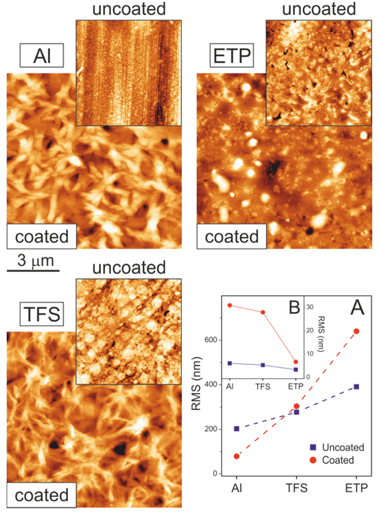
Metals used for food canning such as aluminum (Al), chromium-coated tin-free steel (TFS) and electrochemically tin-plated steel (ETP) were coated with a 2-3-mu m-thick layer of polyaleuritate, the polyester resulting from the self-esterification of naturally-occurring 9,10,16-trihydroxyhexadecanoic (aleuritic) acid. The kinetic of the esterification was studied by FTIR spectroscopy; additionally, the catalytic activity of the surface…

Preparation and Characterization of Bio-Based PLA/PBAT and Cinnamon Essential Oil Polymer Fibers and Life-Cycle Assessment from Hydrolytic Degradation

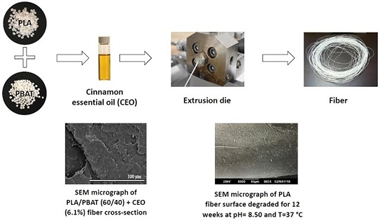
Nowadays, the need to reduce the dependence on fuel products and to achieve a sustainable development is of special importance due to environmental concerns. Therefore, new alternatives must be sought. In this work, extruded fibers from poly (lactic acid) (PLA) and poly (butylene adipate-co-terephthalate) (PBAT) added with cinnamon essential oil (CEO) were prepared and characterized,…

Incorporation of Calcium Containing Mesoporous (MCM-41-Type) Particles in Electrospun PCL Fibers by Using Benign Solvents

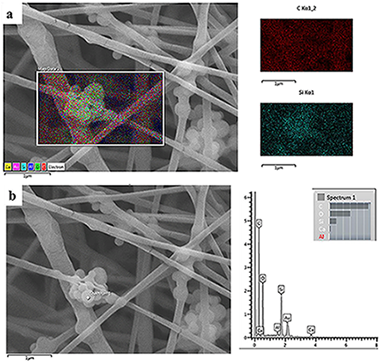
The electrospinning technique is a versatile method for the production of fibrous scaffolds able to resemble the morphology of the native extra cellular matrix. In the present paper, electrospinning is used to fabricate novel SiO2particles (type MCM-41) containing poly(epsilon-caprolactone) (PCL) fibers. The main aims of the present work are both the optimization of the particle…

In Vitro and in Vivo Study of Poly(Lactic-co-Glycolic) (PLGA) Membranes Treated with Oxygen Plasma and Coated with Nanostructured Hydroxyapatite Ultrathin Films for Guided Bone Regeneration Processes

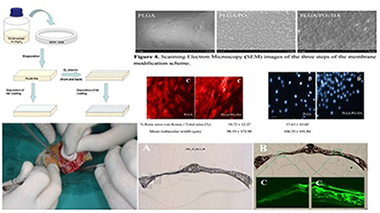
The novelty of this study is the addition of an ultrathin layer of nanostructured hydroxyapatite (HA) on oxygen plasmamodified poly(lactic-co-glycolic) (PLGA) membranes (PO2) in order to evaluate the efficiency of this novel material in bone regeneration. Methods: Two groups of regenerative membranes were prepared: PLGA (control) and PLGA/PO2/HA (experimental). These membranes were subjected to cell…