3D-printed mineral limestone structures for calcium looping thermochemical energy storage: reactivity and performance across cycles

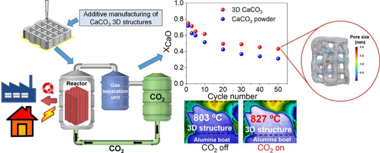
This work presents a proof of concept for the use of 3D-printed CaCO3 structures, prepared from low-cost and widely available mineral limestone, as an innovative approach for thermochemical energy storage (TCES) via the calcium looping (CaL) process in a fixed-bed reactor. These structures offer significant advantages in terms of reaction efficiency, gas flow control, structural…

Microstructural control by freeze-casting of CaO architectures for improved and stable thermochemical energy storage performance

This study investigates the development of porous calcium-based monoliths via freeze-casting (FC) as a novel approach for thermochemical energy storage, particularly within the Calcium Looping (CaL) process. The freeze-casting technique enabled the fabrication of scaffolds with controlled porosity using polyvinyl alcohol (PVA) as a binder. Experimental results demonstrated that freeze-cast monoliths exhibited superior multicycle performance…

Sodium acetate-based thermochemical energy storage with low charging temperature and enhanced power density

The electrification of heat necessitates the development of innovative domestic heat batteries to effectively balance energy demand with renewable power supply. Thermochemical heat storage systems show great promise in supporting the electrification of heating, thanks to their high thermal energy storage density and minimal thermal losses. Among these systems, salt hydrate-based thermochemical systems are particularly…

Thermochemical energy storage using calcium magnesium acetates under low CO2 pressure conditions

The calcium looping multicycle performance of CaO-based materials, derived from calcium magnesium acetates with different Mg content were tested under experimental conditions compatible with thermochemical energy storage. In order to reduce the sintering-induced decay in performance, calcination at an absolute CO2 pressure of 0.1 bar and 0.01 bar is implemented. CaO carbonation is performed at…

Supercooled sodium acetate aqueous solution for long-term heat storage to support heating decarbonisation

Heating decarbonisation through electrification requires the development of novel heat batteries. They should be suitable for the specific application and match the operation conditions of domestic renewable energy sources. Supercooled liquids, often considered a drawback of phase change materials, are among the most promising technologies supporting heating decarbonisation. Although some studies have shed light on…

Steam-enhanced calcium-looping performance of limestone for thermochemical energy storage: The role of particle size

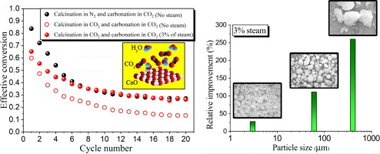
Steam injection has been proposed to attenuate the decay of CaO reactivity during calcium looping (CaL) under operating conditions compatible with carbon capture and storage. However, it is yet unknown whether the perceived advantages granted by steam hold under the distinct operating conditions required for the integration of the CaL process as a thermochemical energy…

Advanced parametrisation of phase change materials through kinetic approach

Phase change materials (PCM) have been widely investigated for heat storage and transfer applications. Numerous numerical simulation approaches have been proposed for modelling their behaviour and predicting their performance in thermal applications. However, simulation approaches do not consider the kinetics of the phase transition processes, compromising the accuracy of their predictions. The phase change is…