




Magnesium calcites for CO2 capture and thermochemical energy storage using the calcium-looping process

In this study, a precipitation-based synthesis method has been employed to prepare magnesium calcites with the general formula Ca1-xMgxCO3, with the objective of use them in the calcium looping (CaL) process for CO2 capture (CaL-CCS) and thermochemical energy storage (CaL-CSP). The structure and microstructure of the samples have been characterized. It has been found by X-ray…
Reforming of biomass-derived producer gas using toluene as model tar: Deactivation and regeneration studies in Ni and K-Ni catalysts

Within the syngas production from biomass gasification, tar removal constitutes a chief issue to overcome for advanced catalytic systems. This work investigates the performance of Ni and Ni-K catalysts for reforming of derived-biomass producer gas using toluene as model tar. At 750 degrees C and 60Lg(-1)h(-1), the stability test (70 h) revealed stable performances (CO2, CH4 and C7H8 conversions of 60, 95 and 100%, correspondingly) uniquely for the Ni-K catalyst. Although the efficient protection towards coking…

Optimizing biogas methanation over nickel supported on ceria-alumina catalyst: Towards CO2-rich biomass utilization for a negative emissions society

Biogas methanation emerges as a prominent technology for converting biogas into biomethane in a single step. Furthermore, this technology can be implemented at biogas plant locations, supporting local economies and reducing dependence on large energy producers. However, there is a lack of comprehensive studies on biogas methanation, particularly regarding the technical optimization of operational parameters and the profitability analysis of the overall process. To address this gap, our study represents a seminal work on the technical optimization of biogas methanation obtaining…

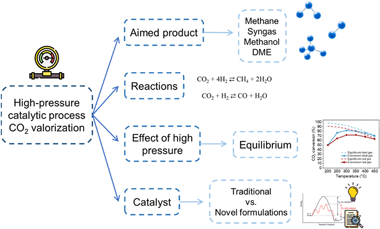
A review on high-pressure heterogeneous catalytic processes for gas-phase CO2 valorization

  This review discusses the importance of mitigating CO2 emissions by valorizing CO2 through high-pressure catalytic processes. It focuses on various key processes, including CO2 methanation, reverse water-gas shift, methane dry reforming, methanol, and dimethyl ether synthesis, emphasizing pros and cons of high-pressure operation. CO2 methanation, methanol synthesis, and dimethyl ether synthesis reactions are thermodynami-cally favored under high-pressure conditions. However, in the case of methane dry reforming and reverse water -gas shift, applying high pressure, results…