


Effect of Na/Ca Adsorbents on NiRu-DFM Performance for Integrated CO2 Capture and Hydrogenation

  Integrated carbon dioxide capture and utilization (ICCU) technology is being developed to address the challenge of increasing atmospheric CO2 levels. Dual function materials (DFMs) are designed with catalytic and adsorbent components that enable the capture and utilization of CO2 within a single reactor. In this investigation, we systematically evaluated the performance of NiRu-DFMs incorporating…
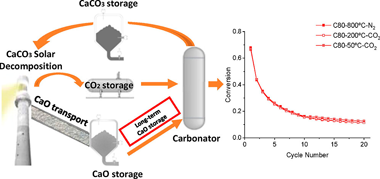
Influence of Long-Term CaO Storage Conditions on the Calcium Looping Thermochemical Reactivity

Long-term storage capability is often claimed as one of the distinct advantages of the calcium looping process as a potential thermochemical energy storage system for integration into solar power plants. However, the influence of storage conditions on the looping performance has seldom been evaluated experimentally. The storage conditions must be carefully considered as any potential…

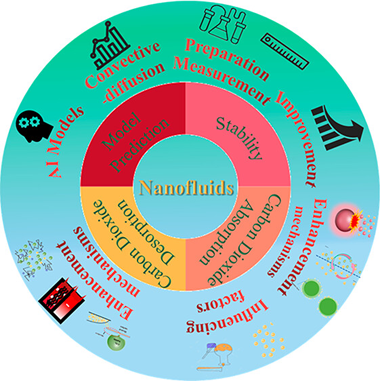
Review and Perspectives of CO2 Absorption by Water- and Amine-Based Nanofluids

The emission of greenhouse gases, especially CO2, hasbecome a major cause of environmental degradation, and carbon capture,utilization, and storage (CCUS) is a proposed solution to mitigateits impact. Nanofluids, a relatively new method for CO2 absorption, have gained attention in recent years. This review focuseson conventional methods for preparing nanofluids along with techniquesto improve their stability and enhance the CO2 absorptionand desorption mechanisms. Additionally, the influences of factors,i.e., nanoparticle and base solution…

Catalytic Upgrading of Biomass-Gasification Mixtures Using Ni-Fe/ MgAl2O4 as a Bifunctional Catalyst

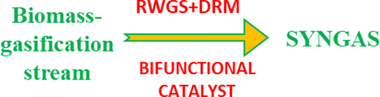
Biomass gasification streams typically contain a mixture of CO, H-2, CH4, and CO(2 )as the majority components and frequently require conditioning for downstream processes. Herein, we investigate the catalytic upgrading of surrogate biomass gasifiers through the generation of syngas. Seeking a bifunctional system capable of converting CO2 and CH4 to CO, a reverse water gas…

Design of Full-Temperature-Range RWGS Catalysts: Impact of Alkali Promoters on Ni/CeO2

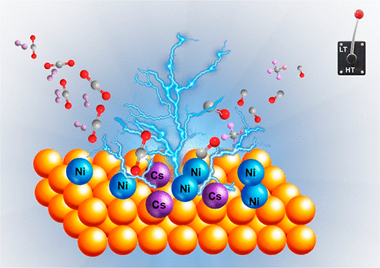
Reverse water gas shift (RWGS) competes with methanation as a direct pathway in the CO2 recycling route, with methanation being a dominant process in the low-temperature window and RWGS at higher temperatures. This work showcases the design of multi-component catalysts for a full-temperature-range RWGS behavior by suppressing the methanation reaction at low temperatures. The addition of alkali promoters (Na, K, and Cs) to the reference Ni/CeO2 catalyst allows identifying a clear…

New Insights on the Kinetic Analysis of Isothermal Data: The Independence of the Activation Energy from the Assumed Kinetic Model

Isothermal experiments are widely employed to study the kinetics of solid-state reactions or processes to extract essential kinetic information needed for modeling the processes at an industrial scale. The kinetic analysis of isothermal data requires finding or assuming a kinetic function that can properly fit the evolution of the reaction rate with time, so that…

Effect of Heat Pretreatment/Recarbonation in the Ca-Looping Process at Realistic Calcination Conditions

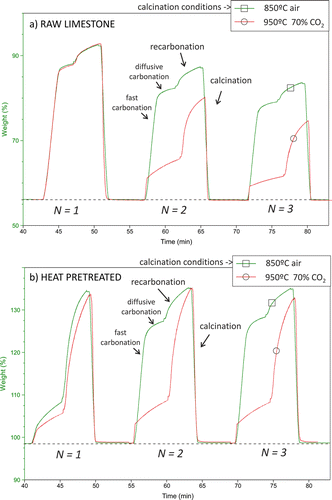
Even though an increasing number of pilot-scale plants are demonstrating the potential efficiency of the Ca-looping technology to capture CO2 at a commercial level, a still standing matter of concern is the loss of carbonation reactivity of the regenerated CaO by calcination, which is expected to be particularly marked at realistic conditions necessarily implying a…

Role of Looping-Calcination Conditions on Self-Reactivation of Thermally Pretreated CO2 Sorbents Based on CaO

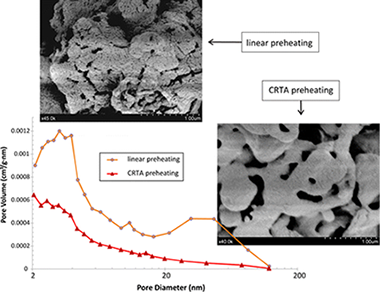
The conversion of thermally pretreated CaO along successive carbonation/calcination cycles has been investigated, as affected by looping-calcination conditions, by means of Thermogravimetric Analysis (TGA). Sorbent samples have been subjected in situ to a thermal preheating program based on Constant Rate Thermal Analysis (CRTA) by virtue of which decarbonation is carried out at a low controlled…