Structural Reversibility of LaCo1-xCuxO3 Followed by In Situ X-ray Diffraction and Absorption Spectroscopy

Combinations of perovskite-type oxides with transition and precious metals exhibit a remarkable self-regenerable property that could be exploited for numerous practical applications. The objective of the present work was to study the reversibility of structural changes of perovskite-type oxides under cyclic reducing/oxidizing atmosphere by taking advantage of the reducibility of LaCoO3. LaCoO3 +/- and LaCo0.8Cu0.2O3…

Quinone-Rich Poly(dopamine) Magnetic Nanoparticles for Biosensor Applications

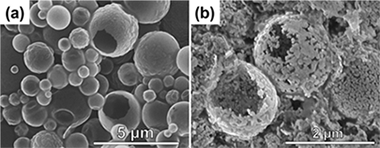
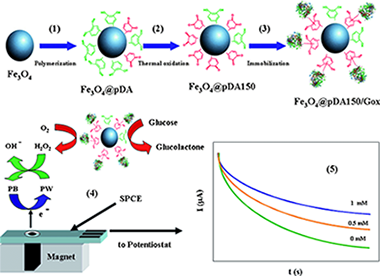
Novel core-shell quinone-rich poly(dopamine)–magnetic nanoparticles (MNPs) were prepared by using an in situ polymerization method. Catechol groups were oxidized to quinone by using a thermal treatment. MNPs were characterized by using X-ray diffraction, X-ray photoelectron spectroscopy, atomic force microscopy, magnetic force microscopy, UV/Vis, Fourier-transform infrared spectroscopy, and electrochemical techniques. The hybrid nanomaterial showed an average…

Mechanisms of Electron Transport and Recombination in ZnO Nanostructures for Dye-Sensitized Solar Cells

ZnO is an attractive material for applications in dye-sensitized solar cells and related devices. This material has excellent electron-transport properties in the bulk but its electron diffusion coefficient is much smaller in mesoporous films. In this work the electron-transport properties of two different kinds of dye-sensitized ZnO nanostructures are investigated by small-perturbation electrochemical techniques. For…

Perovskite Solar Cells Based on Nanocolumnar PlasmaDeposited ZnO Thin Films

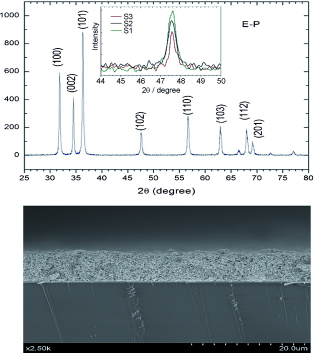
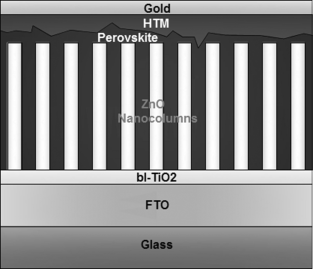
ZnO thin films having a nanocolumnar microstructure are grown by plasma-enhanced chemical vapor deposition at 423 K on pre-treated fluorine-doped tin oxide (FTO) substrates. The films consist of c-axis-oriented wurtzite ZnO nanocolumns with well-defined microstructure and crystallinity. By sensitizing CH3NH3PbI3 on these photoanodes a power conversion of 4.8 % is obtained for solid-state solar cells. Poly(triarylamine)…

Enhanced photoactivity in bilayer films with buried rutile-anatase heterojunctions

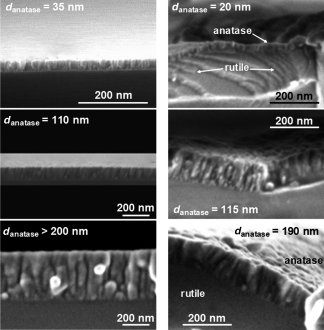
Herein, we study the photoactivity of anatase–rutile bilayer thin films consisting of an anatase overlayer of variable thickness from some tenths to some hundred nanometers deposited onto a rutile thin film. As references single anatase layers of equivalent thickness were deposited onto silicon. All the films were characterized by X-ray diffraction (XRD), scanning electron microscopy…

Enhanced photoactivity in bilayer films with buried rutile-anatase heterojunctions

Herein, we study the photoactivity of anatase–rutile bilayer thin films consisting of an anatase overlayer of variable thickness from some tenths to some hundred nanometers deposited onto a rutile thin film. As references single anatase layers of equivalent thickness were deposited onto silicon. All the films were characterized by X-ray diffraction (XRD), scanning electron microscopy…

Structure of Glancing Incidence Deposited TiO2 Thin Films as Revealed by Grazing Incidence Small-Angle X-ray Scattering

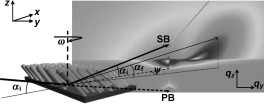
For the first time, grazing incidence small-angle X-ray scattering (GISAXS) analysis is used to characterize the Morphology of TiO2 thin films grown by glancing angle physical vapor deposition (GLAD). According to cross-section scanning electron microscopy (SEM) images, the films consist of near isotilted TiO2 columns of different length and width depending on film thickness. The…