Enhanced green fluorescent protein in optofluidic Fabry-Perot microcavity to detect laser induced temperature changes in a bacterial culture

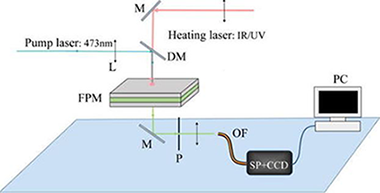
Thermal therapy using laser sources can be used in combination with other cancer therapies to eliminate tumors. However, high precision temperature control is required to avoid damage in healthy surrounding tissues. Therefore, in order to detect laser induced temperature changes, we have used the fluorescence signal of the enhanced Green Fluorescent Protein (eGFP) over-expressed in…

Three-dimensional fabrication and characterisation of core-shell nano-columns using electron beam patterning of Ge-doped SiO2

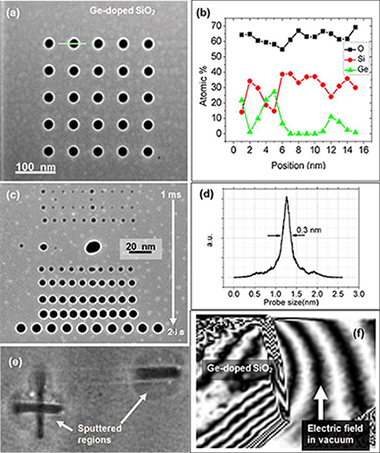
A focused electron beam in a scanning transmission electron microscope (STEM) is used to create arrays of core-shell structures in a specimen of amorphous SiO2 doped with Ge. The same electron microscope is then used to measure the changes that occurred in the specimen in three dimensions using electron tomography. The results show that transformations…

Angular emission properties of a layer of rare-earth based nanophosphors embedded in one-dimensional photonic crystal coatings

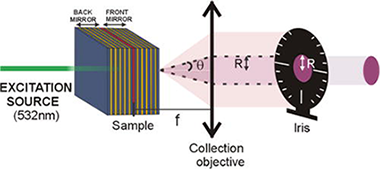
The angular properties of light emitted from rare-earth based nanophosphors embedded in optical resonators built in one-dimensional photonic crystal coatings are herein investigated. Strong directional dependence of the photoluminescence spectra is found. Abrupt angular variations of the enhancement caused by the photonic structure and the extraction power are observed, in good agreement with calculated polar…

Tilt angle control of nanocolumns grown by glancing angle sputtering at variable argon pressures

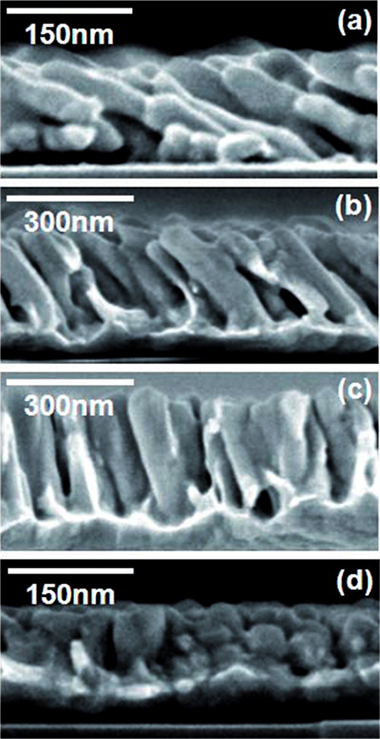
We show that the tilt angle of nanostructures obtained by glancing angle sputtering is finely tuned by selecting the adequate argon pressure. At low pressures, a ballistic deposition regime dominates, yielding high directional atoms that form tilted nanocolumns. High pressures lead to a diffusive regime which gives rise to vertical columnar growth. Monte Carlo simulations…

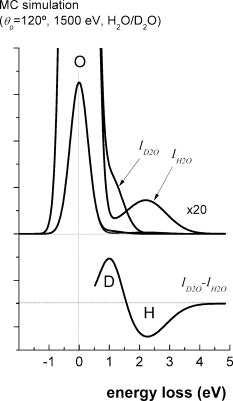
Identification of hydrogen and deuterium at the surface of water ice by reflection electron energy loss spectroscopy

A nondestructive method to distinguish between hydrogen (H) and deuterium (D) at surfaces by reflection electron energy loss spectroscopy is presented. It is based on the analysis of the energy distributions of electrons elastically backscattered from surfaces containing H or D. We consider standard and deuterated water ices as test surfaces. The recoil energy of…

Relation between growth dynamics and the spatial distribution of intrinsic defects in self-assembled colloidal crystal films

Herein we establish a clear relation between the parameters that govern the growth dynamics and the structural quality of colloidal crystal films. We report an optical analysis of the spatial distribution of intrinsic defects in colloidal crystal films and correlate our results with a theoretical model describing the growth dynamics of such lattices. We find…