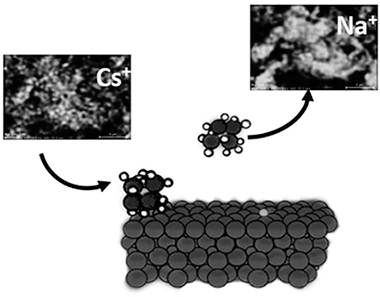
Cesium adsorption isotherm on swelling high-charged micas from aqueous solutions: Effect of temperature

The potential use of a new family of synthetic swelling micas for cesium immobilization from aqueous solution was evaluated and the structural modifications after adsorption were analyzed. The results have revealed that they are good cesium adsorbents compared to natural clays and as the layer charge increases, the adsorption capacity and affinity increase. The cesium…

Biodegradabiliy of spherical mesoporous silica particles (MCM-41) in simulated body fluid (SBF)

Mesoporous silica particles of type MCM-41 (Mobile Composition of Matter No. 41), exhibiting highly ordered mesoporosity (pores with diameter between 2 and 50 nm) and surface roughness, are developed and used as a functional coating on bioactive glass-based scaffolds for bone tissue engineering. The degradability and the mesostructure stability of these novel MCM-41 particles were…

Effect of clays and metal containers in retaining Sm3+ and ZrO2+ and the process of reversibility

Knowledge and understanding about radionuclides retention processes on the materials composing the engineered barrier (clay mineral and metallic container waste) are required to ensure the safety and the long-term performance of radioactive waste disposal. Therefore, the present study focuses on the competitiveness of clay and the metallic container in the process of adsorption/desorption of the…

Hydration properties of synthetic high-charge micas saturated with different cations: An experimental approach

An understanding of the interaction mechanisms between exchangeable cations and layered silicates is of interest from both a basic and an applied point of view. Among 2:1 phyllosilicates, a new family of swelling high-charge synthetic micas has been shown to be potentially useful as decontaminant. However, the location of the interlayer cations, their acidity and…

The effect of polymorphic structure on the structural and chemical stability of yttrium disilicates

Under pressure and temperature conditions like those found in deep geological repositories (DGRs), rare-earth cations may react with silicates to form rare-earth disilicates. This study establishes the stability range of yttrium disilicates in response to changes in pH. The α, β, γ, and δ polymorphs of Y2Si2O7 were synthesized by the sol-gel process at temperatures…

The hydrothermal conversion of kaolinite to kalsilite: Influence of time, temperature, and pH

Kalsilite (the low-temperature form of KAlSiO4) is used as the precursor of leucite, an important component in porcelain-fused-to-metal and ceramic-restoration systems, and it has also been proposed as a high-thermal expansion ceramic for bonding to metals. The present study reports the hydrothermal synthesis and characterization of pure kalsilite from kaolinite in subcritical conditions, as well…

Mineralogical stability of phyllosilicates in hyperalkaline fluids: Influence of layer nature, octahedral occupation and presence of tetrahedral Al

Mineralogical changes in a set of phyllosilicates, differing in their layer nature, chemical composition, octahedral character, and Al content of the tetrahedral sheet, were analyzed after hydrothermal reaction in an alkaline solution. The composition of the alkaline solution was selected to simulate the first stage of cement degradation [NaOH-KOH-Ca(OH)2]. The reaction products have been analyzed…